
Lieferung heute & morgen

Qualitätsgarantie

Willkommens-Angebote freischalten: KOSTENLOSE Lieferung | Bis zu 80 % RABATT | Kostenlose 30-Tage-JoyPlus-Testphase
App herunterladen
A kitchen cutting board needs to do more in everyday use than simply provide a flat surface. It should stay securely in place, avoid putting unnecessary strain on your knives, be easy to clean hygienically and suit the quantity of food being prepared. At the same time, claims such as “antibacterial”, “particularly durable” or “extra robust” may sound convincing at first glance, but on their own they reveal little about how practical a board really is for everyday use.
A wooden cutting board or bamboo cutting board can be kind to knife blades and long-lasting. However, many wooden models are not dishwasher-safe and should not be left in water for extended periods. Underestimating the care required can lead to warping, cracks or a shorter service life.
With plastic and composite materials, the key considerations are whether the surface is sufficiently cut-resistant and how deeply knife marks form. Easy cleaning does not automatically mean that a board is suitable for every type of food.
A compact board saves space, but quickly becomes impractical when preparing larger quantities. Ingredients can slide off the edge or need to be transferred repeatedly. A large cutting board measuring around 40 cm or more in length is useful for extensive preparation, bread or cuts of meat. For small kitchens or occasional use, however, 30 to 36 cm may be sufficient.
Descriptions such as antibacterial cutting board should not be equated with a complete hygiene guarantee. Cleaning, thorough drying and keeping raw and ready-to-eat foods separate remain essential. If a brand refers to specific material properties, this should be understood as a manufacturer’s statement, not as a medical or official efficacy claim.
Wood, bamboo, plastic, wheat straw fibre composite and stainless steel differ considerably:
As well as length and width, material thickness is important. A thicker board is often more stable during vigorous chopping, but it is also more difficult to store. For example, the Suncha bamboo model measuring 45 × 29 cm and 3.5 cm thick is designed to provide a large work surface and a secure base.
Also look for non-slip elements, sufficient weight or a textured underside. A double-sided cutting board can help separate use according to different food groups. This only works, however, if both sides are clearly assigned and thoroughly cleaned after every use.
A cutting board with a juice groove is practical when cutting juicy foods or carving meat. The groove should be wide enough and easy to access so that residue cannot build up inside it. A cutting board with a handle is easier to carry and can also be used as a serving board. For small kitchens, a hanging hole is useful too.
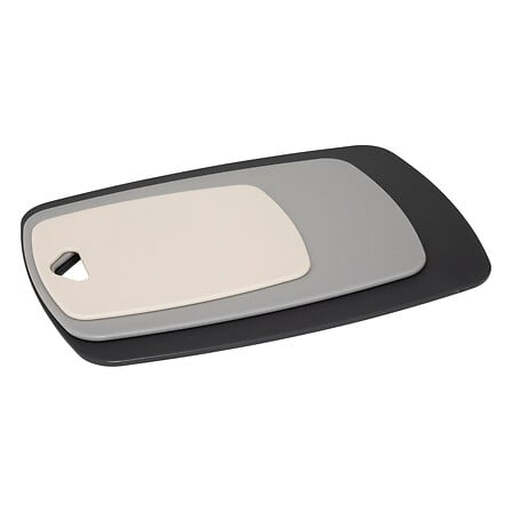
Why this product suits this profile: Three polypropylene sizes cover different chopping tasks and are ideal for households that want several board sizes in a single purchase.
Having different sizes reduces the risk of using a board that is too small for a particular task or taking up more space than necessary.
Three sizes, PP material and a stated format of 35 × 25 × 0,6 cm.

Why this product suits this profile: This large bamboo board combines a generous work surface, a juice groove and a reversible design for different food groups.
The dimensions provide ample working space, while the care instructions make it clear that hand washing is required.
45 × 30 × 1,9 cm, juice groove, reversible design and bamboo surface according to the product description.
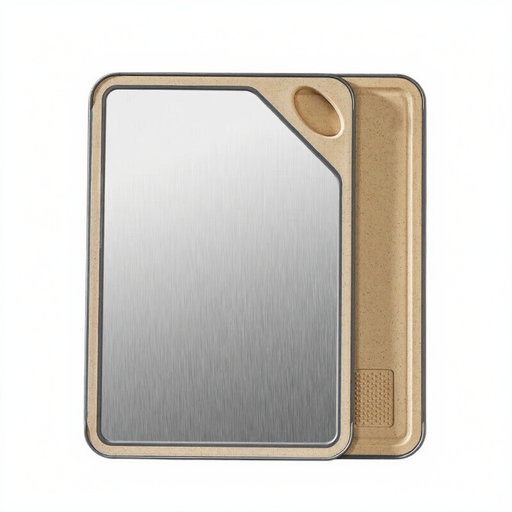
Why this product suits this profile: The double-sided design provides a stainless steel side and a softer wheat straw fibre-PP side for different preparation tasks.
The separate sides help with assigning different ingredients. The term “antibacterial” should be understood as a manufacturer’s statement and does not replace careful cleaning.
304 stainless steel on one side, composite surface on the reverse, 25 × 36 cm and a hanging hole according to the product description.
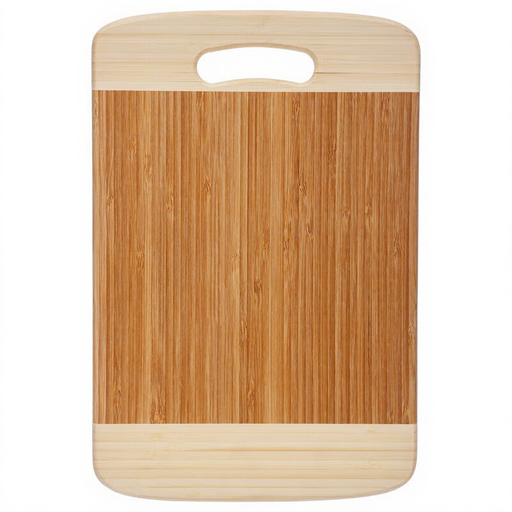
Why this product suits this profile: This compact bamboo board with an integrated handle can be carried from the worktop to the table and then stored away to save space.
The clearly stated dimensions prevent unrealistic expectations of a large work surface, while the handle makes transport and storage easier.
30 × 20 cm, integrated handle, natural bamboo surface and hand washing according to the product description.
For all materials, the same basic rule applies: remove residue promptly after chopping. Use warm water and a mild cleaning product unless the manufacturer’s instructions specify otherwise. The board should be completely dry before being stored flat.
For raw meat and fish, a clearly separate cutting surface or a separate kitchen board is recommended. A double-sided cutting board can support this organisation if the sides are consistently used for different purposes. Wooden and bamboo boards should not be soaked or cleaned in the dishwasher unless this is expressly permitted. If there are deep cracks, severe warping or protruding fibres, replacing the board is advisable.
We have put together a complete, regularly updated list of products that fully meet these strict selection criteria and the safety regulations applicable in the EU.
It depends on how you intend to use it. Wood and bamboo are often kind to knife blades, but require careful hand care. PP is lightweight and easy to clean. Stainless steel provides a water-resistant surface, but may be harder on knife blades. The material specifications, dimensions and care instructions for the individual product are decisive.
For everyday use, a length of around 34 to 45 cm is versatile. If you often prepare large quantities of vegetables, bread or meat, you will benefit from a larger surface. In small kitchens, a 30- to 36-cm model with a handle or hanging hole may be easier to store.
Its service life depends on the material, cutting intensity and care. Wooden and bamboo boards can be used for a long time with hand washing, thorough drying and occasional treatment. Plastic and composite boards should be replaced when deep grooves make cleaning more difficult. Regardless of the material, cracks, splinters and severe warping are clear signs that the board needs replacing.