
Lieferung heute & morgen

Qualitätsgarantie

Willkommens-Angebote freischalten: KOSTENLOSE Lieferung | Bis zu 80 % RABATT | Kostenlose 30-Tage-JoyPlus-Testphase
App herunterladen
A kitchen dish drainer should hold wet dishes securely, drain water in a controlled way and take up as little space as possible. In practice, though, problems are common: the drainer feels unstable, the drip tray overflows, or plates and glasses don’t fit in the holders.
That’s why it’s worth checking the design, dimensions and cleaning requirements before you buy. The tips below will help you distinguish marketing claims from product features that really matter.
The claim “large capacity” is only useful if the length, width and height are given, along with the number of places available. A two-tier dish drainer may hold more dishes, but it also needs extra clearance above the worktop. This can be a problem beneath wall cupboards.
So check:
A loose tray collects water but needs to be emptied regularly. If water is left standing, limescale marks can form and moisture can build up on the worktop. Models with a sloped drip tray, raised edges or a spout that directs water towards the sink are more practical.
Important: a drainage system only works if the drainer is positioned correctly and the tray is cleaned regularly. “Water drainage” doesn’t automatically mean you’ll never need to remove water by hand.
A lightweight dish drainer isn’t necessarily unstable. The design, base and distribution of weight matter more. For metal models, check the material description and look for a suitable surface coating. For plastic parts, sturdy joints and a drip tray that holds its shape are important.
Measure the available space beside the sink, including the tap, distance from the wall and any cupboard doors that might open nearby. A space-saving dish drainer isn’t just narrow; it makes good use of the area available.
For smaller kitchens, these options often work well:
Many models combine steel or stainless steel with a drip tray made from polypropylene (PP) or another type of plastic. Stainless steel is corrosion-resistant, while coated steel can provide a smooth, easy-care surface. However, knowing the material doesn’t replace regular cleaning.
Look for:
A dish drainer should suit the amount of washing-up you actually do. Plates usually need upright slots, glasses need stable places to stand, and cutlery needs a separate basket. A dish drainer with a drip tray is especially practical if you want plates and cups to dry directly over a protected surface.
Also check whether the product description gives specific capacity details. For example, the 5five Black Metal Dish Drainer is listed as holding up to 10 plates, with a cutlery basket and space for six glasses. It measures 39 × 33.5 × 10.5 cm.
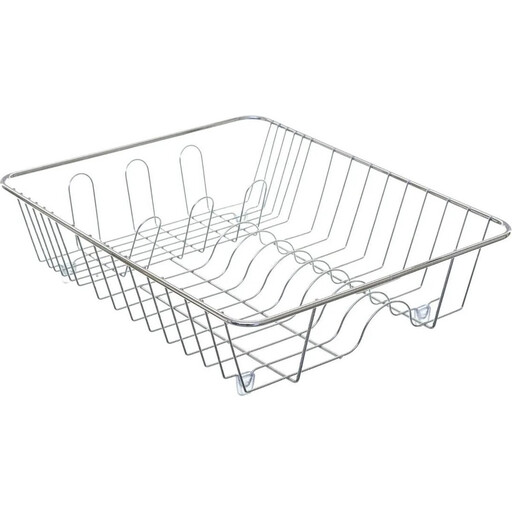
Why it suits this type of buyer: This compact, single-tier model is a good fit for smaller households and kitchens looking for a straightforward way to dry plates, glasses and cutlery.
The precise external dimensions make it easy to check whether you have enough space. The raised edge is designed to keep water contained in the tray.
Steel and ABS plastic construction, a cutlery basket, and space for up to 10 plates and six glasses.
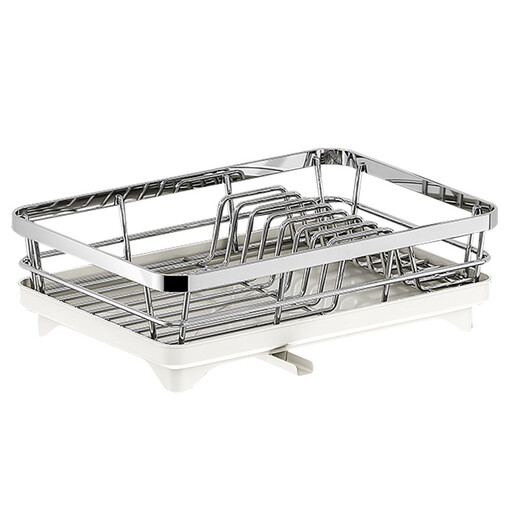
Why it suits this type of buyer: This model is designed for households that prefer a well-organised drying area with a stainless steel rack, drip tray and water drainage system.
The product description specifies stainless steel, a PP tray and a rotating water diverter. This makes the materials and drainage system clear.
Stainless steel rack, integrated drip tray, water drainage and, according to the product description, a design that requires no assembly.
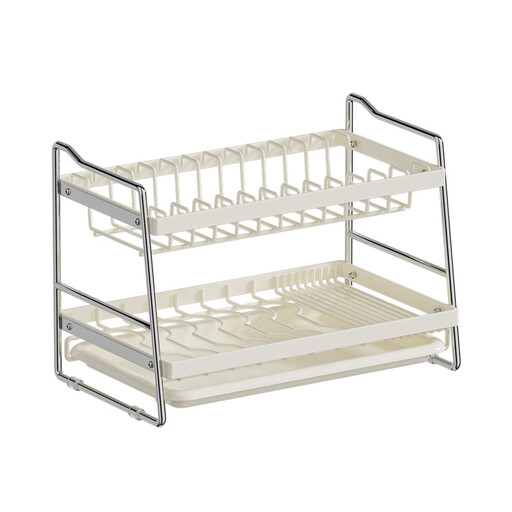
Why it suits this type of buyer: Two levels make use of vertical space and provide separate areas for plates, cups, cutlery and kitchen utensils, all on a relatively compact base.
The dimensions of around 40 × 23.6 × 28.7 cm make it easy to check the space it needs. According to the description, the drip trays direct water towards the sink or a container.
Two-tier design, several drip trays, freestanding use and a stated capacity for dishes, glasses and kitchen utensils.
We’ve put together a complete, regularly updated list of products that meet these strict selection criteria and fully comply with the safety regulations in force in the EU.
Place the dish drainer on a level, sturdy surface. Put heavy plates on the lower level where possible, or in the slots designed for them. Don’t place glasses on wobbly crossbars. If there’s a drainage system, position the tray so that water actually runs towards the sink or into the designated collection area.
For easy care:
The right size depends on how much washing-up you do each day and how much worktop space you have. In a small kitchen, specific external dimensions are more useful than general claims such as “compact”. If there are wall cupboards above the sink, be sure to measure the height too.
A drip tray is practical as long as you empty and clean it regularly. Don’t leave standing water in the system for long periods. The cutlery holder and other contact surfaces also need regular cleaning.
A two-tier dish drainer can make efficient use of the available space, but it needs more height. Before buying, check the model’s height and the clearance beneath wall cupboards, windows and kitchen utensils.