
Lieferung heute & morgen

Qualitätsgarantie

Willkommens-Angebote freischalten: KOSTENLOSE Lieferung | Bis zu 80 % RABATT | Kostenlose 30-Tage-JoyPlus-Testphase
App herunterladen
A kitchen dish drainer should hold crockery securely, direct water away effectively and keep your worktop tidy. In small German kitchens, it is often used every day, making it even more important to choose one that suits your sink, the amount of crockery you wash and the available space.
Many poor purchases are not caused by the price, but by unclear specifications and impractical designs. Check these three common pitfalls before buying:
Measure the area next to the sink in length, width and height. Also take into account the distance from wall cabinets, windows and the tap. A 2-tier dish rack makes better use of vertical space, but requires sufficient clearance above it.
Compact models can be a good choice for a small kitchen. For example, a rack measuring 30 × 14 × 30 cm takes up considerably less worktop space than a large dish drainer measuring 50 × 30.5 × 34 cm. The external dimensions are not the only consideration; you should also check whether plates, cups and cutlery can genuinely be stored separately.
Look for specific details such as the number of plate slots, a removable cutlery basket, a cup holder or a glass holder. A two-tier dish rack can increase the usable space, but it should stand securely and be loaded evenly.
Separate storage is particularly practical:
When reviewing product specifications, distinguish between maximum load, “number of plates” and general storage area. These figures cannot be compared directly.
A steel frame can provide a stable foundation for everyday use. Coatings protect the surface, but they can be damaged by aggressive cleaning products or abrasive sponges. Plastic drainboards are lightweight and usually easy to wipe clean, but should be dried thoroughly on a regular basis.
Bamboo and other wooden components give a kitchen organiser a natural look. At the same time, they require different care from metal or ABS plastic: they should not be exposed to moisture for extended periods. Also check whether the model is dishwasher-safe. Several of the products listed here recommend cleaning with a damp cloth, so automatic cleaning should not be assumed.
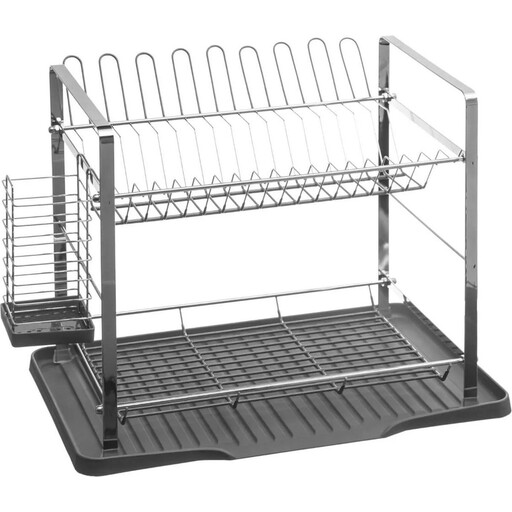
Why this product suits this profile: This two-tier dish drainer provides specific capacity information and is suitable for households that regularly wash several plates and kitchen utensils.
The product specifications state that it can hold up to 17 plates, and include a removable cutlery basket and a drainboard. This makes it possible to check important features specifically before buying.
2 tiers, non-slip base, removable cutlery basket and drainboard; dimensions: 50 × 30.5 × 34 cm.
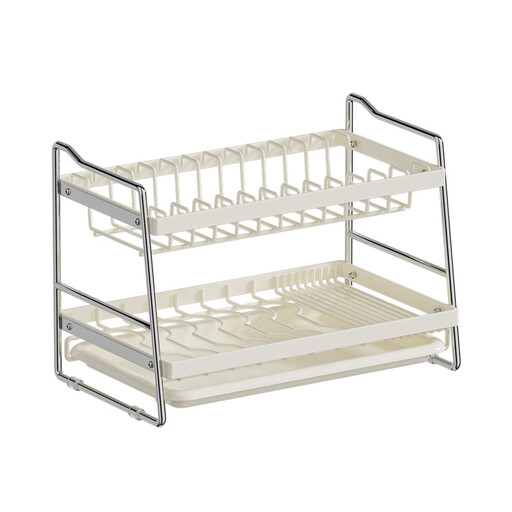
Why this product suits this profile: If you value a clearly organised solution, this freestanding 2-tier model offers integrated draining surfaces and a white finish.
According to the product description, the water drainage system is integrated. This reduces the need for a separately fitting tray; before use, you should check the position of the outlet in relation to the sink.
2 tiers, integrated drainboards, freestanding design, dimensions of approximately 40 × 23.6 × 28.7 cm.
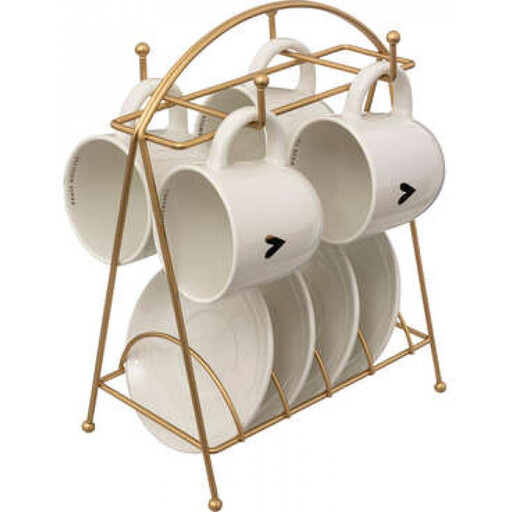
Why this product suits this profile: This model is designed for households that want to keep the cups and saucers from a set visible and within easy reach, rather than using a universal dish drainer.
Its intended use is clearly defined: the rack is designed to hold six cups and their matching saucers. This avoids creating false expectations about its capacity for plates or cutlery.
Stainless steel, handle, set with six cups and saucers, compact footprint of approximately 15 × 19.7 × 26 cm.
Place the dish drainer on a flat, sturdy surface close to the sink. Heavy plates should go on the bottom or in the slots intended for them. Lighter cups and glasses should be positioned so that they do not knock against one another.
For daily care, a damp cloth with mild cleaning product is sufficient for many models. Empty any water from the drainboard before it is left standing, and dry the individual parts regularly. With bamboo or MDF, avoid leaving moisture to pool. After assembly, also check that all connections are secure and that the rack does not wobble.
If you only dry a few items, you can choose a space-saving dish drainer or a small kitchen organiser instead of a large 2-tier model. For families or households with a high volume of washing-up each day, separate tiers, a cutlery basket and controlled water drainage are generally more practical.
We have put together a complete, regularly updated list of products that fully meet these strict selection criteria and the safety regulations applicable in the EU.
The right size depends on the available worktop space and the amount of crockery generated each day. Measure the available space, including the height, and compare it with the product’s external dimensions. A narrow or two-tier model can be a sensible choice for small kitchens.
The tray should reliably collect water, be easy to remove and be straightforward to clean. Check whether it simply collects the water or directs it to the sink via a channel or outlet.
Remove standing water regularly, wipe the rack with a mild cleaning product and allow it to dry completely. A flat surface, a non-slip base and even loading all help to keep it stable.