
Lieferung heute & morgen

Qualitätsgarantie

Willkommens-Angebote freischalten: KOSTENLOSE Lieferung | Bis zu 80 % RABATT | Kostenlose 30-Tage-JoyPlus-Testphase
App herunterladen
A kitchen dish drainer is designed to organise wet dishes beside the sink, drain water in a controlled way and take up as little worktop space as possible. In practice, however, certain purchasing decisions can quickly make a dish drainer impractical: it gets in the way, collects water underneath the dishes or offers less space than expected.
The product name alone says little about how practical an item will be in everyday use. The key factors are its dimensions, design, material and method of water drainage.
A dish drainer does not only need space for the rack itself. You also need to allow for using the sink, opening cupboard doors and leaving a gap between the rack and the wall. In small kitchens, a model that is just a few centimetres too deep can already restrict your work area.
Before buying, measure the available space beside the sink. Pay attention to the length, width and height of the assembled product – not just the packaging dimensions.
A tall 2-tier dish rack can hold more dishes, but it needs sufficient overhead space. The upper level must also be stable and easy to reach. A general claim such as “large capacity” therefore cannot replace specific details, such as the number of plate slots or the size of the storage areas.
For a small household, a compact dish drainer is often sufficient. If you regularly wash pots, plates, glasses and kitchen utensils at the same time, you are more likely to benefit from multiple levels and separate holders.
A loose tray can collect water, but it may not drain it in a targeted way. Water left standing beneath the dishes increases cleaning work and can cause deposits to build up if the tray is not cleaned regularly. With a dish drainer with drainboard, you should therefore check whether the tray can be removed and whether it has a spout or a sloped surface.
Start by measuring the available space. Compact models or a space-saving dish drainer with a vertical design are ideal for narrow kitchens. Also consider the following:
For example, a model measuring 35 × 50 × 13 cm, such as the Etira rack, requires a longer footprint but remains relatively low because of its limited height. A 2-tier model measuring around 40 × 23.6 × 28.7 cm, on the other hand, makes greater use of height and takes up less depth.
A stainless steel dish drainer is generally easy to care for when exposed to moisture regularly. Nevertheless, you should check the welds, edges, coatings and combination of materials. Stainless steel components should be allowed to dry completely after cleaning. Plastic parts are lightweight, but may be less resistant to deformation under heavy loads than metal.
With coated steel racks, it is important that the coating has no damaged areas. Follow the manufacturer’s care instructions. For example, the 5five model is described as having a steel rack, PVC-coated material and an ABS plastic tray; according to the product information, it should be cleaned with a damp cloth and not washed in the dishwasher.
A functional drainboard should be easy to remove and clean. If the rack has a spout, its position must align with the sink. You should also check whether the rack has non-slip feet and remains stable even when loaded unevenly.
The actual capacity depends on more than just the number of plate slots. Large mugs, bowls or frying pans require different spacing from flat plates. A well-organised layout can therefore be more useful in everyday life than the highest possible capacity claim.
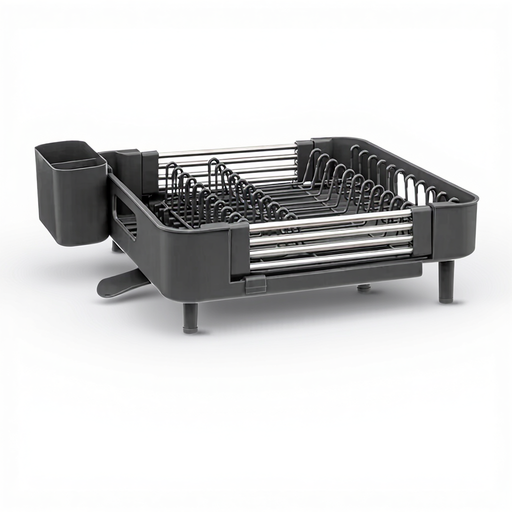
Why this product suits this profile: Measuring 35 × 50 × 13 cm and with a stated capacity of 20 items, it is suitable for households looking for a low-profile solution beside the sink.
The specific size details make it easier to check the available space. This helps prevent a supposedly compact rack from being too deep or too tall.
Stated stainless steel components and a weight of 1.57 kg; designed for indoor use.
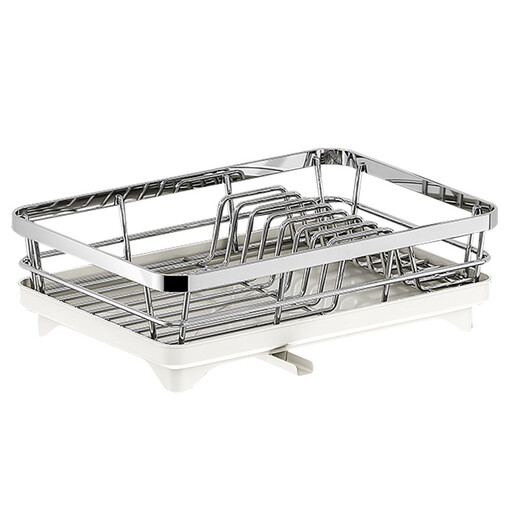
Why this product suits this profile: This model combines stainless steel, a PP drainboard and a rotating spout. It is an appealing choice for anyone who values controlled water drainage and easy cleaning.
The described spout and removable tray address the problem of water being left standing on the worktop.
Stainless steel and PP construction, 42 × 29 × 12.7 cm, integrated storage compartments and a rotating water deflector according to the product description.
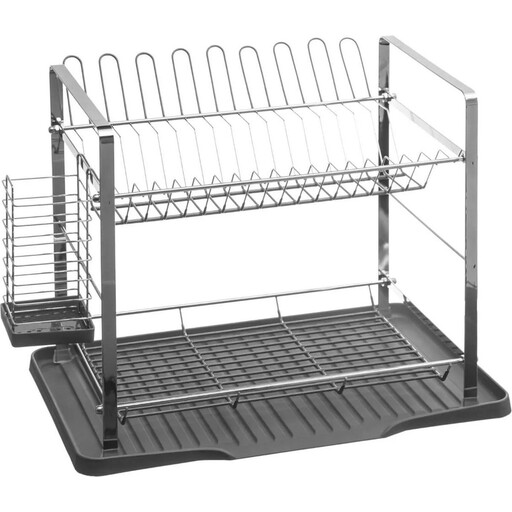
Why this product suits this profile: Measuring 50 × 30.5 × 34 cm, with two levels and room for up to 17 plates, this dish drainer is designed for households that wash dishes regularly.
The specific plate capacity prevents “large capacity” from being treated as merely a vague marketing claim. Measure the available height beforehand.
Two levels, removable cutlery basket, non-slip base and stated drainboard.
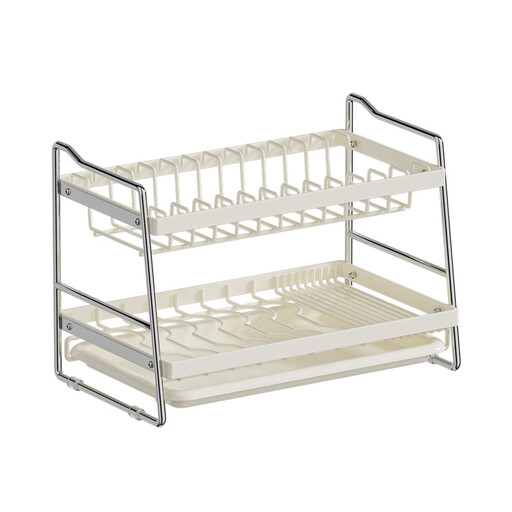
Why this product suits this profile: Measuring approximately 40 × 23.6 × 28.7 cm, it combines limited depth with a 2-tier design. This can be helpful on narrow worktops.
The stated dimensions make planning straightforward. Integrated drainboards reduce the need for an additional mat or tray.
Two levels, integrated drainboards, freestanding use and room for dishes, mugs and kitchen utensils.
We have put together a complete, regularly updated list of products that fully meet these strict selection criteria and the safety regulations applicable in the EU.
Place the dish drainer as close to the sink as possible without blocking the tap or fittings. Plates should be placed in the designated slots, while glasses can be positioned with the opening facing down, provided the design leaves sufficient clearance above the drainboard. Cutlery baskets should be positioned so that water can drain away and no small items remain trapped beneath the rack.
For a longer service life, we recommend:
When choosing a product, also make sure that a kitchen dish drainer is actually designed for dishes. Listings containing terms such as “Drain Rack” may also refer to bathroom or shower drains and are not suitable for plates, cutlery and glasses.
Measure the available length, depth and height beside the sink. You should also allow at least a few centimetres of clearance for the tap, cupboard doors and removing the drainboard. When space is limited in depth, a 2-tier design may be more practical than a wide model.
A suitable drainboard, a sloped surface or a rotating spout can direct water away more effectively. The tray should be emptied regularly and cleaned with a mild detergent. You should also arrange the dishes so that they do not stand directly on a completely flat surface covered with water.
Its lifespan depends on the material, load, moisture and care. Stainless steel components can remain in use for a long time when used correctly and cleaned regularly. With coated or bonded components, any damage should be addressed promptly, as moisture can collect in these areas. The key is to stay within the stated capacity and allow the rack to dry completely.