
Lieferung heute & morgen

Qualitätsgarantie

Willkommens-Angebote freischalten: KOSTENLOSE Lieferung | Bis zu 80 % RABATT | Kostenlose 30-Tage-JoyPlus-Testphase
App herunterladen
A kitchen dish drying rack should hold plates, cups and cutlery after washing in an organised way, without leaving your worktop permanently wet. Especially in small flats or kitchens with a narrow sink, the design determines whether a dish drying rack remains practical or ends up unused in a cupboard after a short time.
Before buying, it is worth taking a close look at three common pitfalls:
Measure the available space next to or above your sink before buying. Take into account not just the length and width, but also the height. A dish drying rack for the sink must not obstruct the tap, wall cupboards or window sashes.
For small worktops, the following designs can be useful:
The stated dimensions should always be compared with the actual space available. The opening direction of cupboard doors and the distance to the sink also matter.
A stainless steel dish drying rack is often chosen for its smooth surface and moisture resistance. However, you should check whether the rack is actually made of stainless steel and which components are plastic. On some models, the tray is made of polypropylene while the rack itself is steel.
Look out for:
A dish drying rack is no substitute for regular cleaning. The tray should be emptied and the rack wiped down with a suitable mild cleaning product when needed.
A dish rack with drip tray should either collect water or channel it in a controlled way into the sink. Check whether the tray extends far enough, has a spout, or features a rotating water deflector. Without a functioning drainage system, water can sit on the worktop.
Stability is equally important. A kitchen dish holder should stand firmly even when the compartments are loaded. Look for:
Especially with a tall 2-tier dish rack, heavy crockery should be placed on the bottom level. This allows the construction to be loaded more evenly.
The following models are matched to different kitchen and usage situations. The key factors are the stated dimensions, materials and features.
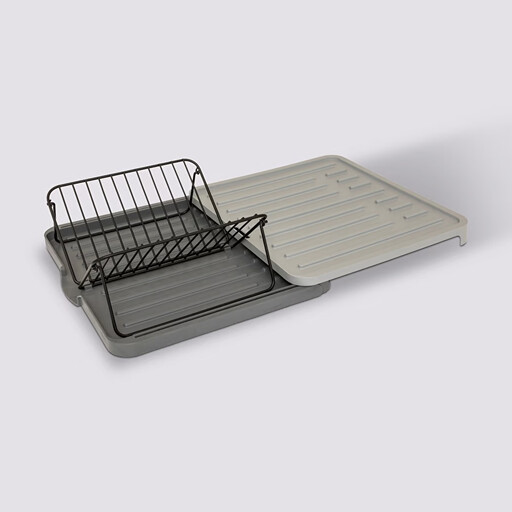
Why this product fits the profile: This model offers clearly stated dimensions of 58.2 × 36.2 × 10.3 cm and is designed for indoor use. According to the product details, the construction holds up to six glasses and comes with a plastic tray.
The separate drip tray prevents water from running directly onto the worktop. The clearly stated external dimensions make it easy to check against your available space.
Steel frame, polypropylene tray and a stated two-year statutory warranty in the EU.

Why this product fits the profile: The rack measures 42 × 29 × 12.7 cm and combines stainless steel with a PP tray. It is designed for the worktop and requires no assembly according to the description.
Material details are listed separately. A water deflector with a rotating outlet supports targeted drainage, rather than letting water sit uncontrolled.
Stainless steel frame, integrated tray, drainage system and separate compartments for crockery.
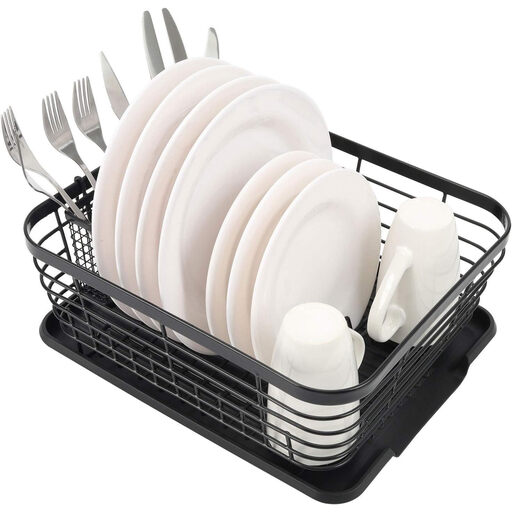
Why this product fits the profile: According to the product description, this three-piece set can be used in the sink or on the worktop. It includes a metal rack, a plastic tray and a cutlery holder.
The compact design at 14.2 × 12.1 × 5.5 inches can be used in different locations. Removable components make it easier to empty and clean the tray.
Stated capacity of at least eight plates, cutlery holder with a dense mesh and use without assembly.
We have put together a complete, regularly updated list of products that fully meet these strict selection criteria and the safety regulations in force in the EU.
Place the dish drying rack as close to the sink as possible, so that wet crockery does not have to be carried over long distances. Plates should stand in the designated slots, while cups and glasses can be placed with the opening facing down or slightly tilted, provided the construction allows it.
Empty the drip tray regularly and remove any water residue after use. For metal parts, drying with a soft cloth is recommended if moisture builds up over time. Do not use harsh cleaning products unless the manufacturer approves them. For models designed for the sink, also check that the dimensions actually match the width of your sink bowl.
For limited worktop space, a space-saving dish rack, a model for the sink or a 2-tier dish rack are all options. The key factors are the actual external dimensions, the height under wall cupboards and a water drainage system that does not run across the worktop.
Choose a dish drying rack with a suitable drip tray, slope or spout. The tray must sit correctly under the rack and be emptied regularly. If there is a drainage outlet, check its alignment towards the sink before first use.
The lifespan depends on the material, load, care and moisture levels. Do not overload the rack, dry metal surfaces when necessary and clean the tray and cutlery holder regularly. Check the individual product information for binding details on guarantees or warranties.