
Lieferung heute & morgen

Qualitätsgarantie

Willkommens-Angebote freischalten: KOSTENLOSE Lieferung | Bis zu 80 % RABATT | Kostenlose 30-Tage-JoyPlus-Testphase
App herunterladen
A kitchen grater should chop food evenly, take up little space and be easy to clean after use. In practice, though, the differences often only become clear in everyday use. Whether you’re a keen home cook, cooking for a family or mindful of healthy eating, it’s worth looking beyond a long list of features or a modern design.
A multi-grater with lots of attachments may seem versatile at first. What matters, though, is whether the blades are suited to the job. A fine grating surface for hard cheese won’t necessarily be right for slicing cucumber or cutting potatoes. Check which attachments are actually included and whether their shapes suit the recipes you make.
A vegetable grater or mandoline needs to stay stable while you use it. Without a suitably large base, a non-slip surface or a secure handle, you’re more likely to end up with uneven slices. A controlled grip is especially important when preparing hard foods such as carrots, nuts or Parmesan.
Fine grating surfaces can trap food residue. A model described as dishwasher-safe may be easier to clean, but you should always follow the care instructions for that particular product. Plastic parts, interchangeable blades and stainless steel surfaces may each have different care requirements.
A stainless steel grater made from rust-resistant steel is a popular choice for hard cheese, chocolate, nuts and vegetables. INOX 430 is a specific grade of stainless steel used in many kitchen utensils. When choosing a grater, also consider the finish of the grating surface, the sturdiness of the handle and the edges of the individual holes.
Plastic can reduce the weight and allow for a flexible design in multi-function graters. The attachments should still click securely into place and be easy to change without much effort.
Before you buy, think about the types of food you prepare regularly:
A single grating surface is compact and easy to store. A multi-function model takes up more storage space, but can replace several kitchen tools.
The dimensions affect both handling and storage. A long, narrow model will often fit in a drawer or a tall kitchen cupboard. A set with several attachments needs to be stored neatly to avoid losing individual parts.
Look for a secure handle, a clear feeding or cutting direction and a stable base. When handling very hard foods, a secure footing matters more than a particularly low weight.
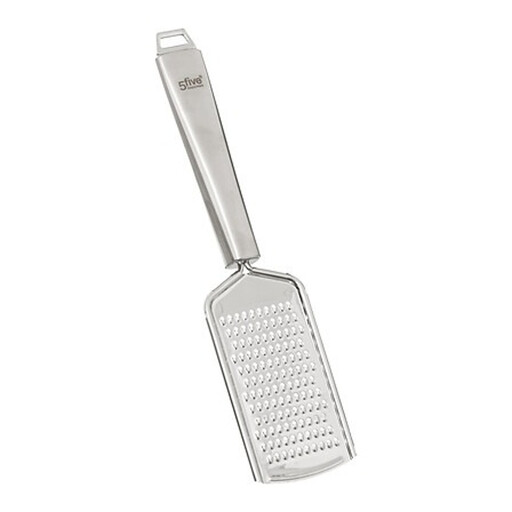
Why this product suits this profile: This compact, single grater is ideal for households that mainly want to grate cheese, nuts or chocolate, without the need for interchangeable attachments.
Its single grating surface means you won’t end up with a confusing collection of accessories you rarely use.
INOX 430 stainless steel, an ergonomic handle and compact dimensions of 25,2 × 5,8 × 2 cm, with a weight of 100 g.

Why this product suits this profile: This universal grater is for anyone who values precise handling, grating on both sides and easy cleaning.
According to the product details, the silicone handle is designed to provide a secure grip on different surfaces. It is also listed as dishwasher-safe.
Grating surfaces on both sides, a heat-resistant design and stated dishwasher suitability.
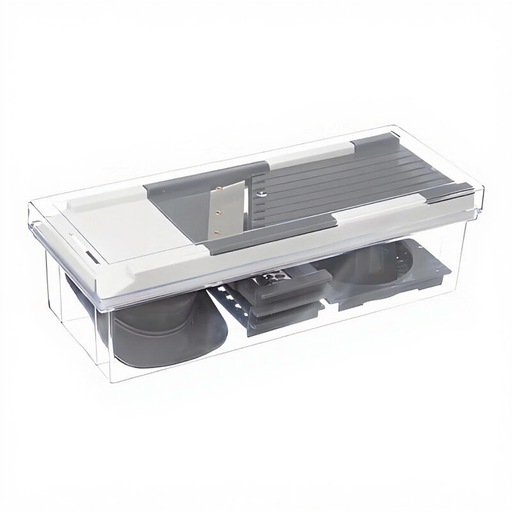
Why this product suits this profile: This 11-piece set is designed for families and frequent users who want to chop, slice, grate and spiralise vegetables, as well as cut them into julienne strips.
The different interchangeable attachments make the functions included clear, rather than relying on a vague multi-function claim.
An 11-piece system for grating, cutting and spiralising, with compact dimensions of 30 × 11,6 × 8,7 cm.
We’ve put together a complete, regularly updated list of products that meet these strict selection criteria and fully comply with the safety regulations in force in the EU.
Whatever type of kitchen grater you use, keep your fingers away from the grating surface. Move the food over the blade in a controlled way and, if using a mandoline, use the finger guard provided, if available. A non-slip mat can provide extra stability. Only change interchangeable attachments once the grater has come to a complete stop, and make sure your hands are dry.
Three things are key to making your grater last:
For hard cheese and chocolate, a fine to medium grating surface is a good choice. A stainless steel grater with an ergonomic handle offers a straightforward, compact solution. If you also want to cut vegetables or turn them into spirals, a multi-grater may be a better fit.
Dishwasher suitability means less hand-washing, but you should still check the care instructions. Some blades stay sharp for longer if washed carefully by hand. Always follow the manufacturer’s specific guidance for your model.
Its lifespan depends on the material, blade quality, cleaning method and how often you use it. Stainless steel can last a long time with proper care. If the blades become bent, damaged or noticeably blunt, replace the grater for safety reasons.