
Lieferung heute & morgen

Qualitätsgarantie

Willkommens-Angebote freischalten: KOSTENLOSE Lieferung | Bis zu 80 % RABATT | Kostenlose 30-Tage-JoyPlus-Testphase
App herunterladen
A kitchen grater should grate cheese, shred vegetables or finely process chocolate. In practice, however, models vary considerably in their materials, stability, ease of use and cleaning. A shiny finish or the label ‘multifunctional’ alone tells you little about whether a grater will remain practical for everyday use in the kitchen.
That’s why it’s worth looking at how a grater is actually made before you buy. This can help you avoid common buying mistakes and choose a product that suits the way you plan to use it.
A box grater or universal grater often has several grating surfaces. This is useful if you want different results: coarse shreds for vegetables, fine surfaces for hard cheese or larger openings for chocolate. But if you mainly grate Parmesan, you may not need a large box grater with several sides.
The key is whether the grating surfaces suit the foods you want to prepare. A grater for hard cheese has different requirements from a mandoline for cutting even slices of vegetables.
A product description for a stainless steel grater should include specific details about its construction wherever possible. The material alone says nothing about the handle, edges, stability or care requirements. For example, the SS HANDLE GRATER SP is described as being made from INOX 430 precision stainless steel. Its dimensions are also listed as 5.8 × 2 × 25.2 cm, with a weight of 0.100 kg.
These details help you assess the product: a slim hand grater takes up little space, while a larger box grater needs more worktop and storage space.
Not every metal or plastic kitchen grater is automatically suitable for the dishwasher. Food can get stuck between the sharp grating surfaces, and you should always follow the care instructions provided by the manufacturer. A model specifically described as a dishwasher-safe grater is particularly practical for households that use it regularly.
If a model isn’t clearly labelled, it’s best to clean it after use with warm water and a suitable brush. This helps stop food residue drying in the openings.
For frequent use, corrosion-resistant materials and neatly finished edges are important. Stainless steel is easy to care for and generally doesn’t absorb odours. When buying, also check that the handle is securely attached to the grating body and that the surface feels rigid.
Plastic parts have different uses: a plastic frame can reduce the overall weight, while a silicone base can help stop the grater slipping on the worktop. Specific information about the materials used is more useful than vague terms such as ‘premium’ or ‘professional’.
A grater for slicing and shredding should make it clear what it can be used for. Coarse grating surfaces and slicing blades are useful for carrots, cucumbers and cabbage. Finer openings are generally preferred for nutmeg, hard cheese, nuts and chocolate.
A universal grater or multifunctional grater is therefore best suited to households that want to prepare different foods with one tool. If you only use one cutting style, a compact stainless steel grater can save space.
An ergonomic handle should feel secure in your hand and allow you to guide the grater with control, even when applying light pressure. For box graters, a non-slip base is also important. Sharp blades should be designed to keep your hand as far away from the grating surface as possible.
For safe use, make sure the grater is on a stable surface and your hands are dry. Switch to a finger guard as soon as a piece of food becomes very small. No grater can replace careful handling.
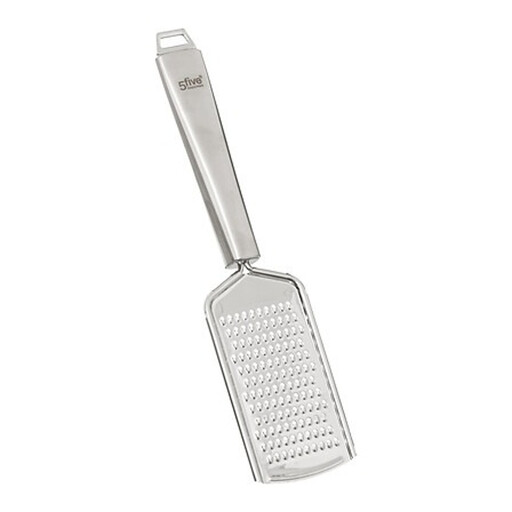
Why this product suits this need: This compact hand grater is ideal for households looking for a space-saving way to grate hard cheese, nuts or chocolate.
The product description specifies INOX 430 precision stainless steel, an ergonomic handle and compact dimensions, rather than relying solely on generic marketing claims.
Made from INOX 430, this model is easy to handle and store, measuring 25.2 cm in length and weighing 0.100 kg.

Why this product suits this need: Families and frequent users get a universal grater that’s specified as dishwasher-safe and has a non-slip silicone handle.
The product details explicitly state that it can be cleaned in the dishwasher and has a silicone handle to prevent slipping.
According to the product description, the double-sided blades are designed for grating in both directions. The dimensions are 33.86 × 9.2 × 7 cm.
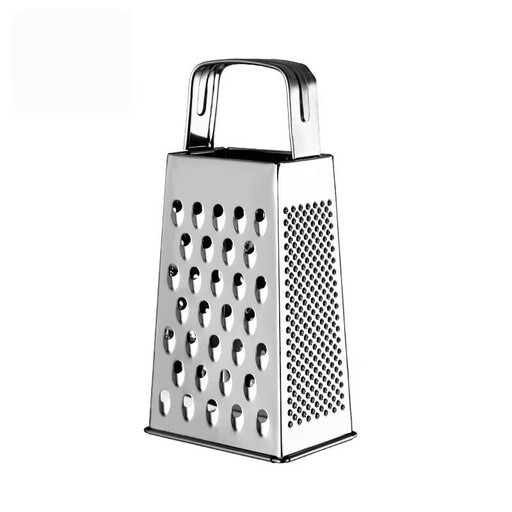
Why this product suits this need: This box grater is designed for several types of food preparation. It’s aimed at people who want to grate or slice vegetables, cheese and other foods with a single tool.
The name specifies four sides and functions for grating and slicing, making its intended uses clearer than those of a universal grater with no further details.
Four-sided design; according to the product name, it’s intended for one-handed use and for grating and slicing.
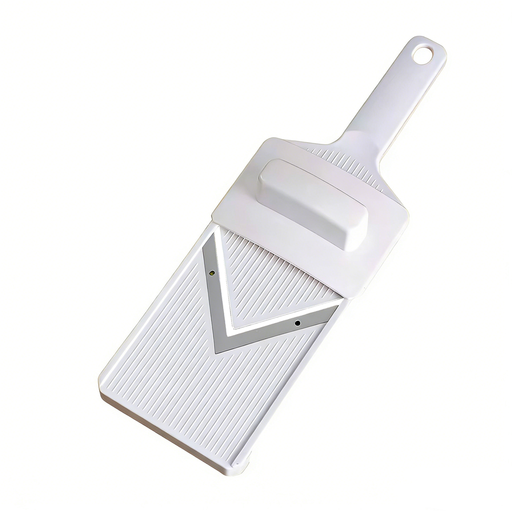
Why this product suits this need: The combination of a vegetable slicer, grater and cabbage grating board is well suited to households that regularly prepare larger quantities of vegetables.
The product name clearly specifies that it’s designed for vegetables and cabbage, setting it apart from a grater intended only for cheese.
Combines grating and slicing; a separate cabbage grating board is specifically listed.
We’ve put together a complete, regularly updated list of products that meet these strict selection criteria and fully comply with the safety regulations in force in the EU.
For hard cheese and chocolate, a finer grating surface and a secure grip are useful. A compact stainless steel grater takes up little storage space. If you also want to coarsely grate or slice vegetables, you could choose a universal grater or box grater.
Remove food residue as soon as possible after use. If your grater is specifically described as dishwasher-safe, follow the manufacturer’s instructions. For other models, it’s best to wash them with warm water, washing-up liquid and a soft brush. Let the grater dry completely before putting it away.
Its lifespan depends on the materials, construction, frequency of use and care. Stainless steel surfaces can last a long time if cleaned properly. Blunt or bent grating surfaces, loose handles and visible corrosion are signs that it’s time to replace the product. That’s why details about the materials, sturdy joins and suitable cleaning instructions are more important when buying than design claims alone.