
Lieferung heute & morgen

Qualitätsgarantie

Willkommens-Angebote freischalten: KOSTENLOSE Lieferung | Bis zu 80 % RABATT | Kostenlose 30-Tage-JoyPlus-Testphase
App herunterladen
A good kitchen knife can make meal preparation significantly easier, while an unsuitable tool quickly leads to frustration. However, the market is saturated with models whose marketing promises often suggest more than the products deliver. As your Joybuy Product Recommendation Officer, I'll help you identify the crucial features and make an informed choice based on facts, not hype.
Before we dive into the important parameters, let's look at the typical traps that often lead to a poor purchase.
To avoid the pitfalls mentioned above, focus on the following objective criteria.
The heart of any knife is its blade. Most modern kitchen knives are made of stainless steel, an alloy of iron, chromium, and other elements.
The shape of the cutting edge determines what tasks a knife is suited for.
The handle is the interface between you and the blade. It must be secure and comfortable.
Instead of making a one-size-fits-all recommendation, we have selected products for different user profiles.
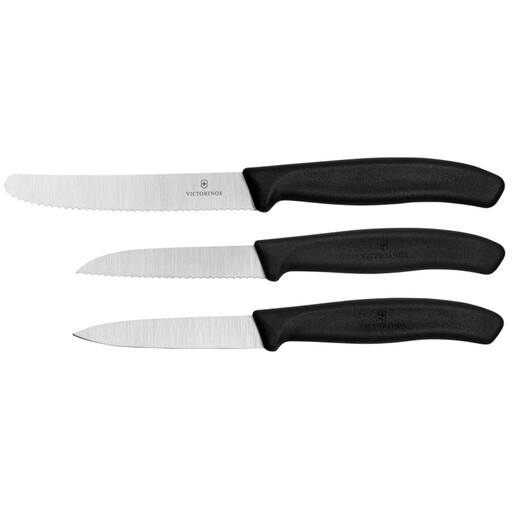
Why This Fits Their Persona: This knife set is ideal for daily use. With a paring knife, a serrated tomato knife, and a vegetable knife, it covers basic cutting tasks without cluttering the kitchen drawer. Perfect for anyone looking for a reliable and straightforward starter set.
Instead of vague promises, Victorinox focuses on proven material quality and functionality. The knives are designed for specific tasks (e.g., serrated edge for tomatoes), and the ergonomic plastic handles are built for durability and easy care.
The set is dishwasher-safe and offers excellent value for money for Swiss-made blades.
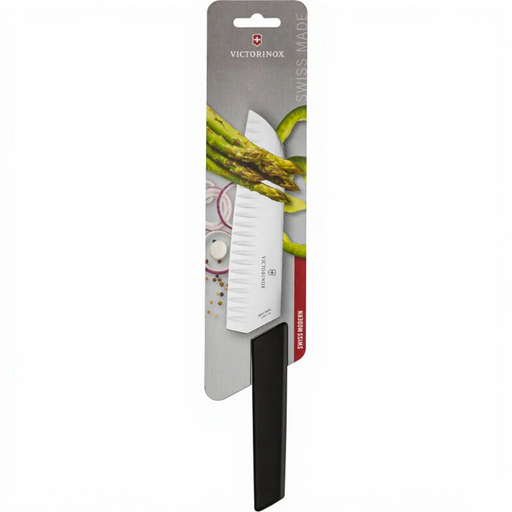
Why This Fits Their Persona: The Santoku knife is the all-rounder for ambitious chefs who value precise cuts for vegetables, fish, and meat. The 17cm blade is versatile, and its modern aesthetic fits well in design-conscious kitchens.
The Granton edge is not a gimmick but a functional feature that reduces food sticking to the blade. The stainless steel blade offers good edge retention that goes beyond mere out-of-the-box sharpness.
The combination of a versatile blade shape (Santoku) and a Granton edge makes it an efficient tool. It is also dishwasher-safe.
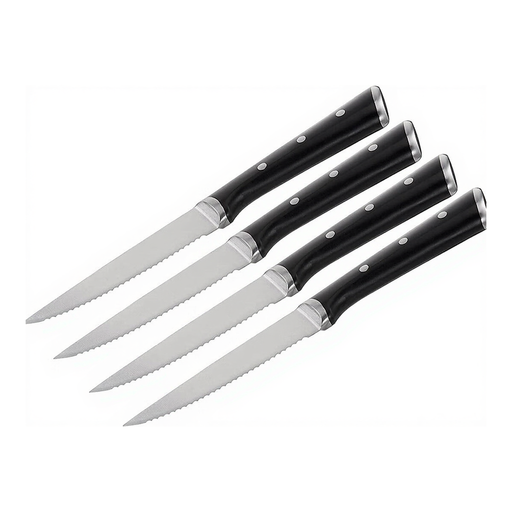
Why This Fits Their Persona: For hosts who regularly invite friends and family for a good meal, a dedicated steak knife set is essential. This 4-piece set from Tefal ensures that every guest has the right tool to cut meat effortlessly.
This set is clearly designed for one purpose and doesn't try to be an all-purpose tool. The Ice Force technology, where the blade is exposed to a -120°C cool-down after heating, is a specific manufacturing process that, according to Tefal, improves the steel's resilience and durability.
The set provides a uniform look for the dinner table and is robust and dishwasher-safe thanks to its ABS plastic handles and stainless steel blades.
We have compiled a complete, up-to-date list of products that fully meet these strict selection criteria and German safety standards.
The main difference lies in the blade shape and cutting technique. The classic European chef's knife has a curved blade that allows for a rocking chopping motion. The Japanese Santoku knife has a straighter cutting edge and a rounded, downward-sloping tip. It is particularly suitable for pulling and pushing cuts and is an all-rounder for vegetables, fish, and meat.
Even a stainless steel knife benefits from proper care. Ideally, clean it with a damp cloth immediately after use, especially after contact with acidic foods. Although many knives are considered dishwasher-safe, hand washing is gentler on the edge in the long run, as harsh detergents and high temperatures can damage the blade. Always dry the knife thoroughly and store it safely in a knife block, on a magnetic strip, or with a blade guard to avoid contact with other hard objects.
That depends on your needs. A knife set can be a cost-effective way to acquire a basic set that matches visually. Make sure the set includes the types of knives you actually need. Buying individually allows you to select the specialized tool for each task and gradually build your collection with high-quality individual pieces, such as a good Santoku knife or a special tomato knife.