
Lieferung heute & morgen

Qualitätsgarantie

Willkommens-Angebote freischalten: KOSTENLOSE Lieferung | Bis zu 80 % RABATT | Kostenlose 30-Tage-JoyPlus-Testphase
App herunterladen
Choosing a new kitchen knife can quickly become overwhelming. Countless models, lofty marketing promises, and massive knife sets make it difficult to make an informed decision. As your Joybuy Product Recommendation Officer, I'm here to help you identify the crucial quality features and avoid common purchasing traps, ensuring you find a tool that will serve you well for years to come.
Many buyers invest in products that soon prove to be impractical or low-quality. You should be aware of three common pitfalls:
To avoid a bad purchase, you should focus on three objective criteria that determine the performance and lifespan of a kitchen knife.
The quality of a knife rises and falls with the steel used. A good stainless steel knife is not only rust-proof but also has excellent edge retention, meaning it stays sharp for a long time. Manufacturers like Zwilling or Victorinox use special steel alloys that are further refined through processes like ice-hardening (e.g., FRIODUR by Zwilling). These processes improve corrosion resistance and the steel's structure, leading to longer-lasting sharpness. Pay attention to the steel specifications, as it is the foundation of every good sharp knife.
A single knife cannot perform every kitchen task perfectly. A thoughtful selection of specialised blades is far more useful than a block full of unsuitable knives. The three most important types for home use are:
A Japanese knife set, often featuring a Santoku or Nakiri knife, offers alternatives for special cutting techniques, particularly for vegetables.
The best blade is of little use if the knife doesn't fit well in your hand. The handle should be ergonomically shaped and offer a secure grip, even when wet. Materials like high-quality synthetic polymers are easy to clean and hygienic. The connection between the handle and the blade (tang) should be seamless and stable, often recognisable by full-length rivets. A well-balanced knife, with its center of gravity at the transition from blade to handle, allows for fatigue-free and controlled work.
Instead of presenting a confusing list, we have selected products that fit specific user profiles and meet the quality criteria mentioned.
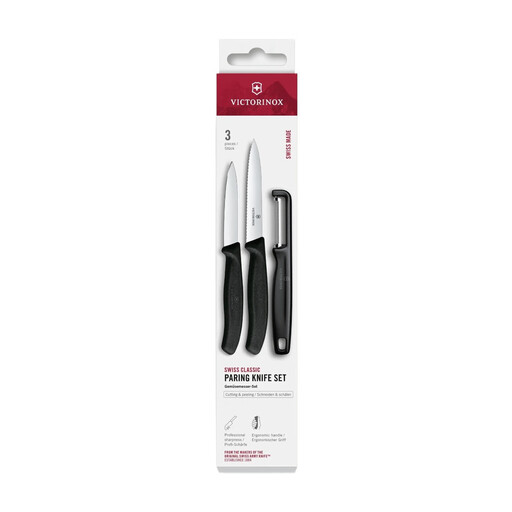
Why this set is a great fit: It provides a high-quality basic kit from a renowned brand without investing in a superfluous set. Ideal for everyday peeling and cutting tasks in the kitchen.
Instead of a low-quality knife block, you get three genuinely useful, sharp tools that reliably perform their tasks and are built to last.
Made in Switzerland, with precision stainless steel blades, and dishwasher-safe for easy cleaning.
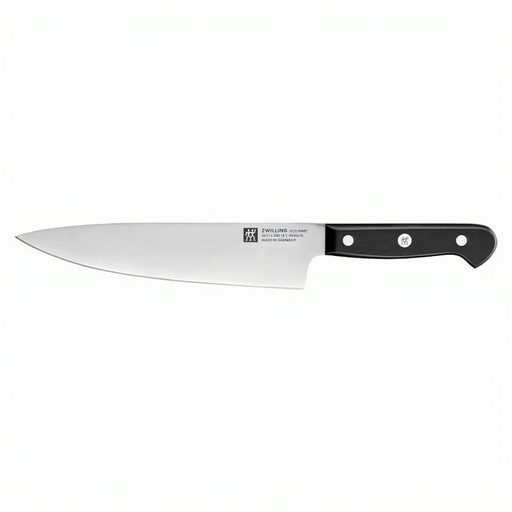
Why this knife is a great fit: A classic chef's knife "Made in Germany," designed as a versatile and robust workhorse for demanding cutting tasks.
It focuses the investment on a single, high-quality tool instead of many mediocre ones. The ice-hardened special steel resists the pitfall of blades that dull quickly.
The FRIODUR ice-hardened blade offers exceptional edge retention and corrosion resistance. The ergonomic three-rivet handle ensures a well-balanced feel.
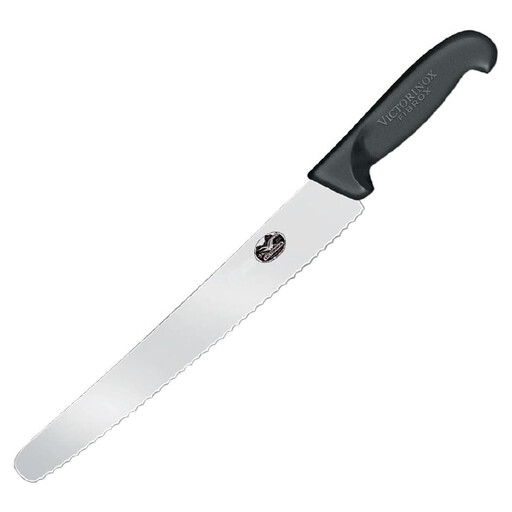
Why this knife is a great fit: Perfect for anyone who regularly cuts fresh bread or cake and needs a clean, precise edge without crushing the food.
This bread knife demonstrates why a specialised tool is often the better choice. It bypasses the problem of all-purpose knives failing at specific tasks like slicing crusty bread.
The 26 cm blade with a precision serrated edge and the non-slip, ergonomic handle ensure safe and comfortable handling.
Explore our full selection of products that meet our strict criteria for quality, safety, and usability, including complete cutlery sets and steak knives.
The frequency depends heavily on usage, the cutting surface, and the quality of the steel. High-quality steel, like that used in Zwilling knives or Victorinox knives, stays sharp longer. As a rule of thumb for daily use, a quick run over a honing steel every few weeks will maintain the edge. A fundamental resharpening on a whetstone is recommended once or twice a year, depending on how heavily it's used.
Not necessarily. A knife set can be practical for a starter kit. However, it is often more sensible to start with a high-quality chef's knife and supplement it with specialised knives you actually need, such as a good bread knife or a handy paring knife. This ensures you only pay for tools you will genuinely use.
"Solingen" is a legally protected designation of origin for cutlery. Knives marked as Solingen knives must meet strict, defined quality and manufacturing standards and have all essential production steps completed in the "City of Blades," Solingen, or its surrounding industrial region. The designation is considered an internationally recognised mark of high-quality craftsmanship.