
Lieferung heute & morgen

Qualitätsgarantie

Willkommens-Angebote freischalten: KOSTENLOSE Lieferung | Bis zu 80 % RABATT | Kostenlose 30-Tage-JoyPlus-Testphase
App herunterladen
Anyone looking to buy a kitchen knife will find a wide selection of individual knives, knife sets and specialist blades online. Product descriptions often use terms such as “professional kitchen knife”, “razor-sharp” or “durable steel”. For an informed buying decision, however, specific details matter: blade length, type of steel, handle construction, care instructions and the intended use.
A broad cleaver or Chinese chef’s knife can be used to slice vegetables, chop herbs and scoop up ingredients with the flat side of the blade. For delicate tasks such as peeling or cutting small pieces of fruit, however, this type of blade can often be awkward to handle. The shape should therefore suit both the cutting task and the way you handle the knife.
Stainless steel generally protects against corrosion, but it says little about the precise hardness, grind or edge retention. Some listings only mention “Stainless Steel” without specifying the type of steel or providing further technical details. If you buy a stainless-steel kitchen knife, you should therefore also look at the blade thickness, grind and care instructions.
A dishwasher-safe kitchen knife may be placed in the dishwasher according to the product information, but high temperatures, detergents and contact with other crockery can still put strain on the edge. Knives with wooden handles should never be left in water and should not be put in the dishwasher. Even with plastic handles, rinsing the knife immediately and drying it carefully is advisable if you want the blade to stay sharp for as long as possible.
Specific information about the steel is more helpful than a general marketing statement. The Xiaotianzi Chinese Chef’s Knife, for example, is listed as HRC 53. HRC refers to Rockwell hardness. A higher value may indicate a harder blade, but it does not automatically mean better everyday performance: hard blades can be more sensitive to incorrect use and require a suitable sharpening angle.
The following points are also important:
A knife with an ergonomic handle should sit securely in your hand without your fingers slipping towards the blade. Plastic and polypropylene handles are easy to care for. Seamless transitions between the blade and handle can make cleaning easier. A heavier knife is not necessarily better: a 268 g model may feel stable during more forceful cutting tasks, while a lighter knife can be more comfortable during longer preparation sessions.
For domestic use, knives should only be used for their intended purpose and kept out of children’s reach. In Germany, specific legal requirements apply to carrying knives in public places.

Why this product suits this profile: The 15-cm blade is compact and designed for everyday cutting tasks. The soft-touch handle and included blade guard are practical features for households with limited storage space.
The product details specify the blade length, stainless steel and coating rather than making a vague “universal” claim. The blade guard makes separate storage easier.
15-cm blade, soft-touch handle and blade guard; the Fresh Kitchen range also includes other blade shapes.
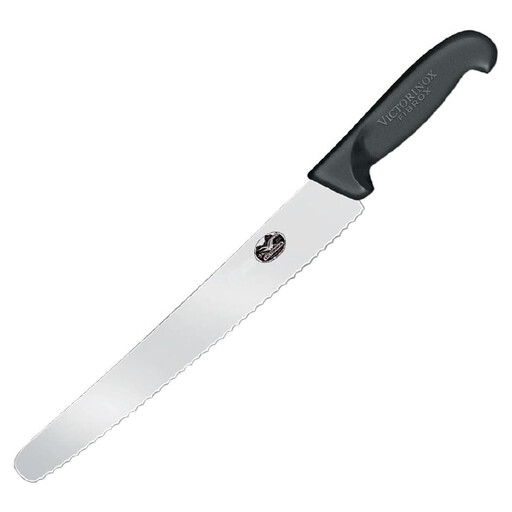
Why this product suits this profile: If you regularly cut bread, cakes or pastries, this clearly specialised solution offers a 26-cm blade, serrated edge and ergonomically shaped plastic handle.
The serrated blade is clearly described as being intended for baked goods. This avoids using a smooth-edged chef’s knife on crusts, where it may be more likely to slip.
26-cm serrated edge, curved blade and dishwasher-safe according to the product details; hand-washing can nevertheless help protect the edge.

Why this product suits this profile: The 18.5 × 8 cm blade is ideal for users who regularly prepare vegetables, herbs and ingredients, while also wanting to use the knife to scoop up cut food.
The product data specifies the blade dimensions, material, handle construction and weight of 268 g. This makes it easier to assess before buying whether the broad shape will suit your kitchen.
Broad blade, seamlessly riveted plastic handle and specialist stainless-steel blade according to the product description.
A kitchen knife set can be useful if you need to cover several tasks. For a small household, a chef’s knife, vegetable knife and bread knife are often enough. A set with both a straight and serrated blade, for example, can be used flexibly for tomatoes, fruit and small preparation tasks. The Victorinox Swiss Classic Vegetable Knife Set contains two 11-cm vegetable knives and, according to the product details, can be cleaned in the dishwasher.
For setting the table, a separate steak and pizza knife set is a practical choice. The Victorinox Swiss Classic Set includes six knives with 11-cm serrated blades. If you often prepare fruit, on the other hand, you could choose an individual fruit and paring knife such as the SHIBAZIZUO Stainless Steel Fruit Knife.
We have put together a complete, regularly updated list of products that fully meet these strict selection criteria and the safety regulations applicable in the EU.
For many households, a chef’s knife or Santoku knife with a medium-length blade is a practical starting point. If you mainly cut vegetables, a Santoku knife may be the better choice. For bread and pastries, a dedicated serrated bread knife is more suitable than a smooth-edged all-purpose knife.
Use a wooden or plastic chopping board, clean the blade promptly and dry it thoroughly. Storing a knife loose in the cutlery drawer can damage the edge. A knife block, magnetic strip or blade guard protects both the blade and your hands.
That depends on how you use it, how comfortable the handle feels and how willing you are to maintain it. For occasional cooking, a simple individual knife is often sufficient. More ambitious home cooks are likely to benefit from a well-matched combination of chef’s knife, bread knife and vegetable knife rather than a large collection of specialist blades that are rarely used.