
Lieferung heute & morgen

Qualitätsgarantie

Willkommens-Angebote freischalten: KOSTENLOSE Lieferung | Bis zu 80 % RABATT | Kostenlose 30-Tage-JoyPlus-Testphase
App herunterladen
A kitchen knife needs to be more than just sharp. What matters is whether the blade shape, handle and care requirements suit your cooking habits. Home cooks, beginners and enthusiastic chefs often choose products advertised as “professional”, “durable” or “rust-resistant” without receiving enough explanation of the technical details.
A knife’s hardness is often stated in HRC. A higher value can help the cutting edge stay sharp for longer, but it does not make the blade indestructible. Hard or frozen foods, glass and stone surfaces, as well as twisting the blade sideways, can damage even a durable blade.
Several factors therefore matter for everyday use: steel quality, sharpening, blade geometry, build quality and the right cutting surface. A kitchen knife should always be used on a stable wooden or plastic chopping board.
According to their product specifications, some models are dishwasher-safe, including certain vegetable knives from ZWILLING and Victorinox. However, heat, detergents and contact with other cutlery can place greater strain on the cutting edge. Hand washing is recommended for many knives, even when they are technically suitable for cleaning in a dishwasher.
It is also important to dry the knife immediately after washing. This helps reduce water marks, corrosion in vulnerable areas and unnecessary wear to the handle.
A kitchen knife set can cover several tasks, but it does not always contain the knives you will actually use. For most households, a chef’s knife or Santoku knife, a small vegetable knife and, if needed, a steak knife are a more practical starting point than a set containing numerous specialist blades.
Stainless steel is easy to care for in everyday kitchen use and resists moisture when cleaned normally. Even so, “rust-resistant” is not a licence to leave the knife soaking or keep water on the blade for extended periods.
Several ZWILLING models feature a FRIODUR ice-hardened blade. The product specifications for the Gourmet models state a hardness of 55 to 58 HRC, along with a V-edge with an overall angle of around 30 degrees. These details are more useful than general claims about sharpness, as they provide a clearer indication of the construction and intended use.
An ergonomic plastic or POM handle can be easy to clean and provide a secure grip. A full-tang or three-rivet construction is often chosen for its balance and stability. The key point is to keep the handle dry, secure and free from damage.
Store kitchen knives in a knife block, on a suitable magnetic strip or in a blade guard. If left loose in the cutlery drawer, blades can knock against one another and create an additional risk of injury.
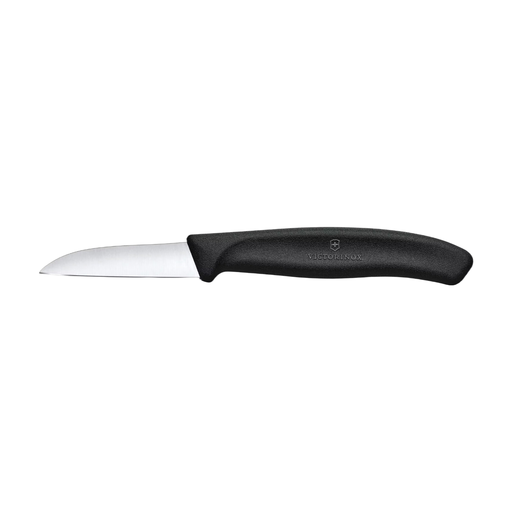
Why this product suits this profile: The short, straight blade and low weight of 20 g make controlled preparation of fruit and vegetables easier.
The product specifications state that it has a straight stainless-steel blade, an ergonomic polypropylene handle and is dishwasher-safe.
6-cm blade, 20 g weight, made in Switzerland and easy to clean.
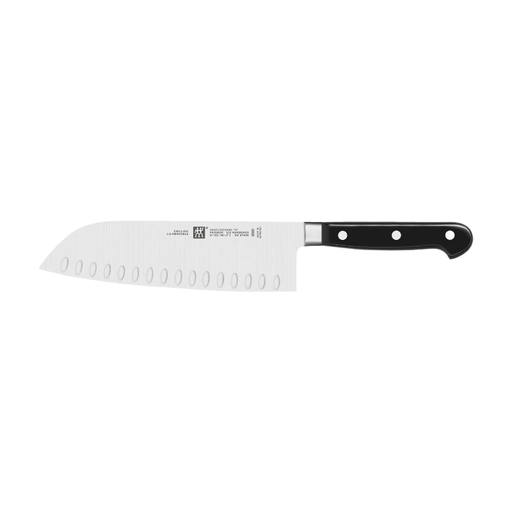
Why this product suits this profile: This Santoku knife combines a broad, Japanese-inspired blade with a full-tang construction, making it suitable for regularly slicing vegetables, fish and boneless meat.
The hollow edge is clearly specified. The care instructions call for hand washing and immediate drying rather than making general claims about dishwasher use.
7-inch Santoku blade, hollow edge, polypropylene handle, full-tang construction and made in Germany.
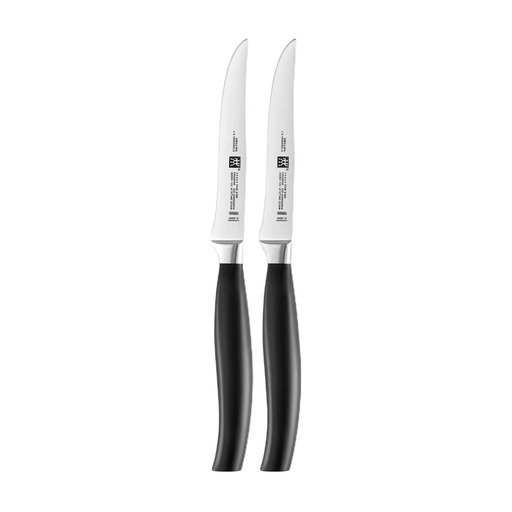
Why this product suits this profile: Two steak knives are a useful addition when meat dishes are regularly served for everyone to share.
The contents are clearly stated as two knives. This removes the common uncertainty about how many table knives a set actually includes.
Two-piece set, SIGMAFORGE speciality steel, ergonomic plastic handle and specified finger guard.
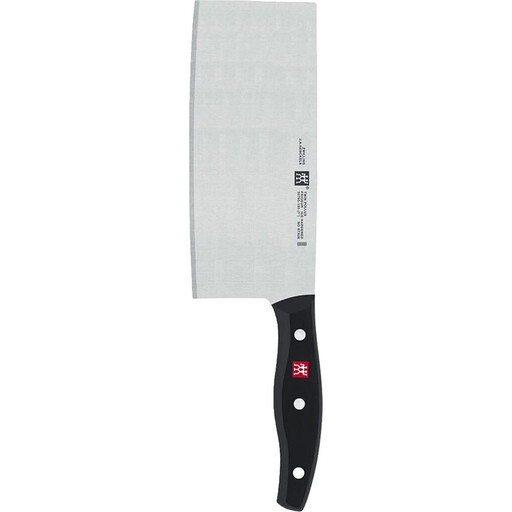
Why this product suits this profile: The broad blade supports slicing, dicing and scooping soft foods, making it well suited to Asian-inspired preparation methods.
The care instructions expressly rule out dishwashers, bones, frozen foods and hard objects. This clearly defines the knife’s intended use.
18.5-cm blade, FRIODUR ice hardening, POM handle with three rivets and a broad blade surface for lifting cut ingredients.
We have put together a complete, regularly updated list of products that fully meet these strict selection criteria and the safety regulations applicable in the EU.
For many beginner cooks, a chef’s knife measuring 18 to 20 cm is versatile enough for a wide range of tasks. If you prefer a more compact blade and a predominantly straight cutting motion, you can choose a Santoku knife. A small paring or vegetable knife completes the basic equipment for preparing fruit and vegetables.
The lifespan of the cutting edge depends on the food being cut, the chopping board, care and frequency of use. Glass, stone and ceramic surfaces can quickly blunt a blade. Regular sharpening with a suitable tool, together with storage in a knife block or protective sheath, helps extend its useful life.
This depends on the model. Some Victorinox and ZWILLING vegetable knives are listed as dishwasher-safe. However, hand washing and immediate drying are usually gentler on the material. For Santoku knives and Chinese chef’s knives, follow the relevant manufacturer’s instructions.