
Lieferung heute & morgen

Qualitätsgarantie

Willkommens-Angebote freischalten: KOSTENLOSE Lieferung | Bis zu 80 % RABATT | Kostenlose 30-Tage-JoyPlus-Testphase
App herunterladen
A kitchen knife set can make daily food preparation much easier – provided the selection matches the tasks you actually carry out in your kitchen. Many offers seem particularly attractive because they include a large number of pieces or use terms such as “ultra-sharp”. What really matters, however, is clear information about the blades, handles, sizes and cleaning requirements.
A large knife set does not automatically include the right knives. Several similar vegetable knives are of little help if you are missing a chef’s knife or a bread knife. So first consider which tasks you regularly carry out:
A 3-piece kitchen knife set can be sufficient for everyday use if each included item has a clearly different purpose.
“Extremely sharp” or “stays sharp for a long time” does not say much without further information. Relevant details include the blade length, edge design, steel specification and manufacturing process. Care and maintenance also have a greater influence on a knife’s lifespan than a single advertising slogan.
Some products mention a special hardening process. According to the product description, the ZWILLING Five Star Set features FRIODUR ice-hardened blades and stainless steel. These are specific product characteristics; they alone cannot determine how long the knives will remain effective in use.
Dishwasher-safe kitchen knives are convenient, but heat, detergents and contact with other cutlery can place greater strain on the edge or handle. If the product description recommends hand washing, this guidance should take priority.
Also check whether the information applies to every component. With a set containing a block, scissors or a peeler, care instructions may differ from one component to another.
For many households, a combination of a small knife and a larger all-purpose knife is a sensible choice. A chef’s knife with a blade length of around 20 cm provides a broad working surface for vegetables, herbs and larger ingredients. Smaller blades measuring approximately 8 to 11 cm are suitable for peeling, removing cores and detailed work.
A chef’s knife set is particularly suitable if you regularly slice, dice and chop. For fruit, vegetables and tomatoes, however, a vegetable knife set with straight and serrated edges may be the better option.
With stainless steel knives, the specific material should be stated in the product description. “Stainless” does not mean that every knife will remain maintenance-free indefinitely. Acids, salt, moisture and incorrect storage can affect the surface.
A product description that specifies 18/10 stainless steel or a particular blade-hardening process is more informative than a general claim about quality.
Ergonomic kitchen knives should sit securely and comfortably in your hand. Check the handle material, slip-resistant properties and the connection between the handle and blade. A knife block, a magnetic rack with suitable protection or a drawer insert will protect the edges better than loose storage.
In households with children, the storage location should not be freely accessible. Knives should only be used on sturdy chopping boards; glass and ceramic surfaces can blunt edges more quickly.
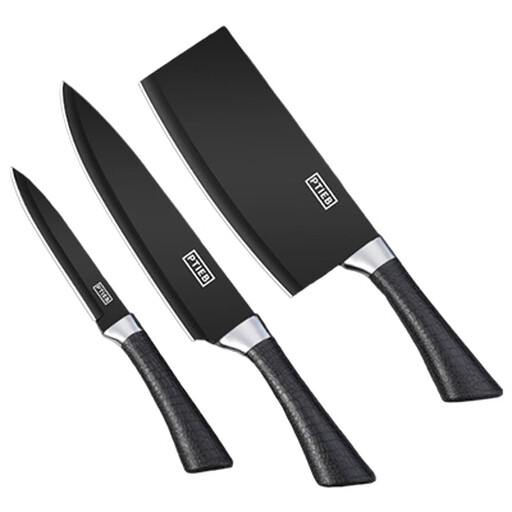
Why this product suits this profile: The combination of a fruit knife, chef’s knife and slicing knife focuses on essential tasks without requiring a large block.
The set contents are clearly specified as three different types of knife. Care instructions and dishwasher suitability should still be checked before buying.
Three knives designed for different cutting tasks in a compact selection.
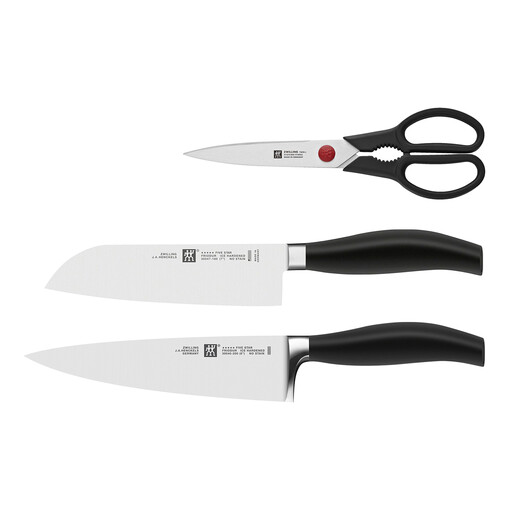
Why this product suits this profile: The set combines a 20 cm chef’s knife, a 16 cm utility knife and 23 cm kitchen scissors. According to the product description, the blades are made from stainless steel and feature FRIODUR ice hardening.
The sizes and included components are listed clearly. This allows you to check in advance whether the selection suits your cutting needs.
A chef’s knife, utility knife and scissors cover a range of kitchen and household tasks.
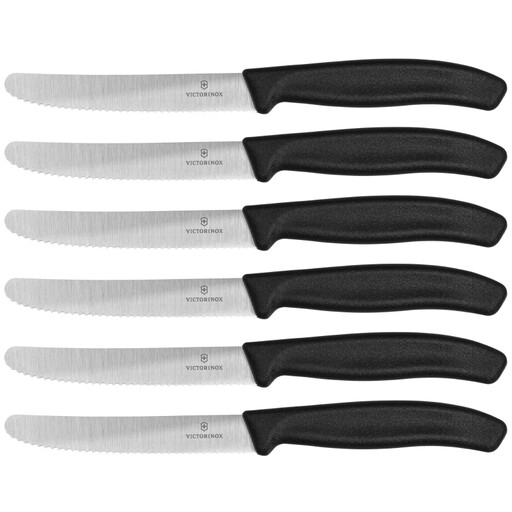
Why this product suits this profile: According to the product description, the set contains six serrated knives with 11 cm blades and ergonomic black handles. They are particularly suitable for soft skins, fruit and vegetables.
The consistent serrated edge is clearly suited to certain foods. However, if you often chop or portion meat, you should add a chef’s knife.
Six similarly designed knives with stated dishwasher suitability and stainless steel blades.
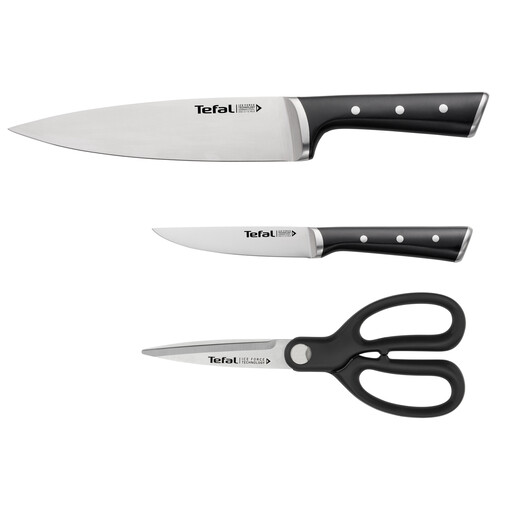
Why this product suits this profile: According to the product description, the set includes a 20 cm chef’s knife, an 11 cm utility knife and kitchen scissors. German stainless steel and dishwasher suitability are also specified.
The three functions are clearly separated. Nevertheless, hand washing should be considered if you want to protect the edge over the long term.
A chef’s knife, utility knife and scissors cover typical cutting and kitchen support tasks.
We have put together a complete, regularly updated list of products that fully meet these strict selection criteria and the safety regulations applicable in the EU.
Even high-quality kitchen knife sets need to be handled correctly:
A knife set with scissors is practical for many households, but it does not replace an additional bread knife if you often cut bread or baked goods.
For beginners and small households, a 3-piece set with a small knife, chef’s or utility knife and an additional component is often sufficient. If you regularly prepare bread, meat or larger ingredients, you may need additional specialist knives.
No. The specification generally permits cleaning in a dishwasher, but it says nothing about protecting the edge over the long term. Hand washing and drying immediately are often the gentler recommendations in product descriptions.
This depends on the steel, edge geometry, usage, chopping board and care. Hard foods, unsuitable surfaces and loose storage can affect the edge more quickly. Controlled sharpening and suitable storage help support consistent performance.