
Lieferung heute & morgen

Qualitätsgarantie

Willkommens-Angebote freischalten: KOSTENLOSE Lieferung | Bis zu 80 % RABATT | Kostenlose 30-Tage-JoyPlus-Testphase
App herunterladen
A kitchen knife set can be a useful addition to any kitchen’s basic equipment. At the same time, many sets look more comprehensive at first glance than they really are in everyday use. What matters is not simply the number of pieces, but whether the knife shapes, materials, storage and care requirements suit the way you cook.
A 5-piece knife set often covers the most important tasks: chef’s knife, bread knife, meat knife or carving knife, utility knife and vegetable knife. A 7-piece knife set often adds a sharpening steel, kitchen scissors or a knife block.
With larger sets, check how many of the pieces are actually kitchen knives. For example, a set with 11 knives may include several steak knives, while only one chef’s knife and one bread knife are intended for everyday food preparation.
Cutting performance depends on more than the blade’s condition when new. Blade material, hardness, cutting angle, chopping board and care all affect how long a knife performs well. Claims such as “permanently sharp” should therefore not be considered in isolation.
An integrated sharpener or sharpening steel can make maintenance easier, but it does not replace using the knife correctly. Frozen food, bones or hard shells can damage the edge if the knife is not designed for these tasks.
A knife set with a knife block protects the blades from contact with other kitchen utensils and provides a dedicated place for storage. However, the block must stand securely and remain dry. Wooden blocks should not be soaked in water. With self-sharpening blocks, only the knives intended for them should be placed in the corresponding slots.
Stainless steel kitchen knives are easy to care for in everyday use and resistant to corrosion when cleaned correctly. The precise steel quality, any hardening process and the construction where the blade meets the handle are more important than a general description such as “high-quality steel”.
For example, the Zwilling Vier Sterne set is described as being made from FRIODUR ice-hardened special formula stainless steel. For this model, the product description states a hardness of HRC 55–58. Hardness is a useful technical reference point, but on its own it says nothing about overall handling or the care the knife requires.
Pay attention to blade lengths. A 20 cm chef’s knife offers a different reach from a compact 15 or 16 cm model. For smaller kitchens or beginner cooks, a shorter blade may be easier to control.
Not every kitchen knife set is dishwasher-safe. Heat, cleaning products and contact with other cutlery can put strain on blades and handles. Several of the sets mentioned here recommend hand washing with warm water followed by immediate drying.
Practical ground rules:

Why this product suits this profile: This 5-piece set focuses on five commonly used knives and comes with an acacia wood block for storage. It is well suited to households looking for a straightforward set of essential knives.
The selection includes chef’s, bread, utility, paring and slicing knives rather than several duplicate knife types. The description recommends hand washing, making the care requirements clear.
Five clearly specified stainless steel knives and an acacia wood block provide a well-organised set of kitchen essentials.
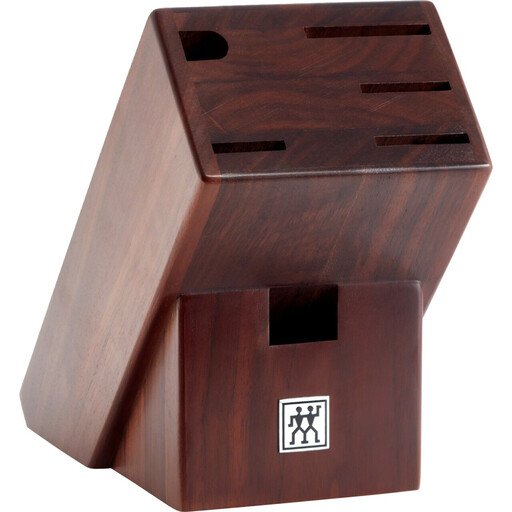
Why this product suits this profile: This 7-piece knife block set combines a chef’s knife, bread knife, vegetable knife, carving knife, sharpening steel and kitchen scissors. It is aimed at households that want clearly designated tools for different food preparation tasks.
The product details specify the blade lengths, FRIODUR ice-hardened special formula stainless steel and the restriction that it is “not dishwasher-safe”. This makes it easier to assess the equipment and care requirements realistically.
The 20 cm chef’s knife, 20 cm bread knife and 23 cm sharpening steel cover essential kitchen tasks, while the block keeps all seven pieces organised.
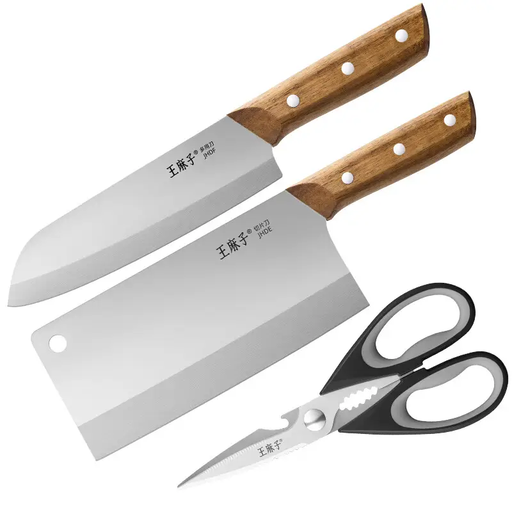
Why this product suits this profile: This 3-piece kitchen knife set includes a slicing knife, a versatile knife and kitchen scissors. It is suitable for users who specifically need just a few tools for meat, vegetables and general cutting tasks.
The compact selection reduces the number of unused extras. The product description highlights forged steel blades, ergonomic wooden handles and a non-slip handle design.
A slicing knife, multi-purpose knife and kitchen scissors form a compact combination for regular food preparation tasks.
We have put together a complete, regularly updated list of products that fully meet these strict selection criteria and the safety regulations applicable in the EU.
For a small household, three to five knives are often enough: a chef’s knife, bread knife, vegetable knife or paring knife, and a utility knife. If you regularly carve meat or cook for several people, you may benefit from a 7-piece or 11-piece knife set. However, check whether the additional pieces are genuinely useful knives or mainly steak knives and accessories.
There is no universal answer. Service life depends on the steel, construction, cutting surface, cleaning routine and frequency of use. Hand washing, immediate drying and a suitable sharpening steel or sharpener can help maintain performance. Damaged or badly chipped blades should no longer be used.
This depends on the individual model. Many knife blocks and wooden handles must not be put in the dishwasher. Even dishwasher-safe blades can be affected by heat, cleaning products and contact with other cutlery, which may shorten their service life. Always follow the care instructions on the relevant product page.