
Lieferung heute & morgen

Qualitätsgarantie

Willkommens-Angebote freischalten: KOSTENLOSE Lieferung | Bis zu 80 % RABATT | Kostenlose 30-Tage-JoyPlus-Testphase
App herunterladen
A kitchen knife set can make everyday meal preparation easier—provided the selection, blade design and care requirements match your needs. Many buyers, however, focus first on the number of pieces or claims such as “extra sharp.” As a result, they end up with models whose knives are rarely used, are difficult to clean or cannot be stored safely.
The Joybuy Product Recommendation Officer selection for 2026 therefore focuses on clear, verifiable details: blade length, blade material, handle design, included items and care instructions.
A comprehensive knife set often contains several specialty knives, even though a chef’s knife, a small paring knife and a bread knife are usually sufficient for everyday cooking. Before buying, check whether the set actually includes blades suited to your cooking habits.
More important than the total number of pieces are:
A sharp blade can quickly lose its performance when used on unsuitable cutting boards, stored loose or cleaned in the dishwasher. Glass and ceramic surfaces are generally unsuitable for kitchen knives because they place greater stress on the cutting edge. Cutting bones, frozen food or very hard shells is also not intended for many kitchen knives.
Edge type, blade stability and care requirements are therefore equally important. A serrated edge, for example, is well suited to bread and baked goods, while a smooth edge enables precise cuts through vegetables, meat and herbs.
An ergonomically shaped handle should sit securely and comfortably in a dry hand. Plastic handles are often easy to care for, whereas wooden handles require more attention and should not be left in water for extended periods. A seamless transition between blade and handle can make cleaning easier, but it does not replace careful handling.
Stainless steel knives are widely used in the kitchen because stainless steel can generally offer good corrosion resistance and practical care requirements. However, the exact composition and manufacturing process vary by model. Terms such as “special steel,” “420 stainless steel” or “FRIODUR ice-hardened” should always be considered in the context of the specific product.
A blade with ice-hardening, as stated for certain ZWILLING models, is not a universal promise of a particular service life. Rather, it describes a manufacturing process specified by the brand. For everyday performance, blade thickness, edge geometry, usage and care remain decisive.
The right length depends on your work surface, handling preferences and ingredients:
Balance also matters. A heavy knife block can stand securely but requires more space. A single knife with a blade guard, on the other hand, can be stored more compactly in a drawer.
Before first use, kitchen knives should be cleaned with warm water and mild dish soap, then dried immediately. Models explicitly marked as unsuitable for dishwashers must be washed by hand. Knives should not be left loose in a drawer, as this can cause injuries and damage the blade.
Suitable storage options include:
When honing or sharpening, the knife must be compatible with the honing steel or sharpening tool being used. A honing steel realigns the cutting edge, while a whetstone or suitable sharpening system removes material. Improper sharpening can alter the blade.

Why this model is a good fit: For smaller households and anyone looking for a single versatile kitchen knife for vegetables, meat and herbs.
The 15 cm blade and included blade guard make its intended use and storage clear, rather than relying on a high piece count as a selling point.
Stainless steel blade with titanium and non-stick coatings and a soft-touch handle; the product details also specify an included blade guard.
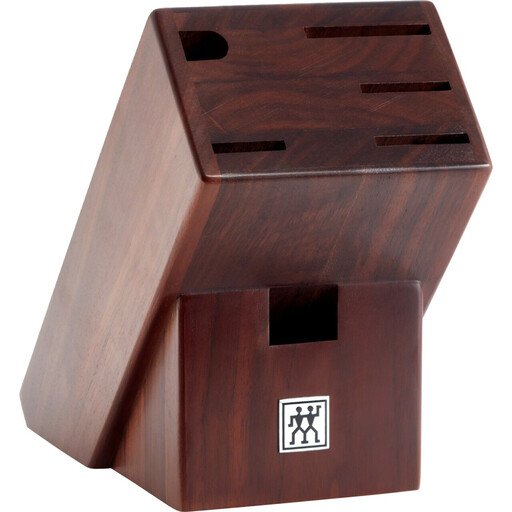
Why this model is a good fit: For households looking for several essential knives, a knife block and additional kitchen utensils in one coordinated set.
The included items are clearly specified: vegetable, carving, chef’s and bread knives, along with a honing steel, scissors and block.
FRIODUR ice-hardened special steel blades, synthetic handles and a block measuring 19 × 29 × 19 cm. According to the product details, hand-washing is required.

Why this model is a good fit: For users who prefer a broad blade for slicing, dicing and transferring prepared ingredients.
The product data clearly states the dimensions, weight and blade material. Its broad shape is intended for ingredients, not bones or hard materials.
18.5 cm long and 8 cm wide special stainless steel blade, seamlessly riveted plastic handle and stated weight of 268 g.
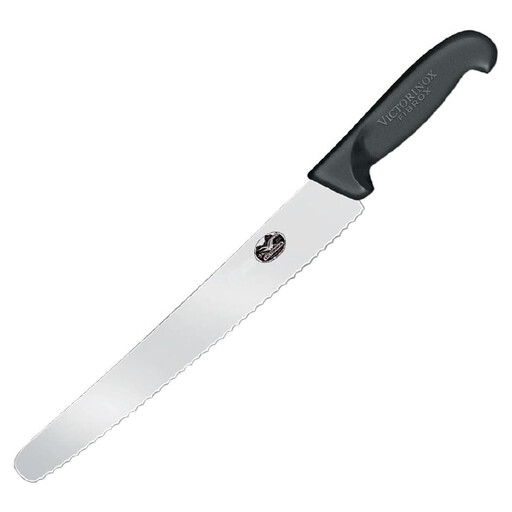
Why this model is a good fit: For households where bread, cake and pastries are regularly sliced and a single knife is preferable to a complete set.
The 26 cm serrated edge is clearly designed for bread and baked goods. This avoids purchasing an extensive set when only a bread knife is needed.
Serrated stainless steel blade, ergonomic non-slip handle and, according to the product details, suitability for bread, cake and pastries.
The complete selection includes products with different blade materials, shapes and intended uses. Before buying, check the included items and care instructions for each product.
For many households, a chef’s knife, a small paring or vegetable knife and a bread knife are sufficient. A larger knife set makes sense when several people cook, a variety of ingredients are prepared regularly or central storage in a knife block is preferred.
Both can be suitable. A knife block provides dedicated slots and quick access, but takes up counter space. A blade guard is ideal for individual knives and drawer storage. The key is to keep the blade protected and prevent it from coming into loose contact with other cutlery.
This depends on usage, blade steel, cutting board and care. A honing steel can be used regularly with suitable knives, while actual sharpening is only necessary once cutting performance begins to decline. If in doubt, follow the care instructions provided by the respective manufacturer.