
Lieferung heute & morgen

Qualitätsgarantie

Willkommens-Angebote freischalten: KOSTENLOSE Lieferung | Bis zu 80 % RABATT | Kostenlose 30-Tage-JoyPlus-Testphase
App herunterladen
Blunt kitchen knives make food preparation harder and can tempt you to apply more pressure when cutting. The right kitchen knife sharpener can help keep your blades in good condition, provided its design, sharpening angle and method of use are suitable for your knife. However, models vary considerably: some are designed exclusively for straight-edged blades, while others offer several sharpening stages or a separate scissor sharpener.
The term ‘4-in-1’ sounds comprehensive, but on its own it says little about how useful a sharpener actually is. What matters is the purpose of each slot. A coarse slot can work on a more worn edge, while a fine stage is used for touch-ups or polishing. An extra slot for scissors is only useful if you regularly maintain kitchen scissors.
A manual knife sharpener with a preset angle makes sharpening easier. However, it won’t necessarily suit every knife. Before buying, check whether the sharpener is suitable for traditional Japanese knives, single-bevel blades or serrated knives. According to its product description, the ZWILLING TWINSHARP is designed for straight-edged knives and has a preset angle of around 35°.
A knife sharpener should stay as stable as possible on the worktop as you draw the blade through it. Non-slip features or a securely positioned handle are therefore more important than decorative extras. Draw the blade slowly through the slot provided, without applying excessive pressure. Always follow the instructions supplied by the manufacturer.
A knife sharpener with multiple sharpening stages should clearly state what each stage is for. Common combinations include:
A knife sharpener with ceramic and steel discs combines different sharpening materials. According to its product description, the ZWILLING TWINSHARP uses stainless steel and ceramic discs for coarse and fine sharpening. Its ABS plastic body is 17 cm long.
Before buying, check that the product description answers at least the following questions:
For many households, a kitchen knife sharpener with a preset guide is easier to use. If you own different types of knife, pay particular attention to the limitations of each model.
Compact sharpeners can be stored in a kitchen drawer. The model ‘Knife Sharpener 215x50x55mm’ is listed as measuring 215 × 50 × 55 mm. These dimensions help you check whether you have enough storage space. After use, remove sharpening particles as directed by the manufacturer. Only use water, cleaning products or a dishwasher if the instructions specifically say they are suitable.
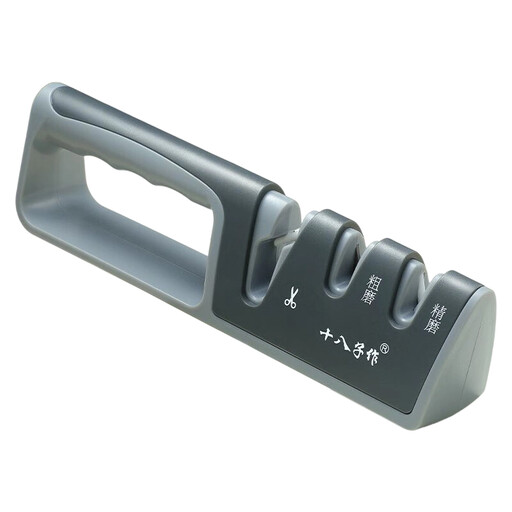
Why this product suits this profile: This compact, one-handed model is designed for households looking for a simple tool to maintain straight-edged kitchen knives regularly.
Its straightforward design avoids unnecessary extra features. Even so, check which blade types are suitable for the sharpening slot before use.
One-handed design and a product description aimed at household use. Its compact size makes it easy to store.
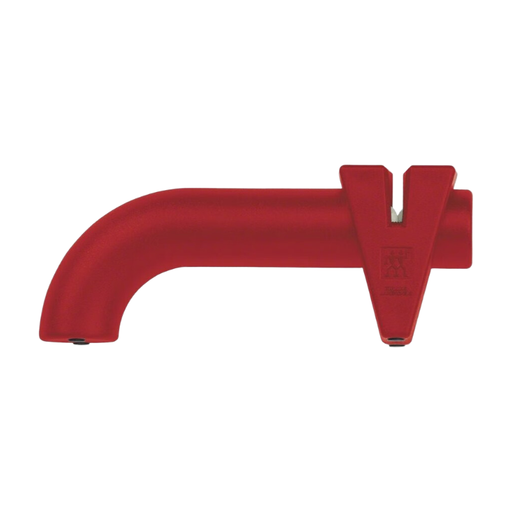
Why this product suits this profile: A good choice if you value clear technical details: this model has stainless steel and ceramic discs, as well as a preset sharpening angle of around 35°.
The product details specify the materials, angle and suitability for straight edges. This makes it easier to assess whether the sharpener is right for you before buying.
ABS plastic body, 17 cm length and separate stainless steel and ceramic discs for coarse and fine sharpening.
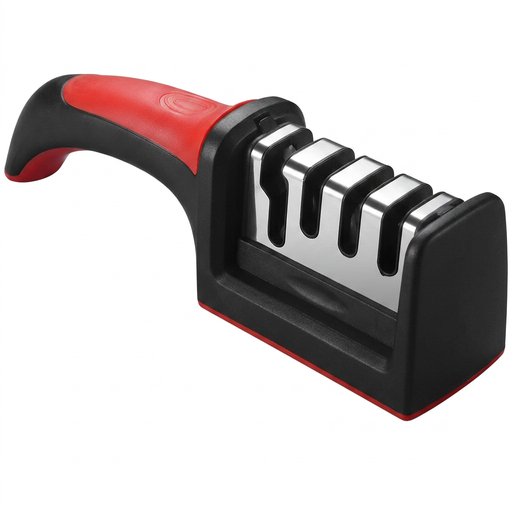
Why this product suits this profile: This sharpener is designed for people who maintain their knives regularly and also want to sharpen scissors.
According to the product description, the four slots each have a different purpose: coarse sharpening, fine sharpening, scissor sharpening and polishing.
Four clearly defined sharpening slots and a design that, according to the product description, helps keep the sharpener securely on the worktop.
We’ve put together a complete, regularly updated list of products that meet these strict selection criteria and fully comply with the safety regulations in force in the EU.
For an even result, make sure your knives are clean and dry. Place the sharpener on a stable, non-slip surface and hold it by the handle as intended by its design. Draw the blade through the slot provided without twisting it sideways. With a 4-in-1 knife sharpener, use each stage only for its intended purpose.
You don’t need to use the coarse stage every time. For regular maintenance, the fine stage is often all you need, if your sharpener is suitable. Sharpening too often or with too much force can wear away material from the blade. Only sharpen scissors in a slot specifically designed for them.
It depends on the quality of the knife, the chopping surface and how often you use it. If you cook regularly, it may be worth checking the blade after a few uses. The main thing to look out for is whether it has become noticeably less sharp when cutting. Use the fine stage only as directed by the manufacturer, and avoid unnecessary use of the coarse stage.
No. Many sharpeners are designed for straight-edged, double-bevel household knives. Serrated knives, single-bevel blades or knives made from specialist materials may need a different sharpening method. Check the product description to make sure the sharpener is compatible before buying.
There’s no single answer. It depends on the sharpening material, how often you use it, how you clean it and how much pressure you apply. Models with a sturdy body and clearly specified sharpening discs are easier to assess from their technical details. Don’t continue using a sharpener if it is damaged or unstable.