
Lieferung heute & morgen

Qualitätsgarantie

Willkommens-Angebote freischalten: KOSTENLOSE Lieferung | Bis zu 80 % RABATT | Kostenlose 30-Tage-JoyPlus-Testphase
App herunterladen
Blunt kitchen knives make chopping and slicing more difficult and can tempt you to apply too much pressure. The right kitchen knife sharpener can restore the cutting edge during everyday use – provided its design, abrasive material and application are suitable for the knife. The choice ranges from simple manual knife sharpeners and multi-stage models to knife blocks with an integrated honing steel.
A multi-stage knife sharpener can cover several sharpening steps. However, this does not automatically mean that every stage is suitable for every knife. Coarse sharpening elements remove more material and are generally intended for very blunt or damaged edges. Fine stages, on the other hand, are used for finishing and smoothing the cutting edge.
The product description should be checked carefully for high-quality or very thin knives. A preset angle can be convenient, but it will not necessarily suit every blade shape.
When sharpening kitchen knives, the device must stand securely on the work surface. If the knife sharpener slips while the blade is being drawn through, the risk of injury increases. Models with a suction cup or non-slip base can offer design advantages here. Even so, a clean, dry and level work surface remains essential.
A suction-cup knife sharpener should be checked for a firm grip before use. The suction cup does not replace careful handling and is not equally reliable on every surface.
Claims about sharpness are of limited value without specific information about the material, stages and angle. Instead, look for clear product data: are the sharpening discs made from stainless steel or ceramic? Is there a coarse and a fine stage? Is the angle fixed? Is the model suitable only for plain blades, or also for scissors?
A manual knife sharpener usually uses V-shaped sharpening elements. With a multi-stage knife sharpener, the order can be important:
A knife and scissors sharpener is practical if both types of tool are used regularly in your household. Scissors should only be sharpened in the designated guide.
Stainless steel and ceramic elements differ in how they work. Stainless steel can be used as a coarser sharpening element, while ceramic is often intended for finer finishing. A whetstone for kitchen knives offers a different approach: the angle is usually controlled by hand, which requires more practice. In return, you can adjust the sharpening process more precisely according to the grit.
A honing steel is often confused with a knife sharpener. For suitable knives, it mainly realigns the cutting edge and does not always replace the actual removal of material. Very blunt blades may require a suitable sharpener or whetstone.
The sharpening angle affects how the cutting edge is worked. According to the product description, the ZWILLING TWINSHARP has a preset angle of approximately 35° for knives with a plain edge. This makes it easier to use, but limits adjustment for specialist blade angles.
You should also check:
The following selection groups specific products according to typical usage situations. The listed features are the deciding factor, rather than sweeping claims about sharpness.
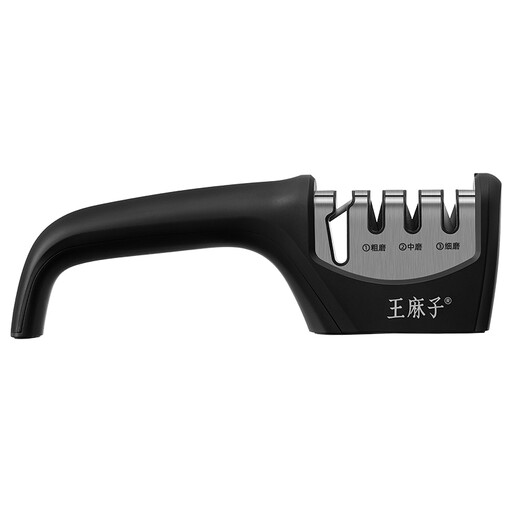
Why this product suits this profile: The four-in-one design is aimed at households that want to combine several functions in one compact manual knife sharpener.
The number of functions is clearly specified. Buyers can check which guide is intended for each blade before use.
Several applications in one device; designed for regular household use.
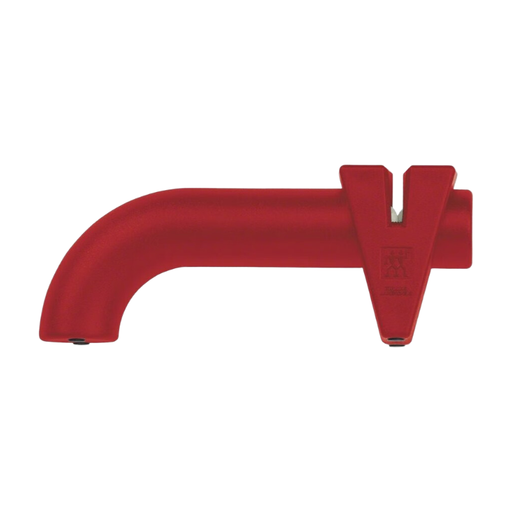
Why this product suits this profile: According to the product data, the compact ZWILLING knife sharpener combines stainless steel and ceramic discs with a preset guide.
The approximately 35° guide reduces the need to set the angle by hand. However, it is intended for plain blades and should not be used for serrated blades.
Two sharpening stages; 17 cm length and ABS plastic housing.
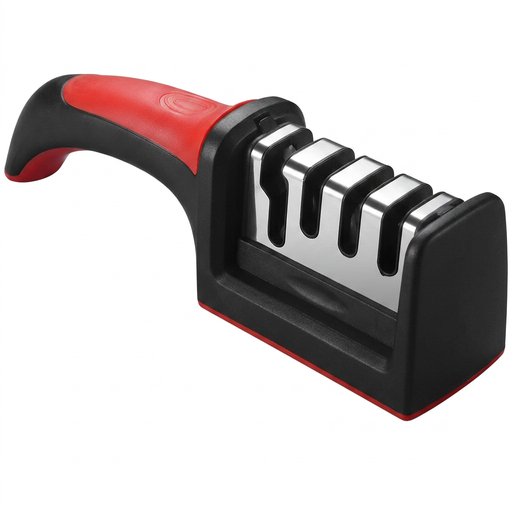
Why this product suits this profile: According to the description, the four clearly labelled slots cover coarse sharpening, fine finishing, scissors sharpening and polishing.
The separate stages help prevent coarse and fine sharpening from being confused. Before buying, check that you have enough space for it on your work surface.
Four sharpening or finishing guides; according to the description, designed to stand securely on the work surface.
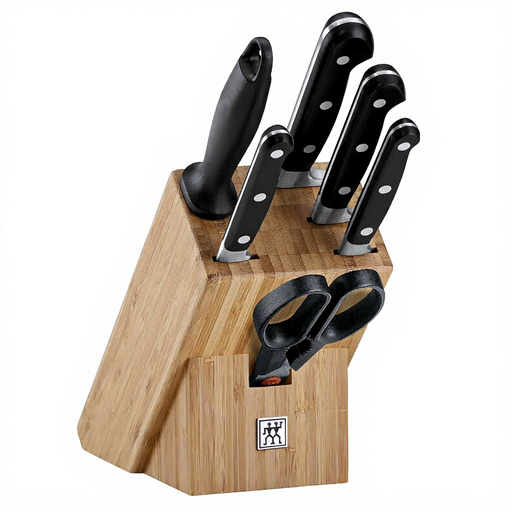
Why this product suits this profile: This set is aimed at buyers who want to purchase knives, kitchen scissors, a honing steel and storage together.
The contents are clearly listed: four knives, kitchen scissors, a honing steel and a bamboo block. This makes it easier to check whether all the parts you need are included.
Chef’s, bread, utility and paring knives; plus scissors, a honing steel and a knife block.
Place the knife sharpener on a stable, dry surface. Hold the handle securely, if there is one, and guide the blade through the guide as instructed in the product manual. Usually, the blade should be moved from the heel to the tip without applying heavy pressure. The number of passes depends on the condition of the edge and the manufacturer’s instructions.
Do not use a coarse stage every time you give a knife a quick touch-up. For regular maintenance, a fine stage may be sufficient on suitable devices. After sharpening, remove any metal particles as instructed and clean and dry the blade with warm water. Damaged knives with cracks, bent tips or loose handles should not be included in your normal sharpening routine.
A knife block with an integrated knife sharpener or honing steel provides secure storage and keeps everything close at hand. Even with knife sets, follow the care instructions: although some models are described as dishwasher-safe, hand washing is often recommended to help protect the materials for longer.
We have put together a complete, regularly updated list of products that fully meet these strict selection criteria and the safety regulations applicable in the EU.
This depends on the quality of the knife, the chopping board, how often it is used and the food being cut. If you cook regularly, it can be useful to check the cutting performance from time to time. For suitable blades, a honing steel is mainly used for maintenance and realignment; actual resharpening involving material removal is needed less often, depending on the condition of the edge.
Both systems have different requirements. A manual knife sharpener usually guides the blade more easily and consistently, provided the angle and blade shape are compatible. A whetstone for kitchen knives gives you greater control over the grit and angle, but requires practice. For beginners, it is particularly important to follow the instructions for the device in question.
Its lifespan depends on the sharpening material, frequency of use, pressure and cleaning. Wear can occur if coarse stages are used very frequently. Before buying, check the material specifications, the stability of the housing and the care instructions. A model should be replaced if the guides are damaged or no longer provide a secure grip.