
Lieferung heute & morgen

Qualitätsgarantie

Willkommens-Angebote freischalten: KOSTENLOSE Lieferung | Bis zu 80 % RABATT | Kostenlose 30-Tage-JoyPlus-Testphase
App herunterladen
Blunt kitchen knives make slicing, chopping and dicing more difficult. That is why many households look for a knife sharpener for kitchen knives that is easy to use and takes up little space. However, not every model is suitable for every blade. Some devices are designed only for straight edges, while others offer multiple stages or additional functions for scissors.
This buying guide from the Joybuy Product Recommendation Officer explains the key product features and shows which designs may suit different households, cooking habits and budgets.
A multi-stage knife sharpener can cover several steps: coarse grinding, sharpening and polishing. This is useful when a blade is heavily worn. For a knife that is maintained regularly, however, a model with one coarse and one fine stage is often sufficient.
The crucial question is whether the stages match the actual condition of your knives. A sophisticated system may be unnecessary for everyday use if you only need to sharpen your knives occasionally.
Many manual knife sharpeners guide the blade at a predetermined angle. This makes them easier to use, but limits the range of suitable knives. For example, the ZWILLING TWINSHARP specifies an angle of approximately 35°, which, according to the product description, is intended for knives with straight edges.
Before buying, you should therefore check:
Some devices advertise fast operation or versatile use. On its own, this says little about how practical the product is in everyday life. Instead, look for clear specifications such as the number of sharpening slots, materials used, dimensions and stability.
For a household knife sharpener, it is also important that the device sits securely on the worktop and can be cleaned easily after use.
A knife sharpener with ceramic and steel discs combines different materials for different sharpening steps. According to the product description, the ZWILLING TWINSHARP uses stainless-steel discs for coarse sharpening and ceramic discs for finer sharpening.
With four-stage devices, the functions may be separated even more clearly. According to the product description, the BJ 4-Stage Kitchen Knife Sharpener has four slots: a coarse slot for working on more heavily worn edges, a fine stage, a scissor-sharpening opening and a final polishing stage.
A knife sharpener for scissors requires an opening specifically designed for that purpose. A standard blade sharpener is not automatically suitable for kitchen scissors. If you want to maintain both knives and scissors with one device, this function should be clearly stated in the product specifications.
Serrated knives have different requirements from straight-edged blades. If the manufacturer provides no corresponding information, you should use the device only for straight-edged kitchen knives.
A manual knife sharpener does not require electricity and can be used directly in the kitchen. Models with a handle or stable base can make operation easier. Check whether the device requires sufficient space on your worktop and whether its dimensions suit your kitchen.
The ZWILLING TWINSHARP is specified as measuring 17 cm in length, with an ABS plastic housing and a weight of 0.131 kg. These are useful reference values that may matter when storing the device.
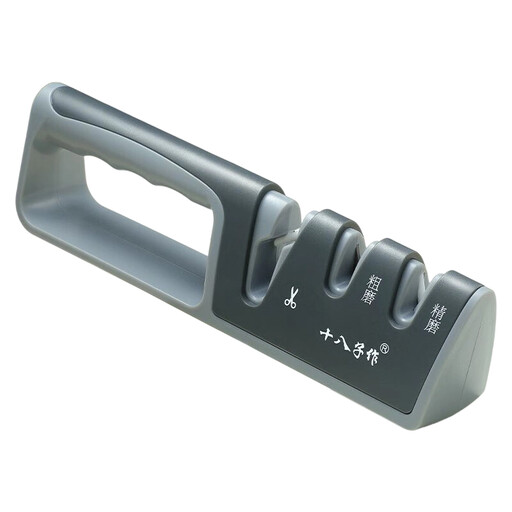
Why it is suitable: The product name indicates a compact household device with a single handle. It is aimed at users looking for a straightforward kitchen knife sharpener for regular use.
The product name clearly indicates its intended household use and manual operation. Information about scissor sharpening or multiple stages should be checked on the product page before buying.
The single handle and household-oriented design can keep everyday operation straightforward.
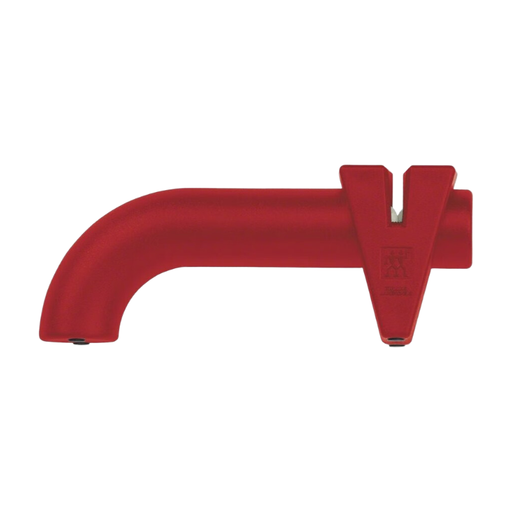
Why it is suitable: This model is worth considering for users who value precise material and size specifications and want to sharpen straight-edged kitchen knives at a fixed angle.
The specified angle of approximately 35° and suitability for straight edges clearly define its intended use. This makes compatibility easier to assess before buying.
ABS plastic housing, stainless-steel discs and ceramic discs; 17 cm length and 0.131 kg weight.
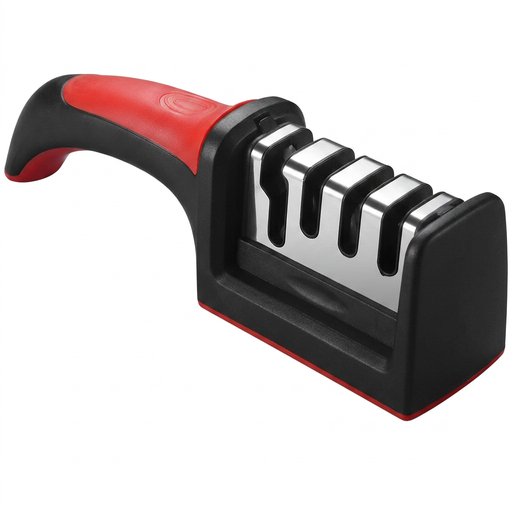
Why it is suitable: Four separate slots appeal to households that maintain knives in different conditions and also want to sharpen kitchen scissors.
Each function has its own slot: coarse sharpening, fine sharpening, scissors and polishing. This reduces the need to purchase a separate device for every step.
Four-stage configuration, dedicated scissor slot and, according to the product description, secure fixation on the worktop.
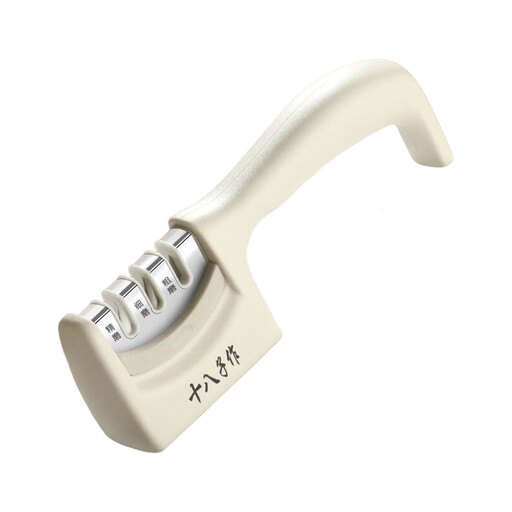
Why it is suitable: The “Three-Stage” designation is aimed at users who prefer a structured sharpening process with multiple stages for household use.
The three-stage design is clearly stated. Before ordering, buyers should check the individual stages, sharpening angle and compatibility with their knives.
Multi-stage configuration and single handle, according to the product name.
Place the device on a stable, dry worktop. Guide the blade through the designated slot according to the manufacturer’s instructions, without applying unnecessary pressure. With a multi-stage system, you generally begin with the coarse stage and then use the finer stage. The exact order depends on the specific product.
After sharpening a knife quickly, remove any metal residue and clean the device according to the care instructions. Do not use a blade sharpener for knives or scissors that the manufacturer does not list as compatible. For damaged, severely bent or specially ground blades, an individual assessment by a suitable specialist may be advisable.
In addition to kitchen knives, tools may also require maintenance. If you are interested in suitable products for sharpening woodworking tools, you can find more options in the Sharpening Woodworking Tools category.
This depends on how often the knife is used, the blade material, the cutting surface and how it is stored. If the knife is visibly cutting less effectively, a fine sharpening stage may be sufficient for regular maintenance. A heavily worn edge may initially require a coarse stage.
Only if the device explicitly features a scissor-sharpening slot. According to the product description, the BJ 4-Stage Kitchen Knife Sharpener has a dedicated scissor stage. For other models, check the product page before use.
A manual knife sharpener does not require electricity. Ongoing costs mainly result from purchasing the device and replacing worn sharpening elements. How long a model can be used depends on the frequency of use, the pressure applied and the material of the blades being sharpened.