
Lieferung heute & morgen

Qualitätsgarantie

Willkommens-Angebote freischalten: KOSTENLOSE Lieferung | Bis zu 80 % RABATT | Kostenlose 30-Tage-JoyPlus-Testphase
App herunterladen
A kitchen knife should cut food cleanly, feel secure in your hand and suit the way you work. But eye-catching product claims don’t always help you make the right choice. A long list of ingredients or a label such as “Damascus steel”, for example, tells you little about whether a knife is suitable for tomatoes, herbs, meat or hard-skinned produce.
Before buying kitchen knives, watch out for these three common pitfalls:
A chef’s knife with a blade around 18 to 22 cm long is suitable for preparing larger quantities of vegetables, herbs, meat and fish. If you prefer a more compact knife and a mainly up-and-down cutting action, a Santoku knife may be a good choice. The broad blade of a Santoku or Chinese chef’s knife can also be used to scoop up chopped ingredients.
A Chinese chef’s knife looks similar to a cleaver, but that doesn’t automatically make it suitable for chopping through bones. Check what it is designed for. For precise tasks such as peeling, trimming and garnishing, a paring knife or fruit knife with a blade around 8 to 11 cm long is easier to handle.
Serrated blades are useful for soft foods with firm skins. A tomato knife cuts through the skin without crushing the flesh too much. Serrated steak knives and pizza knives are designed for cutting through meat fibres and crisp pizza crusts, respectively.
Stainless steel is easy to care for and resistant to corrosion in everyday kitchen use. However, the exact steel composition, hardness and manufacturing process all affect how long the edge stays sharp. Claims such as FRIODUR, hardened stainless steel or special blade steel should always be considered alongside the care instructions.
A higher hardness rating can help an edge stay sharp for longer, but it doesn’t make it damage-proof. Hard surfaces such as glass, stone or ceramic can damage the blade. Use a suitable wooden or plastic chopping board, and don’t cut bones, frozen food or very hard objects unless the knife is specifically designed for them.
An ergonomic handle should feel secure in your hand when dry and allow you to make controlled cuts. A smooth join between the handle and blade can make cleaning easier, while rivets and the handle material can help provide stability.
Check the care instructions, too. Some of the Victorinox knives and WMF knives featured here are listed as dishwasher-safe. By contrast, hand-washing is recommended for the ZWILLING knives in the ranges featured here. Always follow the manufacturer’s instructions rather than relying on general claims about dishwasher suitability.
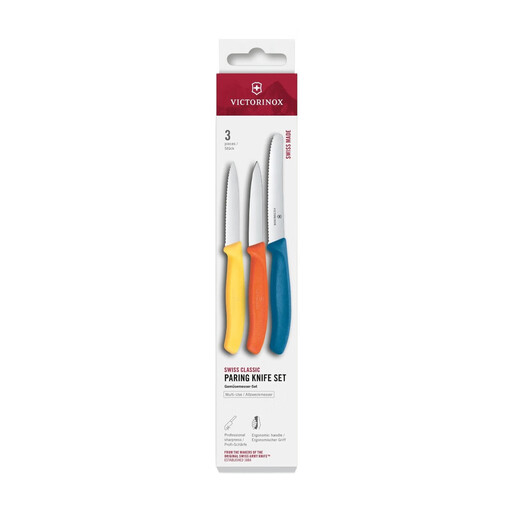
Why it suits this profile: Three 11 cm knives with straight, serrated and versatile edges cover everyday fruit and vegetable prep.
The set focuses on three distinct blade types rather than including lots of similar knives. The blades are made from stainless steel and the handles from polypropylene.
Straight and serrated blades, lightweight design and, according to the product details, dishwasher-safe.
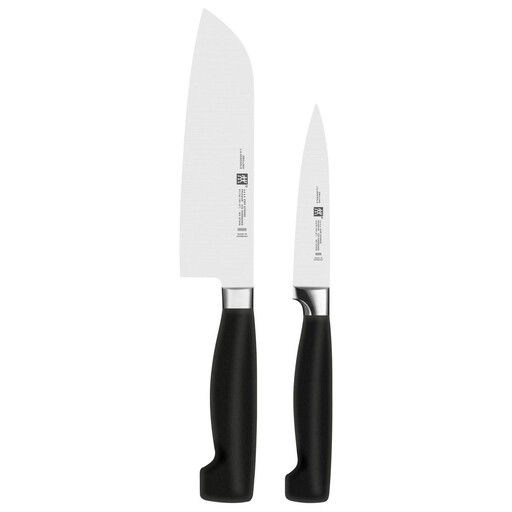
Why it suits this profile: This two-piece set pairs a 20 cm chef’s knife with a 10 cm paring knife for larger and more delicate cutting tasks.
The care instructions are clear: the set is not dishwasher-safe and should be washed by hand and dried straight away.
FRIODUR-hardened special steel, an ergonomic plastic handle and a stated hardness of 55–58 HRC.

Why it suits this profile: The broad blade is 18.5 cm long and 8 cm deep, making it suitable for preparing larger quantities of vegetables and herbs, as well as soft cuts of meat.
The product description clearly explains what the knife is and isn’t for: its blade is designed for slicing and chopping soft ingredients, not as an all-purpose tool for bones or hard objects.
A broad blade for scooping up ingredients, special stainless blade steel and a seamless, riveted plastic handle.
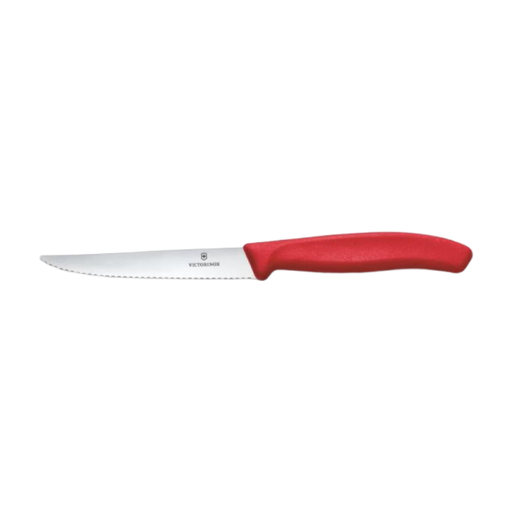
Why it suits this profile: This 11 cm knife is a useful addition to your existing kitchen knives if you often cut pizza, meat, bread or firm-skinned produce.
The serrated edge is designed for specific foods and is no substitute for a chef’s knife when finely chopping or cutting larger items.
Serrated stainless steel blade, ergonomic polypropylene handle and, according to the product details, dishwasher-safe.
We’ve put together a comprehensive, regularly updated list of products that meet these strict selection criteria and fully comply with the safety regulations applicable in the EU.
For everyday food preparation, a chef’s knife or Santoku knife, a small paring knife and a serrated knife for tomatoes, bread or pizza are often enough. A knife set is worth considering if the blades included are suited to different tasks.
It depends on the steel, cutting-edge angle, how often you use the knife and how well you care for it. Cutting on hard surfaces, contact with bones or storing a knife loose in a drawer can damage the edge more quickly. Sharpening it regularly and correctly, and using a suitable chopping board, can help it last longer.
Some models are listed as dishwasher-safe by the manufacturer, including certain Victorinox and WMF knives. Hand-washing is recommended for several ZWILLING knives. Always check the specific product description and dry the blade after cleaning.