
Lieferung heute & morgen

Qualitätsgarantie

Willkommens-Angebote freischalten: KOSTENLOSE Lieferung | Bis zu 80 % RABATT | Kostenlose 30-Tage-JoyPlus-Testphase
App herunterladen
A good kitchen knife needs to be more than just sharp. The blade shape, material, handle, care requirements and intended use all matter. If you focus only on glossy descriptions or the highest possible hardness rating, you could easily end up with a knife that’s impractical for everyday use.
A large chef’s knife is suitable for many cutting tasks, but it isn’t automatically the right choice for every ingredient. A nakiri knife or Santoku knife may be more comfortable for finely dicing vegetables. A paring knife is more manageable for peeling and preparing small ingredients.
A Chinese chef’s knife is also often mistaken for a cleaver. Its broad blade can be used to scoop up and transfer ingredients, but it isn’t designed for bones, frozen food or particularly hard materials. Check the manufacturer’s specific recommendations before buying.
Dishwasher-safe kitchen knives are more convenient to clean, but heat, detergents and contact with other cutlery can put extra strain on the blade and handle. Some models therefore come with a recommendation to wash them by hand, even if they’re dishwasher-safe.
The ZWILLING Gourmet Santoku Knife is one example. According to the product information, it’s dishwasher-safe, but hand washing is recommended to preserve the blade’s sharpness. It’s also a good idea to dry delicate or particularly sharp blades straight after washing.
How well a blade retains its edge depends on more than just the steel. The chopping board, cutting technique, storage and sharpening all affect how long it performs well. Glass, stone and metal boards can damage the edge. A sturdy wooden or suitable plastic chopping board is a good choice for home use.
These are the usual blade lengths for everyday food preparation:
A longer blade gives you more cutting surface, but it also needs more space and control. Smaller kitchens often benefit from a combination of a chef’s knife, a paring knife and a serrated knife.
A straight edge is suitable for precise cuts through vegetables, meat and herbs. A tomato knife or pizza cutter with a serrated edge, on the other hand, grips firm skins and soft centres without squashing the ingredient too much. Serrated blades are therefore handy for tomatoes, bread, sausages, cheese and crisp pizza.
Steak knives also often have a serrated edge. According to its product description, the Silit Trend Steak Knife Set has a serrated blade and is designed for steak, pizza and quiche.
Stainless steel is corrosion-resistant and easy to care for in everyday kitchen use. Terms such as ‘hardened’ and ‘ice-hardened’, or a hardness rating of 55–58 HRC, describe technical properties, but don’t tell you on their own how comfortable a knife will be to use.
Also look for:
Brand-name ranges such as WMF kitchen knives, ZWILLING kitchen knives and Victorinox kitchen knives can vary considerably from one series to another. So don’t rely on the brand name alone: check the blade length, edge and cleaning instructions too.
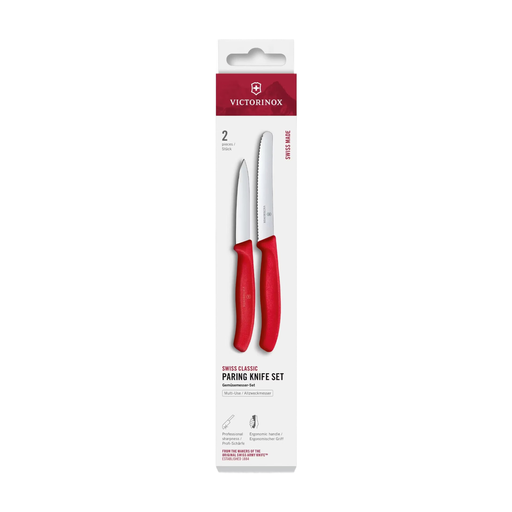
Why this product suits this profile: Two 11 cm blades, one straight and one serrated, handle small cutting tasks as well as fruit and vegetables.
The different blade edges mean you don’t have to rely on a single knife for every delicate task.
Stainless steel blades, ergonomic polypropylene handles and a dishwasher-safe design, according to the product information.
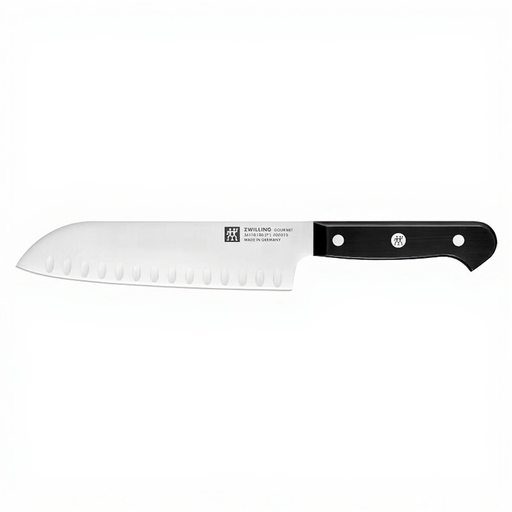
Why this product suits this profile: The 18 cm blade is designed for vegetables, meat and fish, making it suitable for many everyday food-preparation tasks.
The technical details clearly specify the blade length, steel, edge and care instructions, rather than relying on vague claims about sharpness.
FRIODUR ice-hardened stainless steel blade, V-edge and dishwasher-safe design according to the product information; hand washing is recommended to protect the blade.

Why this product suits this profile: The broad, 18.5 cm blade is useful for slicing and dicing, as well as transferring larger quantities of ingredients.
The description makes clear that the broad blade is not intended for heavy chopping through bones or frozen food, and specifies what it is designed for.
Specialist blade steel, an 8 cm blade depth, an ergonomic plastic handle and a broad surface for scooping up chopped ingredients.
We’ve put together a complete, regularly updated list of products that meet these strict selection criteria and fully comply with the safety regulations in force in the EU.
A chef’s knife or Santoku knife for larger cutting tasks, a paring knife for small ingredients and a serrated knife for bread and tomatoes will cover many everyday kitchen jobs. If you barbecue often, you could add a steak knife set.
They can make cleaning easier. However, hand washing with a mild detergent is often gentler and helps the blade keep its edge for longer. Always follow the care instructions for the specific model.
It depends on the steel, edge, chopping board, use and care. Regular sharpening suited to the blade material, along with safe storage, helps maintain its cutting performance for everyday use.