
Lieferung heute & morgen

Qualitätsgarantie

Willkommens-Angebote freischalten: KOSTENLOSE Lieferung | Bis zu 80 % RABATT | Kostenlose 30-Tage-JoyPlus-Testphase
App herunterladen
A kitchen knife should suit your cutting style, the ingredients you work with and how much care you’re prepared to give it. Yet product pages often lead to poor choices with claims such as “razor-sharp”, “Damascus” or “professional quality”. What matters is not just appearance or brand name, but clear information about blade shape, steel, dimensions, handle and care.
A sharp kitchen knife can cut precisely, but it needs a stable cutting surface and careful handling. A very thin or delicate edge isn’t automatically suitable for hard ingredients. Frozen food, bones or hard objects can damage the blade if the knife isn’t designed for them.
The term Damascus knife often refers to the visible pattern on the blade. It doesn’t automatically tell you about the quality of the steel, edge retention or care requirements. Buyers should also check which blade steel is used, whether the edge is single- or double-bevelled, and whether specific care advice is provided.
A large cleaver isn’t always comfortable for finely chopping herbs. Conversely, a small paring knife isn’t designed for large cuts of meat. Depending on its design, a Chinese chef’s knife may also be better suited to slicing and chopping than to breaking down bones. Decide what you’ll use the knife for before ordering.
Blade length affects reach and control. A 17 or 18 cm knife is easy to handle in many households. A broader 20 or 21 cm model offers more surface area, but may need more space on the chopping board.
The weight should suit your hand size and cutting style. A heavier cleaver helps with forceful cuts, while a lightweight Santoku may feel less tiring during longer food-preparation tasks. Balance between the blade and handle matters too. That’s why technical details such as overall length, blade thickness and weight are more useful than vague marketing claims.
With a stainless steel kitchen knife, corrosion resistance is a key consideration. However, not all stainless steel is the same. Details such as “FRIODUR-hardened stainless steel”, “50Cr steel” or “40Cr13” describe different material specifications and should be considered alongside the manufacturer’s care advice.
A double-bevelled V-edge is straightforward for many users, as the knife may be suitable for both right- and left-handed people. Single-bevel blades, as found on some Japanese knives, require more care when handling and sharpening.
Even if a knife is listed as dishwasher-safe, hand washing can help protect the edge and handle. Dry the blade straight after washing. A knife block, magnetic strip or blade guard is suitable for storage. Knives stored loose in a drawer can suffer damage to their edges and may pose a risk of injury.
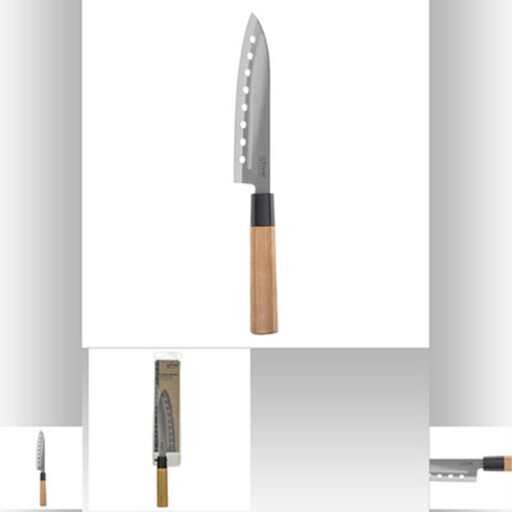
Why this product suits this profile: This Santoku knife handles everyday tasks such as slicing, dicing and chopping vegetables and proteins. Its handle is made from bamboo with a black finish.
The product description specifies the knife type, blade material and recommendation to hand wash it. This makes it easier to judge what it’s suited to than a simple claim about sharpness.
Versatile Santoku shape; stainless steel blade and ergonomically designed bamboo handle.
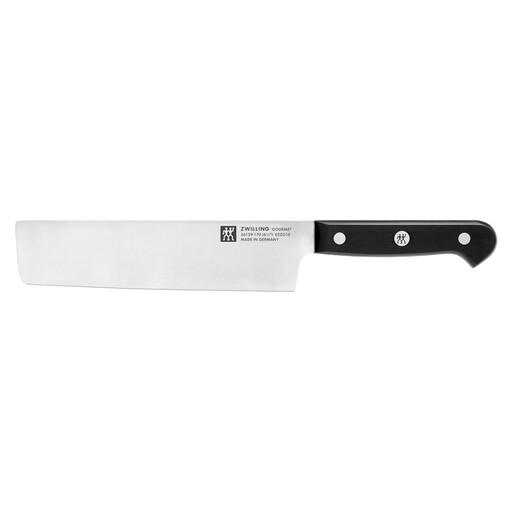
Why this product suits this profile: The straight edge and 17 cm blade are designed for vegetable preparation. According to the product details, the blade is made from FRIODUR-hardened special formula steel and has a V-edge of around 15 degrees per side.
The blade length, edge and material are clearly specified. That makes it easier to choose than relying on vague terms such as “premium blade”.
17 cm Nakiri blade; double-bevelled V-edge; three-rivet construction with a plastic handle.

Why this product suits this profile: According to the product details, the broad blade measures 18.5 × 8 cm. This makes it suitable for cutting and transferring prepared ingredients. The stated weight is 268 g.
The rectangular shape isn’t automatically classed as a cleaver. Buyers can check whether they’re looking for a broad knife for cutting vegetables, meat and herbs.
Broad 8 cm blade; corrosion-resistant special blade steel according to the product description; ergonomically shaped plastic handle with seamless rivets.
We’ve put together a complete, regularly updated list of products that meet these strict selection criteria and fully comply with the safety regulations in force in the EU.
A chef’s knife or Santoku with a blade around 17 to 20 cm long will cover a wide range of tasks. For vegetables, herbs, fish and meat, a versatile model is usually more practical than a highly specialised knife. If you often peel small ingredients or make decorative cuts, add a paring or vegetable knife.
How long the edge lasts depends on the steel, edge, how you use the knife, the chopping board and how you care for it. Glass or stone surfaces can put more strain on the edge. Using a suitable chopping board, hand washing and regular sharpening with the right tool can help keep the knife in good working order. It’s not possible to give a reliable fixed timeframe without knowing how the knife is used.
A kitchen knife set can be useful if it covers several clearly different tasks, such as slicing, peeling and chopping. Before buying, check whether you’ll actually use every knife in the set. A set with overlapping blades may be less practical than two carefully chosen kitchen knives.