
Lieferung heute & morgen

Qualitätsgarantie

Willkommens-Angebote freischalten: KOSTENLOSE Lieferung | Bis zu 80 % RABATT | Kostenlose 30-Tage-JoyPlus-Testphase
App herunterladen
A kitchen knife needs to do more in everyday use than simply look sharp. It should slice vegetables cleanly, chop herbs and, depending on the design, cut meat or fish too. At the same time, models can vary considerably in blade shape, handle, cleaning requirements and storage options.
However, typical purchasing decisions do not always lead to the right product. Three points deserve particular attention:
A stainless steel kitchen knife is more resistant to corrosion than many unprotected steel designs. However, “rust-free” does not mean that the knife requires no ongoing care. Acidic foods, moisture and harsh cleaning products can affect both the surface and the cutting edge.
Look out for the following information:
With a Damascus kitchen knife, you should also establish whether the description refers to a genuine multi-layer blade construction or merely a decorative pattern. Without specific material information, it is only possible to make a limited price comparison.
A kitchen knife with an ergonomic handle should feel secure in your hand and remain easy to control during repeated cuts. The shape, surface, weight and transition between the handle and blade are all relevant.
When choosing a knife for a UK household, we recommend:
Wooden handles should not be left in water for long periods and should generally not be placed in the dishwasher. Plastic handles are often easier to care for in this respect, provided the manufacturer’s instructions allow the relevant cleaning method.
A single chef’s knife can handle many tasks. A Santoku knife is also designed for slicing, chopping and mincing, and is often used with fruit, vegetables, fish and meat. A kitchen knife set can be useful if you need several blade shapes as well as kitchen scissors.
Before buying, consider the following:
Stone or ceramic chopping boards can blunt blades more quickly. Wooden or suitable plastic boards are gentler on the material for many kitchen knives. Loose knives in a drawer also increase the risk of cuts and can damage the blade.
The following models have been assigned to different requirements based on the available product information. Their suitability relates to the listed features and does not replace checking how the knife feels and handles for you personally.
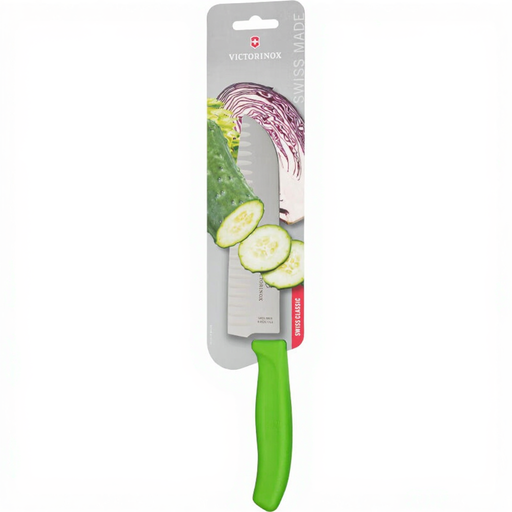
Why this product suits the profile: According to the product information, this Santoku knife has a compact 17 cm blade and is designed for slicing, chopping and mincing. Its weight is listed as 103 g.
The product page specifies the dimensions, weight, stainless steel blade, Granton edge and dishwasher suitability, rather than relying solely on promotional claims about sharpness.
17 cm blade length, stainless steel and thermoplastic handle; dishwasher-safe and rust-resistant according to the product information.
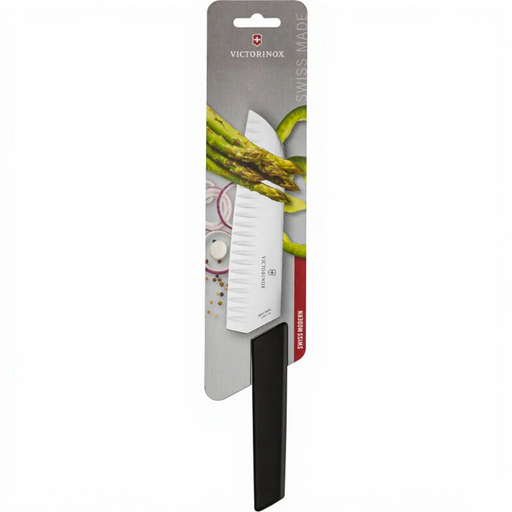
Why this product suits the profile: This model combines a 17 cm steel Santoku blade with a plastic handle and Granton edge. It is aimed at households that value clear product specifications and easy cleaning.
The blade length, material, edge design and cleaning suitability are clearly specified. This makes it easier to compare the model objectively with other kitchen knives.
Steel blade, Granton edge, plastic handle and dishwasher-safe design according to the product information.
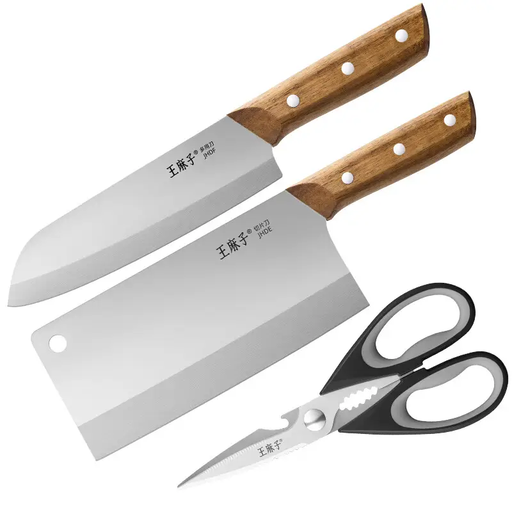
Why this product suits the profile: According to the description, this kitchen knife set includes a slicing knife, a multi-purpose knife and kitchen scissors. This makes it suitable for households with several everyday food preparation tasks.
Instead of relying on a single knife for every task, the 3-piece set divides different uses between several tools.
Three pieces comprising a slicing knife, multi-purpose knife and kitchen scissors; steel blades and Shenmu wood handles according to the description.
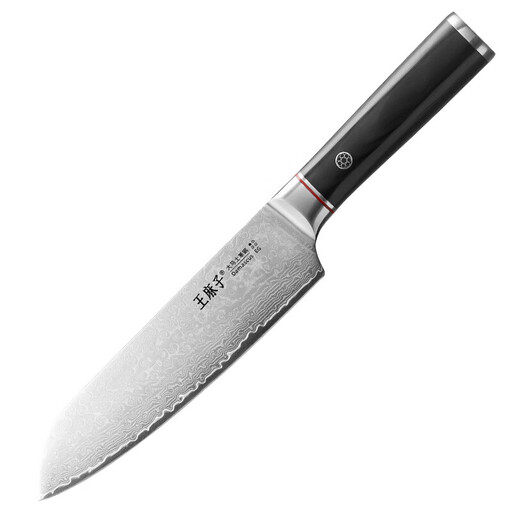
Why this product suits the profile: This model is marketed as a Damascus kitchen knife and multi-purpose knife for cutting meat and vegetables. It is intended for users who prefer a Santoku shape for handling different types of food.
Your choice should not be based solely on the blade pattern. Before buying, check the full details relating to the steel, grind, handle and care requirements.
Santoku shape and stated suitability for meat and vegetables; follow the product information for precise care instructions.
We have put together a complete, regularly updated list of products that fully meet these strict selection criteria and the safety regulations applicable in the EU.
Even a sharp kitchen knife needs regular care. Clean the blade as soon as possible after use, particularly after cutting acidic foods. Do not use abrasive or highly corrosive cleaning products, and dry the knife immediately.
Suitable storage options include:
Before each use, check that the handle and blade are firmly attached. Cut on a stable surface and guide the blade away from your body. Children should not have access to unsecured kitchen knives.
A chef’s knife or Santoku knife can be suitable for both types of food. The key factors are blade length, cutting technique and personal handling. If you frequently portion larger cuts of meat, a blade designed for that purpose may be more suitable than a small multi-purpose knife.
A 17 cm blade offers a compromise between reach and control. It is often suitable for vegetables, herbs, fish and smaller pieces of meat. However, whether this length is right for you depends on your hand size, chopping board and preferred way of working.
The edge life depends, among other things, on the steel, grind, chopping board, food being cut and care routine. Hard surfaces, incorrect cutting movements and loose storage in a drawer can affect the edge more quickly. A suitable honing steel or appropriate sharpening tool can help maintain cutting performance, provided it is compatible with the blade.