
Lieferung heute & morgen

Qualitätsgarantie

Willkommens-Angebote freischalten: KOSTENLOSE Lieferung | Bis zu 80 % RABATT | Kostenlose 30-Tage-JoyPlus-Testphase
App herunterladen
A kitchen machine needs to knead dough, mix ingredients, whip egg whites and ideally handle larger quantities too. In practice, however, several buying decisions can lead to unnecessary expense: a high wattage figure sounds convincing, but on its own it tells you very little about actual suitability. Similarly, a large bowl doesn’t automatically mean it’s designed for big batches of dough.
This buying guide from the Joybuy Product Recommendation Officer will help you put marketing claims into perspective and choose an electric kitchen machine that’s right for your household.
Motor power is often heavily promoted. Figures like 1,000 or 1,600 watts are only meaningful when considered alongside the gearbox, build quality and maximum dough capacity. Some manufacturers distinguish between nominal power and short-term peak power. For example, the monsga SM100 lists 1,000 watts peak power and 600 watts nominal power.
For yeast dough, wattage alone isn’t what counts. Also check whether the manufacturer states a maximum dough quantity and the recommended operating time.
A kitchen machine with a large bowl can be practical if you regularly prepare bread, cakes or pizza for several people. However, the capacity in litres doesn’t automatically describe the maximum permitted flour or dough quantity. With the monsga SM100, the bowl volume is 6 litres, but the product specification recommends using it up to 5 litres.
So pay attention to specific details on:
An extensive set of accessories is only worthwhile if you’ll actually use the attachments. For a kitchen machine for baking, the most important tools are a whisk, dough hook and flat beater. A meat grinder or blender attachment expands the possibilities, but also increases cleaning effort, storage space and purchase cost.
Also check whether spare parts and additional attachments are available for your specific model.
For cream, egg whites and light cake batters, a finely adjustable speed is helpful. When kneading bread or pizza dough, what matters more is a stable gearbox, a secure footing and the recommended maximum quantity. A kneading machine should be operated at low to medium speed, provided the instruction manual says so.
More speed settings allow finer adjustment, but they don’t replace the correct recipe quantity. A pulse function is useful for short, powerful bursts and shouldn’t be seen as a substitute for continuous operation.
Stainless steel bowls are robust, odour-resistant and generally easy to clean. A tilting head makes it easier to change the bowl and attachments. A splash guard is particularly handy with runny batters and at high speeds.
Before buying, measure the space you have available. A machine with a 5.5- or 7-litre bowl needs not only worktop space but also enough room to lift the head.
Look for a secure stand, bowl locking, overload or overheat protection, and automatic shut-off when the head is raised (if the model has this feature). The motor housing must never be immersed in water. Always unplug the appliance before changing accessories or cleaning.

Why this product fits the profile: The features focus on typical baking tasks, offering a 5-litre stainless steel bowl and ten speed settings.
The product details list not only motor power but also bowl size, speeds, overheat protection and recommended pauses during kneading.
5-litre bowl, ten speeds, pulse function, dough hook, whisk and flat beater.

Why this product fits the profile: This model combines an integrated scale, a 7- and 5-litre bowl, plus several baking tools for different quantities.
The actual features go beyond the wattage figure: EasyWeigh scale, variable speed control and DuoBowl system are all clearly specified.
1,200-watt motor, 7- and 5-litre bowls, integrated scale plus K-beater, dough hook, whisk and Flexi-stirrer.
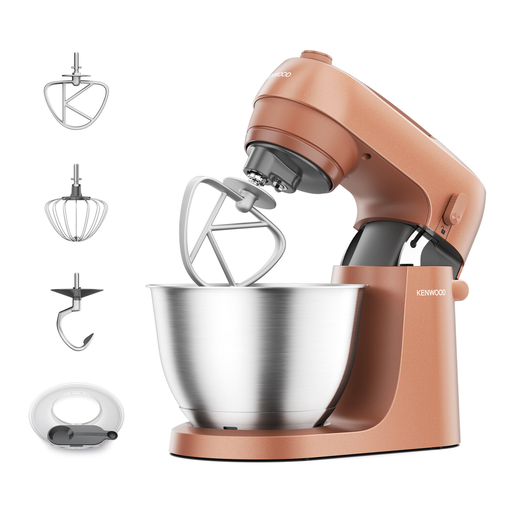
Why this product fits the profile: At 30 centimetres tall, with a 4-litre bowl and carry handle, this machine is designed for limited worktop and storage space.
The compact height and front controls are clearly specified. This makes it easier to assess the space needed before buying.
4-litre stainless steel bowl, 800-watt motor, six speeds, pulse function and three essential baking attachments.

Why this product fits the profile: This model is aimed at households that want to use a meat grinder and blender attachment alongside mixing and kneading.
The added value lies in the clearly listed attachments. However, before buying you should still check whether you have enough storage space for all the functions.
6-quart bowl, up to 1,300 watts according to the product specification, eight speed settings plus meat grinder and mixing container.
We’ve put together a complete, regularly updated list of products that fully meet these strict selection criteria and the safety regulations in force in the EU.
For bread and cakes, the model should have a dough hook, a whisk and a flat beater. A bowl with 5 to 7 litres gives families enough room, as long as you keep an eye on the permitted dough quantity. For heavy yeast doughs, stable feet and a clearly stated maximum dough quantity are more important than a high wattage figure alone.
The lifespan depends on the gearbox, materials, how often you use it and how well you look after it. Overloading, using too much dough and running it for long periods without a break can strain the motor. Clean the removable parts according to the instructions, keep the ventilation openings clear and let the appliance cool down between demanding kneading sessions.
Electricity consumption depends on the nominal power and the actual running time. A machine with a higher wattage will generally use more energy for the same operating time, but it won’t necessarily run for longer or more efficiently. So what really matters for your running costs is how often and for how long you use the kitchen machine.