
Lieferung heute & morgen

Qualitätsgarantie

Willkommens-Angebote freischalten: KOSTENLOSE Lieferung | Bis zu 80 % RABATT | Kostenlose 30-Tage-JoyPlus-Testphase
App herunterladen
A microwave shelf for the kitchen can free up worktop space and keep your appliances neatly organised. But not every model will fit every microwave, worktop or ceiling height. In smaller kitchens in particular, unclear dimensions, unstable designs or hard-to-reach shelves can quickly lead to a disappointing purchase.
This buying guide explains what to look for in a microwave stand, a kitchen shelf for your microwave and additional storage. Our selection is based on clear product specifications, not sweeping marketing claims.
When planning, it’s not just the microwave’s width that matters. You’ll also need to consider its depth and height, how the door opens and the clearance from walls. A shelf with a depth of 40 cm may be deep enough for a large appliance, but the back edge could stick out if your microwave is particularly deep. You should also leave enough clearance around the appliance, as specified in the manufacturer’s instructions.
Before buying, measure:
A metallic finish or a high stated load capacity is no substitute for a well-designed frame. Uneven floors, unevenly distributed weight or a lack of bracing can make a freestanding kitchen shelf wobble. Taller models should be used with an anti-tip restraint, if one is provided.
Look for adjustable feet, cross-bracing or diagonal supports, and make sure the shelf stands on a level surface. Heavy appliances should go on a shelf that’s designed to support them, preferably on a lower level. Never exceed the stated load capacity.
A kitchen organiser with hooks, a spice rack, a basket or a kitchen roll holder can be useful. What matters, though, is whether these features are easy to reach in your day-to-day routine. A wine rack, for example, won’t be much help if you only want to store cooking utensils. For pull-out baskets, also check that there’s enough room to pull them out to the side and forwards.
A worktop shelf needs different dimensions from a tall freestanding unit. For a single microwave, a two-tier shelf that sits on the worktop is often enough. If you also want to store a toaster, air fryer, crockery or groceries, a multi-tier model may be a better choice.
An adjustable microwave shelf offers more flexibility, but make sure it locks securely in place once adjusted. With extendable models, check whether the stated width covers the full adjustment range or just the base width.
Powder-coated or rust-resistant steel is generally suitable for the kitchen, provided the finish stays intact and moisture is wiped away regularly. Coated wood-based materials such as MDF with a melamine finish can be easy to care for. Terms such as water-repellent, scratch-resistant or E1 wood-based material describe specific material properties; they don’t guarantee an unlimited lifespan.
A damp cloth is all you need to clean the products featured here. Avoid harsh cleaners, standing water and prolonged exposure to steam.
The load capacity needs to be suitable for your microwave and any accessories you plan to store. For example, a two-tier spice rack may be rated to hold up to 10 kg per tier. That doesn’t automatically mean another model can support the same load.
Useful safety features include:

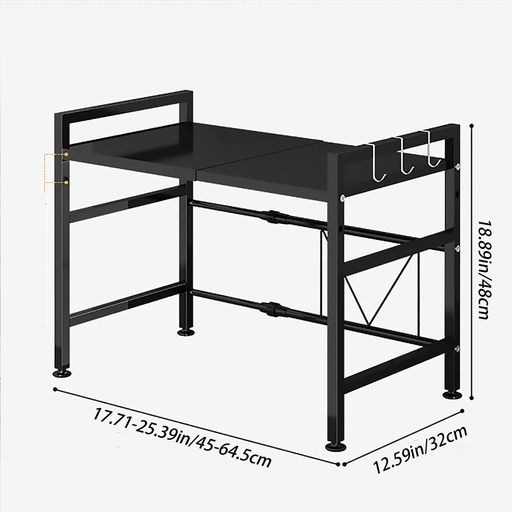
Why it suits this profile: This two-tier model adjusts from 39 to 62 cm wide, making it a flexible choice for households that want to make the most of their worktop space.
The adjustable width reduces the risk of buying a shelf that’s too wide or too narrow. Five hooks provide extra storage without taking up more shelf space.
Powder-coated carbon steel, two tiers, adjustable width from 39–62 cm and five integrated hooks.

Why it suits this profile: This tall freestanding shelf is designed for households looking to organise a microwave and several kitchen essentials vertically.
The product details specify X-shaped and diagonal braces, adjustable feet and anti-tip protection. These are practical stability features to bear in mind during assembly.
Four tiers, measuring 80 × 40 × 168 cm, ten S-hooks, a pull-out basket, a kitchen roll holder and a wine rack.
Why it suits this profile: This modular design is for anyone who wants to organise pots, pans, chopping boards and lids flexibly in a cupboard or kitchen work area.
Eight adjustable tiers and three assembly options let you tailor it to different storage needs. U-shaped grooves with silicone pads are designed to hold pan lids.
Black-coated iron, two organisers in the set, eight tiers and versatile use as a pan lid holder or kitchen shelf.
We’ve put together a complete, regularly updated list of products that meet these strict selection criteria and the applicable EU safety regulations.
Place your microwave shelf on a firm, level surface only. After assembly, check all screw connections and adjust the feet if the shelf wobbles. On taller models, make sure the supplied anti-tip restraint is fitted. Heat, steam and spilled liquids can affect surfaces and finishes, so wipe up any moisture promptly.
Position a spice rack or a kitchen shelf with hooks so that frequently used items are easy to reach. Heavy pans should go on a stable shelf with a suitable load capacity. Keep small assembly parts away from children while putting the shelf together.
It depends on the model and the microwave. As well as the shelf’s external dimensions, allow for safety clearances, the door opening, the cable route and the depth of the worktop. If you have an adjustable model, make sure the selected width is securely locked in place.
Yes, provided the shelf can support its weight and dimensions, and stands securely on a level surface. Always follow the ventilation and positioning guidance in the microwave’s instructions. Don’t overload the shelf.
There’s no reliable one-size-fits-all answer. Lifespan depends on the material, assembly, load, moisture and care. Rust-resistant metal frames, intact finishes and regularly checked fixings can help extend its useful life. If you notice visible distortion, rust or loose parts, stop using the shelf to support a load.