
Lieferung heute & morgen

Qualitätsgarantie

Willkommens-Angebote freischalten: KOSTENLOSE Lieferung | Bis zu 80 % RABATT | Kostenlose 30-Tage-JoyPlus-Testphase
App herunterladen
The search for the right kitchen mixer can quickly become overwhelming. Manufacturers advertise high wattages, countless accessories, and lofty promises. But not every expensive appliance is worth the money, and many budget-friendly models turn out to be short-lived disappointments. As a Joybuy Product Recommendation Officer, I'm here to help you distinguish marketing hype from genuine performance features. This guide will show you the most common purchasing traps and the crucial criteria for making an informed choice.
Before we dive into the technical details, let's look at the three most common reasons why many buyers are dissatisfied with their new appliance.
The Wattage Trap: More Power Isn't Always Better A high wattage is often used as the main selling point for a powerful mixer. In practice, however, raw motor power is only half the story. A poorly designed gearbox or inefficient blades can let that power go to waste. A 600-watt model from a reputable brand with high-quality components can significantly outperform a cheap 1200-watt mixer in both blending performance and durability.
The "All-in-One" Promise Appliances that claim to mix, knead, chop, and juice sound tempting. However, they are often a compromise: the core function, whether it's blending or kneading, suffers due to the multitude of tasks. Such a multi-function device might be a mediocre immersion blender, a weak hand mixer, and an inadequate dough machine all in one.
Neglected Cleaning and Handling A mixer with fixed parts, inaccessible blades, or non-dishwasher-safe accessories quickly becomes a chore. If cleaning the appliance after each use is more complicated than the preparation itself, it will quickly end up gathering dust in a cupboard.
To avoid the pitfalls mentioned above, you should focus on three objective core parameters. These determine the actual performance and everyday usability of your appliance.
Instead of just looking at the wattage, the quality of the motor and power transmission is crucial. A motor with copper windings is generally more durable and efficient than one with aluminium windings. For a stand mixer with a bowl, a planetary mixing action is a clear sign of quality. It ensures that the attachments not only rotate on their own axis but also travel along the edge of the bowl, incorporating all ingredients evenly.
The longevity and safety of a mixer depend directly on the materials used.
Consider what tasks your mixer will primarily perform.
Based on the criteria above, we have put together a selection of appliances that are well-suited for specific profiles in UK households.
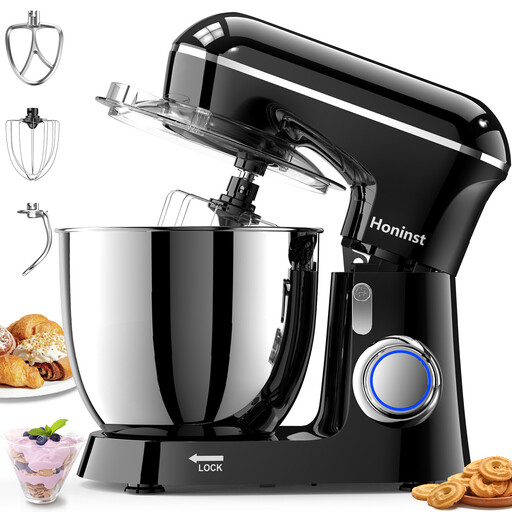
Why it's a good fit: Ideal for anyone who regularly makes bread, cake, or pizza dough. The large 6.5-quart bowl (approx. 6.2 litres) and planetary mixing action handle even large batches of dough reliably and evenly.
This appliance is a specialised dough machine, not a weak jack-of-all-trades. The power is efficiently transferred to the dough via the planetary mixing system.
Large capacity stainless steel bowl; 10 speed settings for precise control; Includes dough hook, flat beater, and whisk.
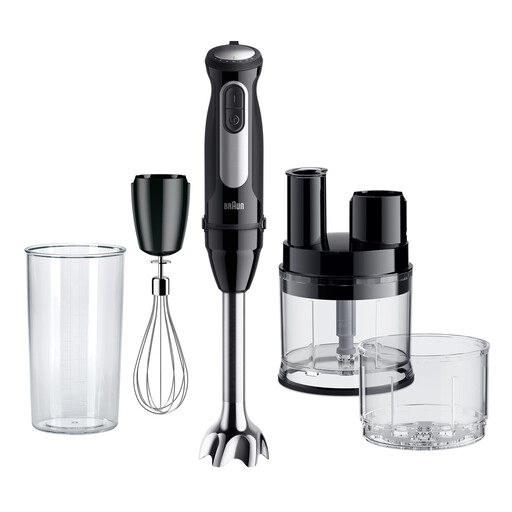
Why it's a good fit: For anyone who needs a flexible tool for soups, dips, baby food, and light batters. This immersion blender set is ready to use in seconds, space-saving, and easy to clean.
Instead of being a weak all-rounder, this set offers a modular system (EasyClick Plus) where each attachment is optimised for its specific task. The dishwasher-safe parts solve the cleaning problem.
Powerful 1000-watt motor; SplashControl technology to prevent messes; Comprehensive accessory set including a chopper and whisk.
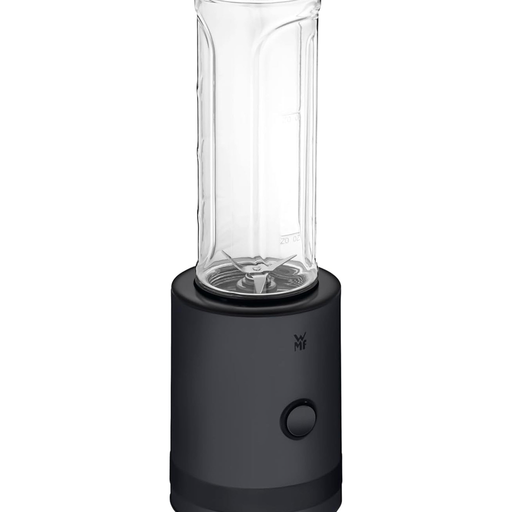
Why it's a good fit: Perfect for professionals or singles who want to make fresh smoothies quickly and easily. The blending jar doubles as a leak-proof travel bottle.
This appliance focuses on a single task—making smoothies—and excels at it. The simple design makes cleaning extremely quick and easy.
Compact design made of Cromargan stainless steel; Two dishwasher-safe to-go bottles (0.6 L) made of BPA-free Tritan; 4-pronged stainless steel blade, also suitable for crushing ice.
We've compiled a complete, up-to-date list of products that fully meet these strict selection criteria and UK safety regulations.
For most everyday tasks like puréeing soups or making smoothies, an immersion blender or stand blender with a motor power between 400 and 800 watts is perfectly sufficient, provided the components are high quality. For regularly kneading heavy doughs in a stand mixer, models from 1000 watts upwards are recommended, although the efficiency of the gearbox also plays a role here.
This depends on the material of the blending jar. Jars made of glass or heat-resistant, BPA-free plastic (like Tritan) are generally suitable for hot liquids. With cheap plastic jars, there is a risk that they could warp or release chemicals. Always let very hot soups (above 80°C) cool for a few minutes before blending to minimise pressure buildup in the container, and read the manufacturer's instructions.
The quickest method for a stand blender is self-cleaning: fill the jar halfway with warm water and a drop of washing-up liquid, then run it on the highest setting for 30 seconds. Rinse afterwards. For an immersion blender, the blending shaft and attachments should be detachable and dishwasher-safe. This simplifies cleaning significantly and ensures better hygiene.