
Lieferung heute & morgen

Qualitätsgarantie

Willkommens-Angebote freischalten: KOSTENLOSE Lieferung | Bis zu 80 % RABATT | Kostenlose 30-Tage-JoyPlus-Testphase
App herunterladen
A kitchen mixer should work reliably every day – whether you are chopping vegetables, blending smoothies, whipping cream or kneading dough. However, many purchasing decisions go wrong not because of insufficient power, but because of unsuitable designs and unclear manufacturer specifications.
Typical pitfalls include:
The appliance categories mainly differ in terms of their intended tasks:
If you regularly prepare bread, pizza or yeast dough, choose a mixer for kneading with suitable dough hooks and a stable bowl. For frozen fruit or ice cubes, however, the blade design, pulse function and explicitly stated ice-crush function are more important.
Wattage provides a useful indication, but it is not the only measure of quality. Smaller motors are often sufficient for light mixing tasks. When kneading heavy doughs, the manufacturer should provide specific quantity and time recommendations.
A mixer with several speed settings allows you to adapt the appliance more effectively to different ingredients. A low setting is suitable for combining ingredients, while higher settings are ideal for whipping. A pulse or turbo function can provide short bursts of power, but should not be confused with continuous operation.
A 0.6-litre container is often sufficient for individual portions. Families are more likely to benefit from a 1.2- to 1.5-litre blender. Food processors commonly have capacities of 4 to 6 litres. The recommended usable capacity is important, as the stated maximum capacity does not always correspond to the practically usable quantity.
A mixer with stainless steel bowl provides a durable mixing bowl and is well suited to baking ingredients. With plastic containers, users should look for a clear measurement scale, sturdy closures and clearly stated material suitability.
On many appliances, safety locks prevent operation if the container or attachment has not been fitted correctly. Rubberised feet or suction cups reduce slipping on smooth worktops. The motor housing should not be immersed in water; removable parts must be cleaned according to the instructions.
Particular care is required when handling sharp blades. Before changing attachments and before cleaning, disconnect the appliance from the mains.
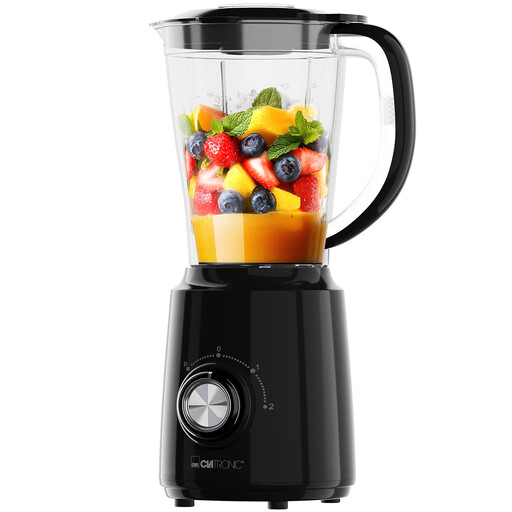
Why this product suits the profile: This versatile blender handles everyday tasks such as smoothies, sauces, soups and baby food without being designed as a food processor.
The product description specifies a 1.5-litre capacity, four stainless steel blades, three speed settings plus a pulse/turbo function and an ice-crush function.
Removable container with measurement scale and removable blades; BPA-free container according to the product description.
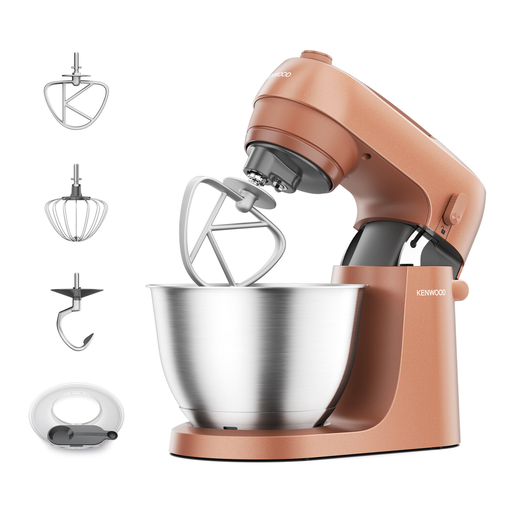
Why this product suits the profile: This compact food processor is aimed at keen home bakers looking for a stirring and kneading solution that takes up a manageable amount of space.
The stated height of 30 cm makes it easier to store beneath wall cabinets. The maximum quantities for cake and bread dough are clearly specified.
4-litre stainless steel bowl, 800-watt rating, six speed settings, pulse function, plus a K-beater, whisk and dough hook.
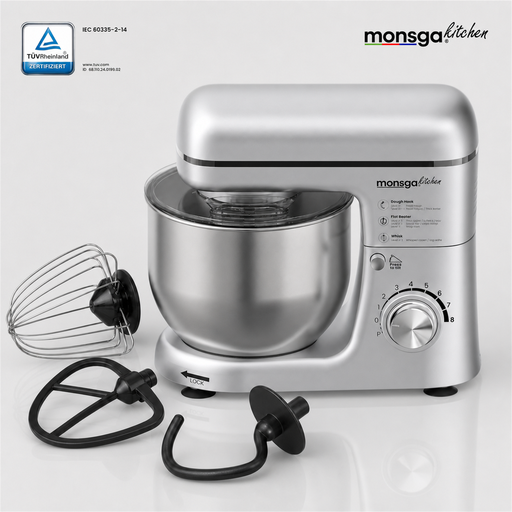
Why this product suits the profile: The large bowl and selection of dough hook, flat beater and whisk are well suited to families and people who bake frequently.
The description distinguishes between a maximum volume of 6.0 litres and recommended use of up to 5.0 litres. This makes it easier to plan realistic quantities.
6-litre stainless steel bowl, eight speed settings, tilting motor head and dishwasher-safe accessories according to the product description.
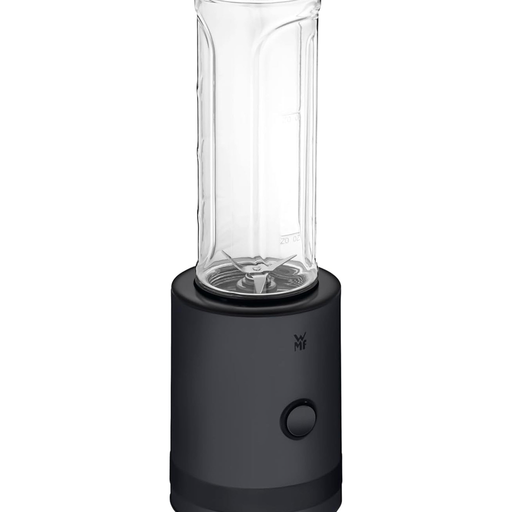
Why this product suits the profile: Two 0.6-litre containers with drinking lids are designed for individual smoothies and taking them with you.
The capacity is clearly limited to individual portions. This prevents a compact appliance from accidentally being treated as a family blender.
300 watts, four stainless steel blades, two drinking containers and dishwasher-safe containers according to the product description.
We have put together a complete, regularly updated list of products that fully meet these strict selection criteria and the safety regulations applicable in the EU.
For regular kneading, a food processor with dough hooks and a bowl is usually more suitable than a blender or small hand mixer. Look for the recommended dough quantity, low speed settings and a stable construction. The maximum operating time should comply with the instructions.
There is no single ideal wattage. Compact appliances may be sufficient for smoothies and sauces. For heavy doughs, the gearbox, dough hooks, bowl size and permitted dough quantity are also important. The power rating should therefore always be considered alongside the other technical specifications.
Its lifespan depends on usage, cleaning, workload and compliance with the manufacturer’s specifications. Overfilling, continuous operation at high speed and unsuitable ingredients can put additional strain on the motor and blades. The appliance should be cleaned after every use, dried thoroughly and stored in a dry place.