Bakers making small batches of biscuits
If you want to weigh chocolate in grams for a single batch, a clear display and suitable increments are important things to consider.


For a small batch of biscuits, a clearly readable scale that shows grams and has a tare function is usually enough, as long as the bowl and ingredients are within the maximum capacity. Finer increments matter mainly if your recipe actually calls for quantities of less than one gram; on their own, they don’t prove that a scale is more accurate.
If you want to weigh chocolate in grams for a single batch, a clear display and suitable increments are important things to consider.
If you add several ingredients to the same container one after another, a tare function makes it easier to weigh each one. Make sure the bowl and its contents stay within the maximum capacity.
If a recipe calls for ingredients weighing less than one gram, finer increments may be useful. Also check that the container and ingredients fit on the weighing platform.
For chocolate in a small batch of biscuits, a clear gram display and a suitable bowl are particularly important. Finer increments matter most when a recipe calls for quantities of less than one gram.
| Consideration | What to check before buying | Who is this important to? |
|---|---|---|
| Gram increments | Check that the recipe quantity is compatible with the increments and stated measuring range of the specific model; consider the increments and measurement deviation separately. | If I want to weigh chocolate according to a recipe, a clear display matters to me. Around 36 % of consumers prioritise getting the portion size right. |
| Weighing ingredients in a container | Check that you can reach the tare button with the bowl in place and that the total weight stays within the maximum capacity. | If I want to weigh chocolate and other ingredients in the same bowl, a tare function is important to me. Around 29 % of consumers focus above all on weighing ingredients in a container. |
| Bowl, display and storage | Compare the bowl’s dimensions with the weighing platform and check that the display remains visible while weighing. | If my bowl might obscure the display or storage space is limited, I look at the platform size and height. Around 21 % of consumers prioritise a good fit and easy-to-read display. |
| Care and everyday use | Check the power supply, what’s included and the cleaning instructions for the specific model version. | If I only use the scale occasionally, I want battery changes and cleaning to be straightforward. Around 14 % of consumers prioritise ease of use and manageable ongoing costs. |
The display increment alone doesn’t tell you how far a reading may be from the actual weight.
Check the increments, stated measuring range and any available information about measurement deviation separately.
The bowl and ingredients both add to the load on the scale. A bowl in place may also obscure the display.
Compare your bowl’s dimensions with the weighing platform and display position of the specific model.
An app or a high maximum capacity may not offer any practical benefit when you’re simply weighing chocolate.
First, choose a scale to suit the recipe quantity, your bowl and the features you’ll actually use.
The Optiss BC50U0 is worth considering if you want to read small quantities in grams.
The KS 19 Pure White is a slim option, while the KS 36 is designed for weighing tasks that need finer increments.
The Cleo KE1714 is an option if you want to weigh ingredients on a glass platform.
The digital kitchen scale, with a 20 × 20 cm weighing platform, could be a good choice for a wider bowl.
The SCORE 21930 combines a kitchen scale with an optional nutritional information app.
This selection includes digital scales for kitchen and baking use; one model is specifically described as a coffee scale. For each option, check that the recipe quantity, bowl and display suit the way you plan to use it.
 No image available
The product title mentions use in the kitchen, for baking and for cooking; the scale is also specifically described as a coffee scale.
The title lists a timer, flow rate display and switching between ounces and kg.
 No image available
The tare function is useful when weighing several ingredients one after another in the same container.
The product description lists increments of 1 g and a maximum capacity of 5 kg.
 No image available
The tare function can be useful when weighing ingredients in the same container.
The product title lists 1 g increments, a maximum capacity of 5,000 g and the units g, ml, oz, lb and fl. The 1 g increment alone doesn’t indicate measurement deviation.
 No image available
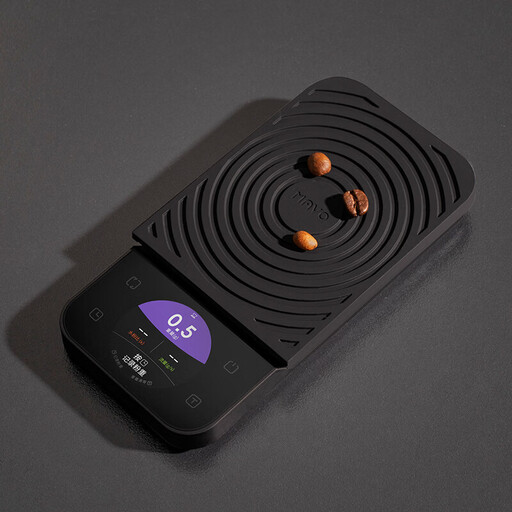
The product description mentions weighing in the kitchen, while the title also highlights coffee preparation.
The description lists an LED touchscreen, a timer and a flow rate display.
 No image available
The removable bowl is a handy option if you want to weigh ingredients directly in a container.
The product description lists a maximum capacity of 5,000 g and dimensions of 20.5 × 18 × 4.5 cm.
Put a suitable container on the scale, tare it to zero and add chocolate until you reach the quantity in grams specified in the recipe. If you tare again afterwards, keep an eye on the total weight of the container and the ingredients already added.
Not just because it has smaller increments. First, compare the quantities in your recipe. A precision scale such as the Beurer KS 36 is more relevant if you also want to weigh ingredients weighing less than one gram. Increments and actual measurement deviation are different things.
Don’t assume it’s dishwasher-safe: WMF explicitly states that the model mentioned isn’t dishwasher-safe, and GEFU says the same about the SCORE. Follow the cleaning instructions for your specific model version.
The seller, not the manufacturer, is generally responsible for putting faults right, as explained by the Verbraucherzentrale. It states that faulty goods are covered by a two-year period and that separate repair rules apply to purchases made from 31 July 2026. Germany’s Federal Ministry for the Environment points out that used batteries must not be put in household waste; waste electrical equipment must also be taken to an authorised collection point.
No. Germany’s Federal Network Agency describes the CE marking as the manufacturer’s declaration that applicable requirements have been met, not as an independent comparison of weighing accuracy.