Bakers using small amounts of salt
If you’re weighing a small amount of salt for a recipe, compare the graduation and minimum weight, and check whether a suitable container will fit on the weighing platform.


Choose a scale based on the smallest amount of salt you need to weigh and the total weight of the bowl and ingredients. A precision scale is suitable for small quantities, while a larger kitchen scale is better for weighing ingredients into a bowl. A combination scale can cover both ranges. The tare function and a clear display can make it easier to weigh ingredients together, but a built-in timer does not demonstrate shared schedule synchronisation. The stated graduation is not an independent accuracy test.
If you’re weighing a small amount of salt for a recipe, compare the graduation and minimum weight, and check whether a suitable container will fit on the weighing platform.
If you’re adding ingredients to a bowl one after another, clear tare controls, enough room for the bowl and an easy-to-read display can help you work in sync.
If you switch between small amounts of salt and heavier dough batches, or want to time each step, check the weighing capacity and timer function separately.
For this baking and ingredient-weighing scenario, it’s important to consider small amounts of salt, the weight of the bowl, ease of use and timing separately.
Suitable if: small amounts of salt are your priority and you can weigh them separately in a suitable container. Beurer states that the KS 36 has a graduation of 0.1 g and a maximum capacity of 2 kg.
Trade-off: According to Beurer, the KS 36’s weighing platform measures 11.5 × 8.0 cm, so it may not be suitable for a large mixing bowl.
Suitable if: you’re weighing ingredients into a larger bowl and whole grams are precise enough. WMF lists tare, a 23 × 15 cm weighing platform and a maximum capacity of 5 kg for model CMMF 3201000339.
Trade-off: According to the manufacturer, the WMF model displays measurements in 1 g increments, so it’s not the finer option for quantities below a whole gram.
Suitable if: you want to weigh small amounts of salt and a heavier bowl of dough using one device. CASO states that the KitchenDuo has a precision range up to 1 kg in 0.1 g increments and a standard range up to 15 kg in 1 g increments.
Trade-off: The graduation depends on the selected weighing range; the manufacturer’s specifications are no substitute for an independent accuracy test.
Suitable if: you want to time a single step directly on the device. GEFU states that the PREZISO has a timing function of up to 19:59 minutes.
Trade-off: The timer function does not demonstrate that a schedule can be shared between several people.
| Priority | What to check when buying | Who is this important for? |
|---|---|---|
| Small amounts of salt | Compare the recipe quantity, graduation, minimum weight and space for a salt container. GEFU states that the PREZISO has a minimum weight of 1 g and measures in 0.1 g increments up to 1 kg; above that, it measures in gram increments. | If I’m weighing only a small amount of salt, I want to choose a suitable graduation and weighing range. Around 36% of consumers prioritise weighing small amounts of salt. |
| Weighing ingredients together | Check the tare controls, display position and container size; agree who will keep track of the salt being added. | When baking together, I want to be able to tell whether the display shows an individual addition or the total weight. Around 29% of consumers prioritise being able to follow the weighing process together. |
| Quantities of different sizes | Compare the total weight of the bowl and ingredients with the graduation in the relevant range. CASO lists different precision and standard ranges for the KitchenDuo. | If I switch between a small amount of salt and a heavier batch of dough, I want the scale to handle both tasks. Around 21% of consumers prioritise weighing different-sized quantities. |
| Timing steps together | Distinguish between a timer on the device and confirmed synchronisation between people. GEFU states that the PREZISO has a timer of up to 19:59 minutes. | If I want to time a step, I check whether a timer on the device is enough or whether we need to organise a shared schedule separately. Around 14% of consumers prioritise timing steps. |
The graduation describes the increments shown on the display; it doesn’t, by itself, tell you the actual measurement deviation for your amount of salt.
Also compare the minimum weight and weighing range, and consider the container you plan to use. Only rely on claims about measuring accuracy if they’re based on a test of the specific model.
The bowl and ingredients both contribute to the total load. A small precision scale may be suitable for salt in a lightweight container, but not necessarily for the whole bowl of dough.
Compare the total weight with the maximum capacity, then decide whether to weigh small quantities separately or choose a suitable range for the bowl.
The GEFU PREZISO is listed as having a timing function, but this does not demonstrate that tasks or appointments can be synchronised between people.
Agree responsibilities and timings separately. Rely on a shared planning feature only if it’s explicitly described for the specific model.
CASO states that the three AAA batteries required for the KitchenDuo are not included. GEFU recommends cleaning the PREZISO gently and keeping water out of the device.
Check the power supply and care instructions for the specific model before buying.
The KS 36 is a precision scale for small ingredients, while the KS 19 is a separate everyday model for larger containers.
The KitchenDuo combines a precision range with a larger standard range, while the FinoCompact is a separate precision scale.
The PREZISO combines precision weighing with a timing function for a single step.
Model CMMF 3201000339 is designed for weighing ingredients into a larger bowl.
These kitchen scales are designed for weighing ingredients in bowls or containers. For small amounts of salt, check the stated graduation and minimum quantity for each model.
 No image available
The removable bowl lets you weigh ingredients directly in it.
Maximum capacity: 5,000 g. Dimensions: 20.5 × 18 × 4.5 cm. Battery-powered.
 No image available
The tare function is designed for weighing ingredients in a container.
Stainless steel surface; maximum capacity: 5 kg; graduation: 1 g.
 No image available
The tare function is designed to deduct the weight of the container.
Maximum capacity: 5 kg; graduation: 1 g; switchable units: g, ml, oz, lb and fl oz.
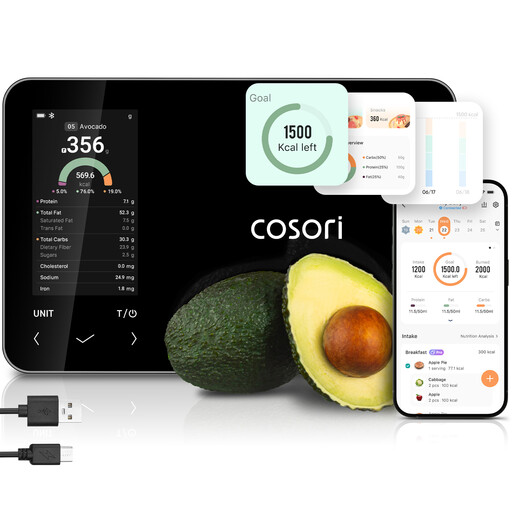 No image available
The tare function is designed for weighing ingredients in a container.
Maximum capacity: 5,000 g; graduation: 1 g from 3 g; USB-C charging.
The stated graduation is not designed for 0.1 g increments.
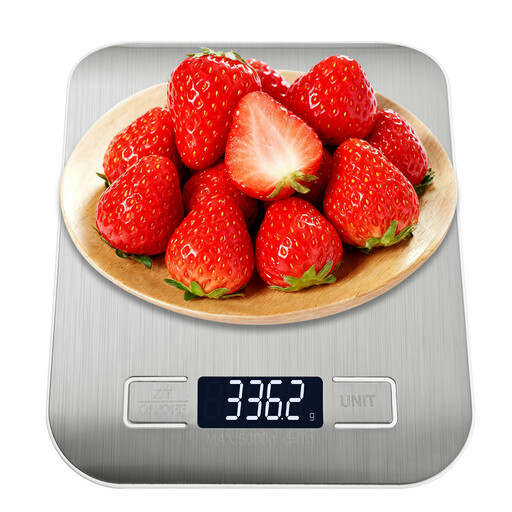 No image available
According to the product description, the LCD display has easy-to-read numbers.
Maximum capacity: 5 kg; graduation: 1 g; multiple weight units; white stainless steel surface.
The stated graduation does not offer 0.1 g increments.
Agree in your recipe or workflow who will weigh the salt and who will confirm that it’s been added. Tare a suitable container and make a note of whether the display shows the individual addition or the total weight. The devices mentioned have a tare function, but there’s no evidence of automatic shared record-keeping.
Use the salt proportion in your specific recipe and scale it in relation to the same amount of flour. King Arthur Baking uses flour weight as 100% in baker’s percentages and gives 1.8–2% salt by flour weight as an example for bread. This isn’t a recommendation for every type of dough or individual dietary requirements.
A built-in timer can help you time a single step, but it doesn’t demonstrate shared scheduling between people. GEFU lists a timing function of up to 19:59 minutes for the PREZISO; agree responsibilities and any other timings separately.
According to CASO, the three AAA batteries required are not included with the KitchenDuo. For other models, check what’s included and how the device is powered.
GEFU recommends placing the PREZISO on a flat, stable surface and cleaning it with a soft, slightly damp cloth. Keep water out of the device. These care instructions apply to this model; for another scale, follow its own instructions.