For smaller quantities, a scale with a tare function is handy if you want to weigh fruit and other ingredients one after another in the same container. With large bowls, their weight and the ingredients must stay within the maximum capacity. An easy-to-read display and a surface that’s simple to clean can make preparing food together easier. A stated 1 g graduation describes the display increment, but on its own it does not prove the scale’s measuring accuracy.
Which scale is right for you?
For following recipes
If you want to weigh fruit and jam sugar one after another in the same container, look for a tare function. The German Federal Centre for Nutrition explains the ratios for certain types of jam sugar, while WMF lists tare as a feature of its kitchen scale.
For cooking with larger batches of fruit
When you’re weighing a lot of fruit, the bowl counts towards the total load on the scale. For certain 2:1 and 3:1 types of jam sugar, the German Federal Centre for Nutrition gives examples using 1 to 1.5 kg of fruit and 500 g of jam sugar. The scale must also be able to support the container.
For cooking together without the fuss
If you’ll be using the scale while preparing food together, look for easy-to-reach controls, a clear display and a suitable surface. WMF lists large buttons and an LCD, while ADE describes the KE1511 as having a safety glass surface.
What should you look for when choosing?
First, think about whether you’ll be weighing ingredients in the same container, placing a large total load on the scale or simply wanting to clean it easily after preparing fruit.
| Key consideration |
What to look for |
Who will find this especially important? |
| Weighing ingredients to a recipe |
Tare function; check the quantities on the pack of jam sugar you’re using. |
If I want to weigh fruit and jam sugar one after another in the same container, a tare function is particularly useful. Around 36% of consumers prioritise weighing ingredients to a recipe. |
| Capacity for the bowl and fruit |
Compare the combined weight of the container and largest quantity of ingredients with the maximum capacity. |
When weighing a large quantity of fruit, I want to put the bowl on the scale too, without exceeding its maximum capacity. Around 29% of consumers are primarily concerned with having enough capacity for the container and ingredients. |
| Cleaning the weighing surface |
Check the surface material and the care instructions for the specific model. |
After preparing fruit, I want to remove any residue easily and clean the scale in line with its care instructions. Around 21% of consumers prioritise cleaning the surface. |
| Display and power supply |
Check that the display is easy to read where you plan to use the scale, and see whether it takes batteries or charges via USB. |
When cooking together, I want to be able to read the measurement clearly and know how the scale is powered. Around 14% of consumers prioritise ease of use and power supply. |
Common buying mistakes
-
Comparing only the fruit’s weight with the maximum capacity
The bowl adds to the load on the scale too. The tare function resets the display, but it doesn’t increase the maximum load the scale can support.
Before you buy, estimate the combined weight of the bowl and the largest quantity of ingredients you plan to weigh.
If the capacity is too low, you’ll need to split the ingredients across several weighing sessions or use a different container.
-
Assuming a 1 g display proves the scale is accurate
The stated graduation describes the increments shown on the display. It doesn’t automatically tell you how accurate the measurements actually are.
Distinguish between display increments and stated measuring accuracy, and don’t rely on the term “accurate to the gram” alone.
-
Assuming wipe-clean means dishwasher-safe
A wipe-clean weighing surface doesn’t mean the electronic device can be submerged in water or put in the dishwasher.
Follow the care instructions for the exact model. According to its product page, the WMF scale we checked isn’t dishwasher-safe.
Using an unsuitable cleaning method can damage the device.
Brands and model variations to consider
The details below apply to the specific models mentioned and shouldn’t be taken as applying to every product from each brand.
WMF
The black digital kitchen scale, CMMF 3201000339, is worth considering for smaller quantities and weighing ingredients in a bowl.
- WMF lists a maximum capacity of 5 kg, 1 g graduation, tare, large buttons and an LCD for this model.
- The bowl and ingredients must stay within the 5 kg limit. According to the product page, this model isn’t dishwasher-safe.
ADE
The ADE-HOME KE1511 is an option if you’re looking for a safety glass surface and a tare function.
- The product page lists a maximum capacity of 5 kg, 1 g graduation and tare.
- A safety glass surface doesn’t mean the scale can be submerged or put in the dishwasher. Follow the model’s care instructions.
ZWILLING
The silver Enfinigy 53011-051-0 is worth considering for larger containers or quantities if you’re looking for a rechargeable scale.
- For this version, ZWILLING lists a capacity of up to 10 kg, a glass surface, tare and a rechargeable battery.
- If you’d rather not have to charge the scale, check whether a rechargeable battery suits the way you plan to use it.
Beurer
The KS 34 XL Stainless Steel is an option for heavy bowls or larger quantities of fruit.
- Beurer lists a capacity of 15 kg and a continuous weight display for this version. The German datasheet also specifies tare and 1 g graduation.
- These details apply to the KS 34 XL Stainless Steel, not to every Beurer kitchen scale.
Etekcity
The EKS-L221-SUS is a rechargeable option if you need a higher capacity.
- Etekcity lists USB-C charging and a capacity of 10 kg for the EKS-L221-SUS.
- These details apply to the complete model designation, EKS-L221-SUS.
Joybuy products for your kitchen
These Joybuy product options are digital kitchen scales for weighing fruit and other ingredients in the kitchen.
 No image available
Digital kitchen scale with tare function, 5 kg
The tare function is useful if you want to weigh ingredients one after another in the same container.
The product name lists a maximum capacity of 5 kg and an LCD. The bowl and ingredients must stay within the maximum capacity combined.
View at Joybuy
 No image available
Digital kitchen scale with stainless steel surface, 5 kg
The tare function listed in the product name is useful for weighing ingredients in a container.
The product name lists a stainless steel surface, LCD, tare, a maximum capacity of 5 kg and a 1 g increment. This graduation alone doesn’t prove independent measuring accuracy.
View at Joybuy
 No image available
Digital kitchen scale, 10 kg
The stated maximum capacity may be useful if you need to weigh a heavier load made up of a bowl and its ingredients.
The product name lists a maximum capacity of 10 kg, a 1 g increment, tare, an LCD display and dimensions of 21 × 15,5 × 2,9 cm. The 1 g increment alone doesn’t prove independent measuring accuracy.
View at Joybuy
 No image available
Digital kitchen scale with removable bowl
The removable bowl is a useful feature if you want to weigh ingredients in a container of your own.
View at Joybuy
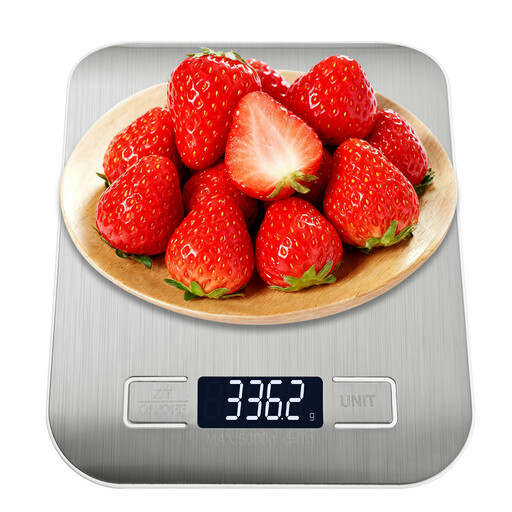 No image available
Vivreal CFC-03White kitchen scale, 5 kg
The stated capacity may suit smaller quantities. Remember to include the combined weight of the bowl and ingredients.
The product name lists a capacity of 5 kg, a 1 g increment and a stainless steel surface. According to the product description, clean the surface with a dry or slightly damp soft cloth. Avoid water and impacts from heavy objects.
View at Joybuy
Frequently asked questions
How do I weigh fruit and jam sugar for jam?
Weigh the amount of fruit required by your recipe, use the tare function to reset the bowl’s weight to zero, then measure the remaining ingredients according to the jam sugar you’ve chosen and its instructions. For certain 2:1 and 3:1 types of jam sugar, the German Federal Centre for Nutrition gives 500 g of jam sugar for 1 to 1.5 kg of fruit as an example. This isn’t a universal ratio for every product.
Can I put a digital kitchen scale in the dishwasher?
Not necessarily. The WMF product page explicitly states that the scale described there isn’t dishwasher-safe. Check the care instructions for the specific model and clean the surface only as directed.
Do I need a verified scale to weigh fruit at home?
When you’re weighing ingredients at home for a recipe, the result isn’t being used to calculate a commercial transaction. The weights and measures office explains that scales must be verified when their measurements are used to determine a charge. Commercial use is subject to the relevant requirements under measurement and verification regulations.
Who should I contact if a newly purchased scale is faulty?
If your scale is faulty, contact the seller. The consumer advice centre explains that, as a rule, sellers are responsible for new goods being free from defects for two years from the date they’re handed over. This is separate from any voluntary manufacturer’s guarantee.
How should I dispose of an old digital kitchen scale in Germany?
Dispose of the scale separately from household waste. The German Environment Agency recommends taking old electrical equipment to an appropriate collection point, such as a recycling centre or a designated take-back point. Removable batteries should be handed in separately.


