Class leaders making several batches of muffins
You want to weigh ingredients repeatedly and be able to read the display even when a mixing bowl is on the scale.


For measuring yoghurt by weight in grams, a digital kitchen scale with a grams display and tare function is sufficient, provided the bowl and ingredients together stay within its maximum capacity. For a cookery class, you’ll also want a suitable weighing platform and a display that remains easy to read with the bowl in place. A finer display increment alone does not prove greater accuracy.
You want to weigh ingredients repeatedly and be able to read the display even when a mixing bowl is on the scale.
You want to use the tare function easily and weigh yoghurt directly in a bowl that fits on the scale.
You’re looking for a scale that’s easy to store away, and want to check that the bowl and display work well together when weighing.
First, check that your bowl sits securely on the weighing platform and that the total weight stays within the scale’s maximum capacity. Then consider whether the tare button is easy to reach, the display is easy to read and the care instructions apply to the exact model.
| What you need | What to look for when buying | Who is this important to? |
|---|---|---|
| Taring and weighing ingredients | Check for a grams display and an easy-to-reach tare button. | If I want to weigh yoghurt and other ingredients one after another in the same bowl, the tare function is particularly important. Around 36% of consumers put this step-by-step weighing feature first. |
| Bowl and total weight | Compare the bowl’s base, the display position and the maximum capacity for the bowl plus ingredients. | With a larger mixing bowl, I make sure it sits securely and doesn’t cover the display. Around 29% of consumers prioritise a suitable bowl size and total capacity. |
| Display during the class | Check with your own bowl that the display and weight reading remain visible; consider a backlight or hold function if available. | If several people need to read the recipe measurement, I want a display that stays visible with the bowl in place. Around 21% of consumers prioritise readability. |
| Cleaning and storage | Check the care instructions and dimensions for the exact model. | After the class, I want to remove any yoghurt easily and put the scale away without taking up much space. Around 14% of consumers focus on care and storage. |
The bowl and any ingredients already added also put weight on the scale. The display may start at zero after taring, but the maximum capacity applies to the actual total weight.
Compare the model’s stated maximum capacity with the heaviest total weight you expect from the container and its contents.
An increment of 0.5 g or 1 g tells you how the display changes. On its own, it doesn’t prove that the measurement error is the same.
Distinguish the stated increment from independently tested performance, and check which weight range the figure applies to.
According to the manufacturers, the black WMF scales mentioned here and the GEFU SCORE are not dishwasher-safe.
Check the care instructions for the exact variant before cleaning the scale after your class.
The Optiss BC50U0 combines a tare function with a 17,5 × 22,5 cm glass platform and an illuminated display. This can be useful when weighing ingredients in a bowl.
The slim KS 19 Pure White has a tare function, while the KS 34 Stainless Steel offers a higher capacity and a hold function.
The Page Compact 300 is a compact platform scale for adding ingredients to a bowl step by step.
The black digital kitchen scale is a platform scale with a tare function and LCD display.
According to the manufacturer, the SCORE has a tare function and can be used for weighing without a mobile device. Its nutrition app isn’t needed to weigh yoghurt.
The Joybuy models below are digital kitchen scales with tare functions. Compare the weighing platform, maximum capacity and display with your bowl and how you plan to use the scale.
 No image available
The tare function is useful for weighing ingredients in a bowl.
Maximum capacity: 5 kg; glass platform; LCD display; dimensions: 205 × 150 × 20 mm.
 No image available
The one-button reset function is designed for taring a bowl.
Maximum capacity: 5 kg; stainless steel platform; LCD display; dimensions: 18 × 14 × 2 cm.
 No image available
The tare function is designed for weighing in a container; the stated maximum capacity may be useful if you use a heavy bowl.
Maximum capacity: 10 kg; stated 1 g increment; stainless steel and plastic; dimensions: 21 × 15,5 × 2,9 cm.
 No image available
The tare function is designed for weighing ingredients in a bowl one after another.
Maximum capacity: 5 kg; stated increment: 1 g; LCD display; units: g, ml, oz, lb and fl.
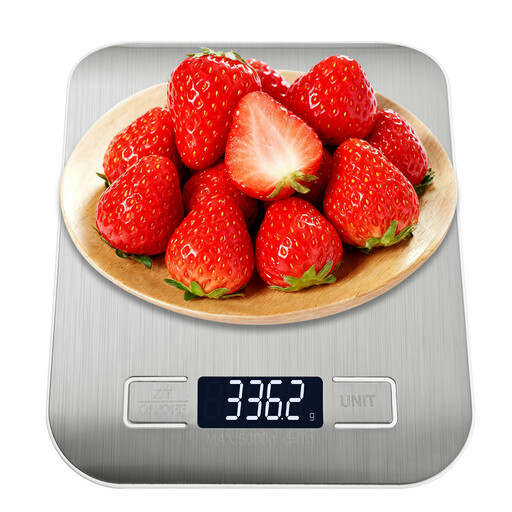 No image available
The tare function lets you weigh ingredients in a bowl.
Maximum capacity: 5 kg; stated 1 g increment; stainless steel surface; dimensions: 18 × 14 × 1,5 cm.
If the recipe gives a weight in grams, select g, tare the bowl and weigh up to that amount. The ml function isn’t a reason to assume the same number of grams without a suitable conversion for that specific product.
Place the scale on a firm, level work surface, put the bowl on it and tare before adding ingredients. Check that you can see the display and reach the button with the bowl in place, and keep the total weight below the maximum capacity stated for your model.
Not necessarily: according to the manufacturers, the black WMF scale mentioned here and the GEFU SCORE are not dishwasher-safe. Clean your specific device according to its instructions; a wipe-clean weighing platform doesn’t mean it’s dishwasher-safe.
The German Environment Agency recommends not putting electrical waste in household rubbish. If possible, remove any removable batteries before handing the scale in, and dispose of them separately at a battery collection point.