Weighing ingredients to a recipe
If you weigh the sultanas separately first, make sure you can easily read the weight in grams. Beurer gives the KS 19 Black a 1 g graduation; this is a manufacturer’s specification, not independent proof of accuracy.


When weighing sultanas, the main things to consider are whether you can read the display with your chosen container on the scales, and whether the scales are on a suitable surface. If you’re adding other prepared ingredients to the same bowl one after another, you’ll want an easy-to-reach tare button and a clearly visible display. With a large bowl, you’ll also need to consider the available surface area and the combined weight of the bowl and its contents. A display that measures in grams alone doesn’t prove that the scales have a correspondingly low margin of error.
If you weigh the sultanas separately first, make sure you can easily read the weight in grams. Beurer gives the KS 19 Black a 1 g graduation; this is a manufacturer’s specification, not independent proof of accuracy.
If you’re adding prepared ingredients to the same bowl one after another, a tare function and a display you can see with the bowl in place are important. Beurer and WMF list tare functions for their respective models.
For a wide or heavy bowl, check the weighing platform, readability and maximum capacity together. WMF lists a 20 × 20 cm platform for one model, while Tefal gives the Optiss BC50U0 a platform measuring 17,5 × 22,5 cm.
First, decide whether you’ll weigh just the sultanas or add several prepared ingredients to the same bowl one after another. Then check your bowl, the total load and how the scales operate.
| What matters | What to check when buying | Who is it important to? |
|---|---|---|
| Reading recipe quantities | Check the gram increments across the weight range you need, and make sure the display is easy to read with your bowl in place. | If I weigh the sultanas separately to the recipe first, I want to be able to read the display at a glance. Around 38% of consumers are likely to have this as their main priority. |
| Adding ingredients to one bowl | Check that you can reach the tare button with the bowl in place, and see how the scales behave when left unused. | If I’m adding prepared ingredients to the same bowl one after another, I want to be able to reset the scales to zero easily between ingredients. Around 31% of consumers are likely to prioritise weighing ingredients in succession. |
| Using a large bowl | Compare the base of your bowl with the weighing platform, and check the combined weight of the bowl and its contents against the maximum capacity. | If my mixing bowl is wide or heavy, I need a stable platform and enough capacity, without losing sight of the display. Around 23% of consumers are likely to focus mainly on platform size and maximum capacity. |
| Choosing a power source | Check the battery type or activation method. For kinetic models, check whether the shape of your bowl’s base is suitable. | If I want to avoid changing batteries, I need to know whether activation requires an extra step. Around 8% of consumers are likely to prioritise the power source over other buying considerations. |
Increments describe how much the display changes by each step. On their own, they don’t establish the maximum margin of error.
Compare the stated increments across the weight range you need. Only rely on claims about actual weighing performance if they’re based on tests of the exact model.
Tare resets the display, but it doesn’t reduce the load on the scales. The bowl and its contents both count towards the maximum capacity.
Check the total weight against the maximum capacity. Also make sure the bowl is stable and the display remains visible.
A bowl can obscure the display or controls. CASO also says that the suitable bowl-base diameters for the Kitchen Ecostyle depend on the position of its arm.
Measure the base of your bowl and check that you can read the display and use tare with the bowl in place.
Battery-powered and kinetic scales work differently; kinetic scales are activated with a movement of the hand.
Check the power source, what’s included and how the specific model is activated before you plan your routine around it.
The KS 19 Black is a compact glass-platform scale with a tare function.
The CMMF 3201000754 digital kitchen scales have a documented weighing platform measuring 20 × 20 cm.
The Optiss BC50U0 combines a backlit display with a glass platform measuring 17,5 × 22,5 cm.
The Kitchen Ecostyle is a battery-free kitchen scale with kinetic activation.
ADE describes the PW501 as a semi-professional portion scale.
The Joybuy products below are digital scales whose product descriptions mention cooking or baking. Check the listed features of each model and make sure they suit your bowl and the way you weigh ingredients.
 No image available
The product description lists baking as a use and mentions a timer function and switchable units.
 No image available
The product description lists baking and meal prep as uses. It also mentions tare, a maximum capacity of 5 kg and a Bluetooth connection; before buying, check which connectivity features you actually want to use.
 No image available
The product description mentions tare and weighing ingredients one after another. It also lists a maximum capacity of 5 kg and an accuracy figure of 1 g; this isn’t independent proof of measurement performance.
 No image available
The product description lists baking and cooking as uses, along with tare and a maximum capacity of 10 kg. It gives an accuracy figure of 1 g; check that this suits your needs, but don’t take it as independent proof of accuracy.
 No image available
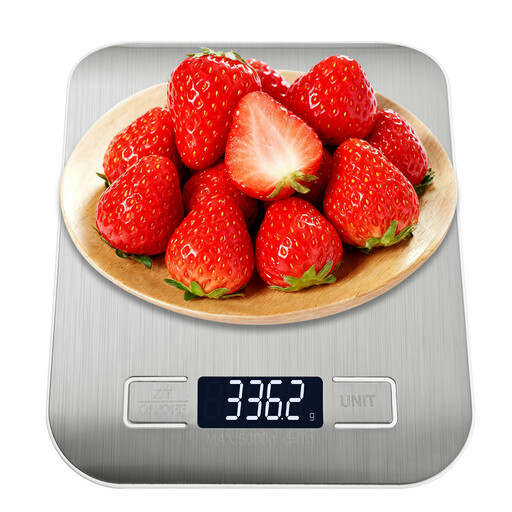
The product description lists baking and preparing ingredients as uses. It also mentions a maximum capacity of 5 kg, a stainless-steel weighing platform and switchable units.
Put the bowl on the scales and use tare to reset the display to zero before adding the sultanas. If you’re adding more ingredients, you can tare again between each addition; the total load must still stay within the maximum capacity.
Check how the specific model behaves when left unused. F.A.Z. Kaufkompass says that the Ideenwelt CFC2021-S reviewed there switches off automatically after one minute; this doesn’t tell you how other scales will behave.
The Physikalisch-Technische Bundesanstalt doesn’t specify a legal minimum requirement for household scales. Weighing goods for sale is a different use case, and the relevant requirements should be checked separately.
No. The gram increments describe the display steps and don’t, on their own, prove the maximum margin of error. If actual weighing performance matters, look for tests of the exact model.
According to the German Environment Agency, take used batteries to collection boxes in shops or to local collection points. Don’t put them in your household waste.