Weighing ingredients in one bowl
If you add dry couscous and then other ingredients to the same bowl, an easy-to-reach tare function is important.


If you weigh dry couscous and other ingredients one after another in the same bowl, an easy-to-reach tare button, a display in grams and a suitable weighing surface are essential. With a larger bowl, its weight counts towards the total load, so check the maximum capacity and make sure you can see the display and use the buttons with the bowl in place. A stated graduation of 1 g does not, by itself, prove that the measurement error is no more than 1 g.
If you add dry couscous and then other ingredients to the same bowl, an easy-to-reach tare function is important.
When preparing several portions, check that the bowl sits securely on the weighing surface and that the display remains visible. The bowl’s weight also counts towards the total load.
If you only use your scales occasionally, ease of use, a surface that’s easy to clean and compact dimensions can all help you choose.
| Priority | What to check | Who will find this most important? |
|---|---|---|
| Weighing ingredients one after another | Tare button is accessible with the bowl in place; display can be set to grams. | If I’m weighing couscous and other ingredients step by step in the same bowl, I want to be able to tare the scales easily after each one. Around 36% of consumers prioritise weighing several ingredients in succession. |
| Bowl size and total load | Weighing surface suits the bowl; maximum capacity is sufficient for the bowl and its contents combined. | With a wide or heavy salad bowl, I want to weigh ingredients safely without the bowl obscuring the display. Around 29% of consumers focus above all on bowl fit and capacity. |
| Display and controls | Display remains easy to see with the bowl in place; buttons can be used while weighing ingredients in succession. | When I’m measuring ingredients in several stages, the bowl shouldn’t hide the numbers or tare button. Around 21% of consumers prioritise readability and ease of use. |
| Cleaning, power and storage | Check care instructions and dimensions; check the battery type and what’s included. | If you only weigh ingredients occasionally, you’ll want to clean your scales easily after preparing food and store them without taking up much space. Around 14% of consumers put care, power and storage first. |
The graduation tells you the weight increments shown on the display. It isn’t, by itself, independent proof of the measurement error. And a test result for one model doesn’t apply to other scales.
Compare the stated graduation separately from independent test results for the specific model.
When weighing ingredients in a bowl, the bowl also adds to the load on the scales.
Include the bowl and the planned quantity of ingredients when comparing the total weight with the stated maximum capacity. Also check that the bowl sits securely and the display remains visible.
Depending on the bowl, the display or tare button may still be awkwardly positioned or obscured, even on a large surface.
Consider the weighing surface, button position and display together, and check that they work with your bowl.
The KS 19 Ice Cream is a slim set of kitchen scales designed for weighing ingredients in a bowl.
The CMMF 3201000754 digital kitchen scales have a 20 × 20 cm weighing surface.
The Optiss BC50U0 is worth considering if you’re looking for a larger glass platform and a backlit display.
The Kyra KE2501 is an option if you need a higher stated capacity.
The CFC2021-S is a specific model you can use to compare simple kitchen scales.
This selection includes digital kitchen scales for weighing ingredients in a bowl, as well as models with a higher capacity or additional app features.
 No image available
An option if you’re looking for digital kitchen scales with a tare function for weighing ingredients in a bowl.
The product name specifies an LCD display, stainless steel and a maximum capacity of 5 kg.
 No image available
The tare function is useful if you’re weighing several ingredients one after another in the same bowl.
The product name specifies 1 g increments, a maximum capacity of 5 kg and the units g, ml, oz, lb and fl.
 No image available
A possible choice if you want to weigh a heavy bowl or a larger quantity of ingredients. Still, check that your bowl sits securely.
The product name specifies a tare function, a 10 kg capacity and dimensions of 21 × 15,5 × 2,9 cm.
 No image available
The removable bowl may suit you if you want to weigh ingredients directly in a container that’s part of the scales.
 No image available
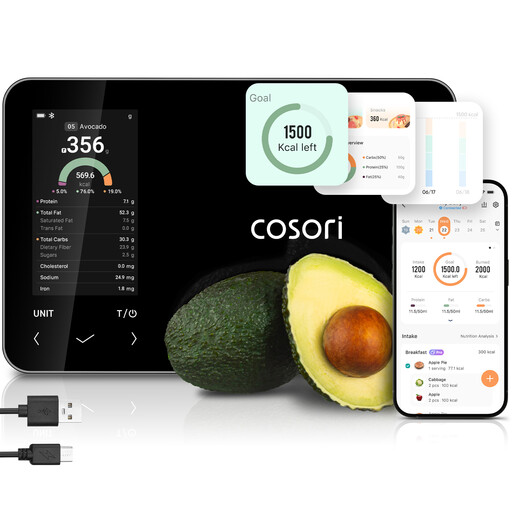
An option if you’re also considering kitchen scales with app connectivity.
The product name describes the model as a Smart Nutrition Scale with app. Before buying, check which features and compatibility you need.
If your recipe gives a quantity of dry couscous, weigh it dry in grams. Weighing the finished salad is a separate step; the scales must be able to support the bowl and its contents together.
Place the bowl on the scales and tare them. Add the first ingredient, then tare again if you want to read off the next ingredient separately. The bowl and all its contents must not exceed the model’s maximum capacity when combined.
Follow the care instructions for the specific model and check the battery type and what’s included. Tefal lists two AAA batteries included with the Optiss BC50U0; ADE Home also lists two AAA batteries for the Kyra KE2501.
For the private weighing described here, there’s no evidence that official verification is a requirement when buying scales. The Landesbetrieb Mess- und Eichwesen NRW describes verification as applying to official and commercial transactions, as well as measurements in the public interest. If ingredients are sold or charged for by weight, check the specific use separately.
No. The Federal Institute for Risk Assessment (BfR) points out that inadequate temperatures during transport and storage can allow harmful bacteria to multiply. If your salad contains perishable ingredients, plan how to keep it chilled during transport and until it’s eaten. Kitchen scales can’t solve this food hygiene issue.