Bread makers who need to measure salt precisely
If you weigh small amounts of salt separately, compare the display increments and check that your container will fit on the weighing platform.


If you weigh small amounts of salt separately, a precision scale or weighing spoon with suitable display increments could be a good choice. If you also want to weigh a bowl of dough on the same scale, the key factors are the tare function, maximum capacity and weighing surface. Compact all-purpose scales can offer a higher capacity, depending on the model, but often have coarser increments. A stated graduation alone does not prove actual measuring accuracy.
If you weigh small amounts of salt separately, compare the display increments and check that your container will fit on the weighing platform.
If you want to put the scale away after baking, check its dimensions and whether the particular model can be stored flat or hung up.
If you weigh several ingredients in the same container, a tare function, sufficient capacity and a suitable weighing surface are important.
First, check whether the scale offers suitable display increments for the amounts of salt you use. Then consider the space you’ll need to use and store it, as well as its capacity for your bowl and dough ingredients.
| What you need | What to check | Who is this important to? |
|---|---|---|
| Reading small amounts of salt | Graduation, maximum capacity including the container, and whether you can check the displayed reading. | If I weigh salt separately in small amounts, I need suitable display increments. Around 42% of consumers prioritise precise measuring. |
| Space for use and storage | Appliance dimensions, weighing surface and, if applicable, a hanging fixture. | I want to put the scale away after baking and keep my worktop clear. Around 33% of consumers prioritise compact storage. |
| Weighing ingredients in a mixing bowl | Tare function, weighing surface and maximum capacity for the bowl and its contents together. | If I weigh ingredients into the mixing bowl one after another, I need a tare function and sufficient capacity. Around 25% of consumers prioritise weighing ingredients into a bowl. |
A finer display describes the increments in which a value is shown; on its own, it is not independent proof of measuring accuracy.
Compare the graduation separately from any information about measuring performance, and check that the container and its contents stay within the maximum capacity.
A compact scale may take up little worktop space, but it might not suit the base of your bowl or let you read the display with the bowl in place.
Check the bowl’s base, how easy the display is to read and the combined weight of the bowl and ingredients against the model’s specifications.
According to the manufacturer, the Soehnle Cooking Star has a maximum capacity of 500 g and is designed for weighing small amounts.
A weighing spoon could work for measuring salt separately. For a mixing bowl, you’ll need a scale with a suitable capacity and weighing surface.
You may also need a platform scale for a bowl and larger quantities of ingredients.
The Beurer KS 36 is a flat precision scale for small ingredients weighed separately.
The Cooking Star is a weighing spoon, while the Page Compact 300 is a flat all-purpose scale.
The Optiss BC50U0 is a platform scale for weighing ingredients into a bowl.
The SCORE is an all-purpose scale with an optional app feature.
This selection includes digital kitchen scales for dough ingredients and weighing into a bowl. If you weigh salt separately, check whether the stated display increments on each model suit the amounts you use.
 No image available
The stated tare function and maximum capacity of 5 kg may be useful for weighing several ingredients into one bowl.
Product details: LCD display, tare function and g, ml, oz, lb and fl oz units. The “1 g” specification alone proves neither 1 g graduations nor measuring accuracy.
 No image available
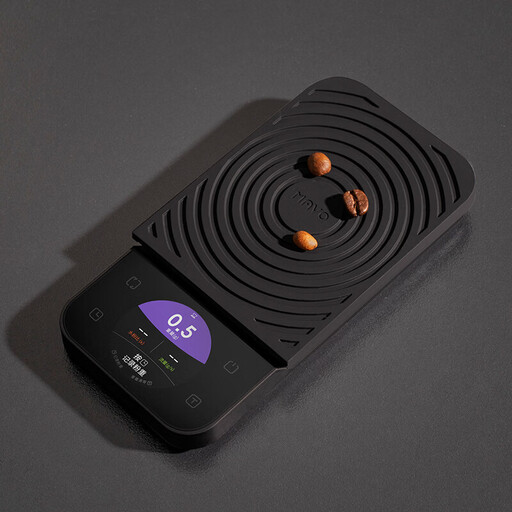
The description mentions kitchen weighing, as well as espresso and pour-over modes. Before choosing, check that the features suit your baking routine.
The description lists a 0.1 g specification, which should be confirmed against a technical data sheet. Check the graduation before buying if you want to use it to weigh small amounts of salt.
A timer and flow-rate display are also mentioned, but no specific dimensions are given.
 No image available
The removable bowl and stated maximum capacity of 5 kg make this a possible option for weighing ingredients in a container.
Product details: dimensions of 20,5 × 18 × 4,5 cm. Check that it will fit on your worktop and in your storage space.
 No image available
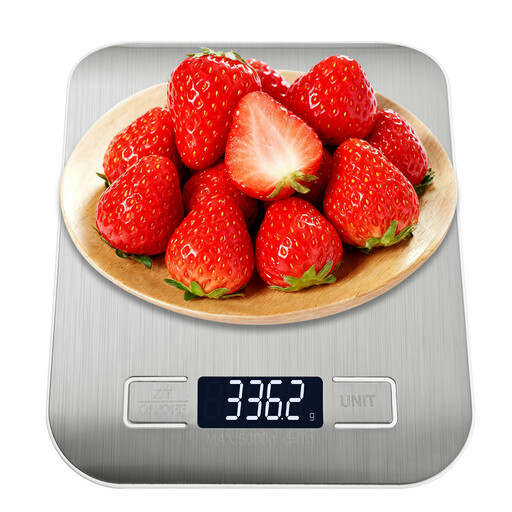
The stated dimensions of 18 × 14 × 1,5 cm may be useful if you plan to store it in a drawer.
Product details list a maximum capacity of 5 kg, a stainless steel surface and switchable units. The title gives “1 g” as an accuracy specification, but this alone does not establish 1 g graduations.
 No image available
The tare function and stated maximum capacity of 5 kg may be useful for weighing ingredients into a bowl.
The stated 1 g graduation gives coarser display increments than a 0.1 g graduation, as found on some precision scales. Bear this difference in mind if you’re weighing small amounts of salt.
Yes, as long as the particular model has a tare function, the bowl sits securely on the scale, and the combined weight of the bowl and its contents stays within the maximum capacity. For very small amounts of salt, you should also check the graduation.
For the Soehnle Cooking Star, the manufacturer specifically states that the removable weighing spoon is dishwasher-safe. This does not automatically apply to the electronic unit.
According to the manufacturer, the Page Compact 300 needs a CR2430 battery and the Cooking Star needs a CR2032 battery. The product pages for both models say that a battery is included; check the details for the specific model.
No. Germany’s Federal Environment Agency explains that electrical and electronic waste should be collected separately. Removable batteries should be taken out before you hand in the appliance and disposed of separately at a battery collection point.