Portioning rice in a bowl
You want to weigh rice in a container and use the tare function to subtract its weight, without having to transfer ingredients you’ve already prepared.


For weighing rice in a bowl, a digital scale with a tare function is a good place to start: you can zero the scale with the bowl on it before adding the rice, but the combined weight of the bowl and its contents must still stay within the maximum capacity. A finer graduation or an app is mainly useful if you also weigh small quantities of ingredients or want to use these extra features; a finer display alone does not prove greater weighing accuracy.
You want to weigh rice in a container and use the tare function to subtract its weight, without having to transfer ingredients you’ve already prepared.
You’re looking for a scale that can be stored flat after portioning, without the bowl obscuring the display or controls.
You also prepare spices or other small quantities of ingredients, and want to choose a scale with a suitable graduation, minimum load and capacity for these tasks.
First, check the tare function and maximum capacity for weighing rice in your bowl. Then consider storage space, readability and any extra features.
| What matters | What to check before buying | Who is it important to? |
|---|---|---|
| Tare function and portioning | Check whether you can tare the scale with the bowl in place, and whether the bowl and its contents will stay within the maximum capacity. | If I weigh rice directly in a container, I want to subtract the container’s weight without having to transfer anything. Around 40% of consumers prioritise a tare function and straightforward portioning. |
| Space and readability | Compare the dimensions of the bowl and weighing platform, and check whether you can still see the display with your container in place. | When I’ve set up on a small worktop, I need enough space for the bowl and a clear view of the display. Around 30% of consumers pay particular attention to space and readability. |
| Small additional quantities | Check the minimum load, graduation across the weight range you’ll use and maximum capacity of the specific model separately. | If I weigh small quantities of spices as well as rice, a suitable graduation for that weight range matters. Around 20% of consumers prioritise weighing these small additional quantities. |
| Cleaning and power supply | Check the model’s cleaning instructions, its power supply and whether you’ll need batteries. | If residue gets on the scale while I’m preparing food, or I want to avoid changing batteries, cleaning and power supply matter. Around 10% of consumers give these factors particular priority. |
A graduation of 0.1 g or 1 g describes the increments shown on the display. On its own, it doesn’t tell you how far a measurement may be from the actual weight.
Check the graduation, minimum load and maximum capacity separately. A test of the exact model is a better guide to weighing accuracy than the graduation alone.
Even when the display has been tared, the bowl still adds weight to the scale. The bowl and its contents must stay within the maximum capacity combined.
Compare the capacity of the specific model with the total weight you’ll actually put on the scale, and check that the display is still easy to see with the bowl in place.
The Tefal Optiss BC50U0 included in the test and the Optiss BC5005 found at Joybuy have different model numbers. A similar family name alone doesn’t prove they’re the same model.
Before buying, check the full model number and compare the key features. Don’t assume test results apply to a different version just because it has a similar name.
The Optiss BC50U0 could suit weighing rice in a bowl if you’re looking for a larger platform and a backlit display.
The KS 19 Pure White is a slim glass scale with a tare function.
The SCORE adds a nutritional information app to weighing, while the PREZISO is designed for small additional quantities.
The Slim is a slim tare scale, while the KitchenEnergy is an alternative if you’d rather avoid changing batteries.
This selection features digital kitchen scales with a tare function for weighing rice in a container. One model also lists a finer graduation for small quantities.
 No image available
The tare function is useful for weighing rice in a bowl.
The product title lists a stainless steel surface, an LCD display and a maximum capacity of 5 kg. The bowl and its contents count towards the total.
 No image available
The tare function is handy for weighing rice in a bowl without including the bowl’s weight.
The product title lists a maximum capacity of 10 kg and dimensions of 21 × 15,5 × 2,9 cm. The bowl and its contents must stay within the maximum capacity combined.
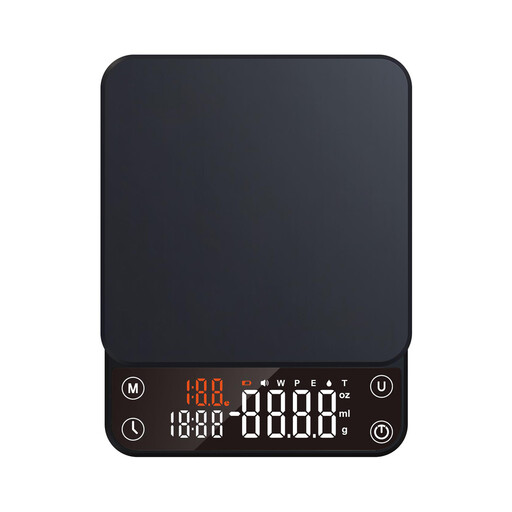 No image available
The auto-tare function is useful for weighing rice in a container; the finer graduation may also come in handy for small quantities.
The product description lists 0,1-g increments below 1 kg, 1-g increments from 1 kg and a maximum capacity of 3.000 g. The container and its contents must stay within this limit combined; the graduation doesn’t indicate the actual measurement deviation.
Place the empty bowl on the scale and tare it to zero before adding the rice. Make sure the bowl and rice stay within the maximum capacity of your scale combined.
No. The graduation describes the increments shown on the display, not necessarily the actual measurement deviation. The Physikalisch-Technische Bundesanstalt (PTB) classifies scales by factors including graduation and maximum capacity; a graduation figure alone doesn’t prove a particular level of accuracy.
In that case, it’s a question of food storage, not choosing a scale: cool cooked food after preparation and keep it chilled until you reheat it. The German Federal Institute for Risk Assessment points out that spores of Bacillus cereus can survive normal heat treatments; weighing rice won’t make improperly stored rice safe to eat.
Check the power supply for the exact model; CASO, for example, lists a CR2032 battery for the Slim. If a product is faulty, the Consumer Advice Centre says you generally have statutory rights against the seller. Electrical waste shouldn’t go in household rubbish; the German Environment Agency recommends collecting removable batteries separately.