Weighing individual portions of salt
If you weigh salt separately for several small batches of dough, finer increments can be helpful. Soehnle specifies 0.1 g increments for the Cooking Star; this model has a maximum capacity of 500 g.


For small amounts of salt, a precision scale with suitably fine increments is useful; for flour and dough in a large bowl, check the maximum capacity, including the bowl. Manufacturer specifications for Soehnle models show the difference: the Cooking Star has 0.1 g increments and a maximum capacity of 500 g, while the Page Profi 300 offers a 20 kg capacity, 1 g increments and a tare function. If you weigh both regularly, two scales can handle the different tasks, but they take up more space and need extra care.
If you weigh salt separately for several small batches of dough, finer increments can be helpful. Soehnle specifies 0.1 g increments for the Cooking Star; this model has a maximum capacity of 500 g.
If you weigh ingredients directly into a large bowl, you need to include the bowl’s weight. Models such as the Soehnle Page Profi 300 and Beurer KS 34 Stainless Steel are designed for heavier loads, according to their manufacturers.
If you add ingredients to a container one at a time, the tare function can make the process easier. A clear display or a hold function can also be useful if the bowl obscures the display.
The key question is whether you weigh small portions of salt separately or place the ingredients and bowl together on the scale.
| What you need | What to look for when buying | Who is this most relevant to? |
|---|---|---|
| Small portions of salt | Compare the smallest portion you need to weigh with the scale’s increments in grams; don’t assume that the increments indicate proven measurement accuracy. | If I weigh salt separately for several small batches of dough, a fine display matters more to me than a high capacity. Around 36% of consumers prioritise weighing small portions of salt. |
| Capacity for large batches | Check the weight of your heaviest bowl plus the maximum amount of ingredients against the scale’s maximum capacity, and consider the size of the weighing platform. | For large batches of dough, I want to weigh the bowl and ingredients together without exceeding the maximum capacity. Around 29% of consumers prioritise capacity for this reason. |
| Adding ingredients one at a time | Check that the tare function, display and, where applicable, hold function work with your container and weighing routine. | When I prepare several batches in succession, tare and a clear display help me add ingredients as I go. Around 21% of consumers prioritise this process. |
| Care and power supply | Check the care instructions and power supply for the specific model; don’t assume that the weighing platform is waterproof because of its material. | If I bake often, I want a scale that’s easy to clean and don’t want to keep replacing disposable batteries. Around 14% of consumers prioritise care and power supply. |
A good fit if: You weigh small portions of salt separately and need finer increments. Soehnle specifies 0.1 g increments for the Cooking Star.
The trade-off: The Cooking Star has a maximum capacity of 500 g, so it isn’t suitable for heavy bowls of dough.
A good fit if: You weigh ingredients directly into a large bowl and the total weight stays within the scale’s maximum capacity. According to the manufacturer, the Soehnle Page Profi 300 offers a maximum capacity of 20 kg, 1 g increments and tare.
The trade-off: Its 1 g increments are less fine than the Cooking Star’s 0.1 g increments; consider whether this level of detail is suitable for your smallest portion of salt.
A good fit if: You regularly weigh both small portions of salt and heavy bowls, and want to use a suitable scale for each task.
The trade-off: Two devices take up more space and require extra care.
A specification such as 0.1 g describes the display increments of that particular model. It doesn’t automatically tell you how much the reading may vary for every small portion of salt.
Compare the increments and the intended weighing range of the specific model. Don’t assume further accuracy claims without suitable measurement data.
When you weigh ingredients directly into a bowl, the bowl is on the scale too. A small spoon scale with a maximum capacity of 500 g and a platform scale designed for heavier loads therefore serve different purposes.
Allow for the weight of your heaviest container as well as the maximum amount of ingredients, and check that the bowl fits on the weighing platform.
An unsuitable scale may mean you need to weigh ingredients separately or buy an additional device.
The German manufacturer’s specification for ZWILLING relates to the silver model with article number 53011-051-0. A similarly named black variant on Joybuy doesn’t confirm that it’s the same version.
Before buying, compare the full article number, colour and what’s included.
The documented models cover different tasks: a compact scale for small portions and a platform scale for larger bowls.
The KS 34 Stainless Steel is an option if you weigh a larger bowl and want to read the display after weighing.
According to the German manufacturer’s specifications, the Enfinigy scale 53011-051-0 combines tare with a rechargeable battery.
The EKS-L221-SUS is a model documented by the manufacturer with tare and USB-C charging.
This selection includes digital scales for weighing ingredients, including compact models and scales designed for weighing ingredients in a container. Choose a model with increments and a maximum capacity suited to your portions and bowls.
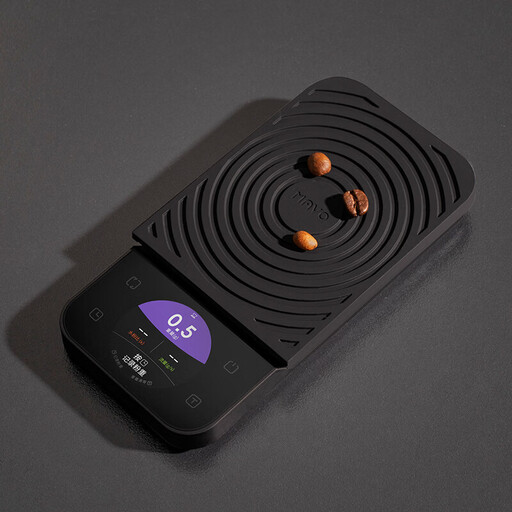 No image available
The stated 0.1 g increments are useful for small portions of salt weighed separately; the description also lists kitchen weighing as a suitable use.
The description also mentions weighing modes and a removable silicone mat. Check the maximum capacity before placing a container and its contents on the scale.
 No image available
The removable bowl can be useful if you want to weigh ingredients in a container.
The stated maximum capacity is 5 kg, including the bowl. Make sure you allow for the container’s weight when weighing.
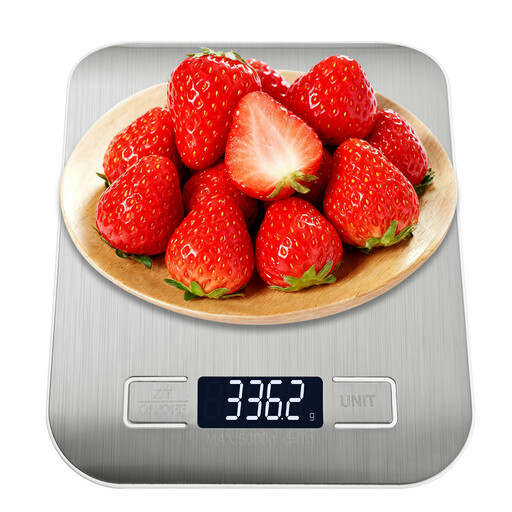 No image available
For weighing ingredients to a recipe, the description lists an LCD display and switchable units.
According to the description, the model has a maximum capacity of 5 kg, 1 g increments and a stainless steel weighing platform. For small portions of salt, 1 g increments are less fine than 0.1 g increments. The surface should be cleaned with a dry or slightly damp cloth.
 No image available
The stated maximum capacity of 10 kg may suit larger quantities of ingredients; remember to include the weight of the container.
The description lists 1 g increments, several units and a glass surface. It advises against immersing the device in water. As the product title mentions app connectivity, check compatibility with your device before buying.
Multiply the flour and salt quantities in the recipe by the same batch factor. Baker’s percentages express each ingredient as a proportion of the flour weight, not the total dough weight. King Arthur Baking gives 1.8–2% salt by flour weight as a general guide for bread dough; this isn’t a rule for every recipe or dietary requirement.
Place the bowl on a stable part of the scale, tare it, then weigh in the ingredients one at a time. First, check that the bowl and its contents together are within the maximum capacity; a separate precision scale may be more suitable for very small portions of salt.
For a consumer purchase, the seller’s statutory liability for faulty goods is separate from any voluntary manufacturer’s guarantee. The Verbraucherzentrale explains that, in general, the seller is responsible for the goods being free from defects when handed over for two years. Any additional guarantee is subject to its own terms and conditions.
If you’re weighing ingredients for your own dough at home, this isn’t a commercial transaction. If measurement results are used for purposes such as calculating a bill, the specific use must be assessed under Germany’s weights and measures legislation; Germany’s verification authorities list weighings used for billing as requiring verification.
Take the scale to a suitable collection or return point for electrical waste; don’t put it in your household rubbish. The Umweltbundesamt recommends removing any removable batteries before disposal, where possible, and taking them separately to a battery collection point.