If you weigh small amounts of salt separately, check the stated weighing range and the scale’s increments. A flat precision scale takes up little storage space, but depending on the model, it may not support a heavy mixing bowl. If you want one scale to weigh a filled bowl too, compare its capacity and weighing platform with its increments: a flat kitchen scale and a combined kitchen and precision scale are suited to different tasks.
Who are the different types of scale suited to?
Bakers who measure ingredients precisely
If you weigh small amounts of salt separately, a compact precision scale could be a good fit. Beurer and CASO offer models with fine increments; check the stated weighing range and the weight of your container.
Bakers short on cupboard space
If you want to put your scale in a drawer or hang it up after baking, its height and storage options matter. Soehnle describes the Page Compact 300 as having a slim design and a hanging option.
Bakers who want one scale for everything
If you want to weigh both salt and larger quantities of dough on the same scale, consider its precision range, capacity and footprint together. CASO describes the KitchenDuo as having separate precision and standard ranges.
What should you look for when buying?
| Buying priority |
What to look for |
Who is this important to? |
| Small amounts of salt |
Check the weighing range and increments; make sure the container and its contents are within the maximum capacity. |
If I want to measure salt precisely on its own, suitable increments matter more than a large platform; around 36% of consumers put precise measuring first. |
| Storage and footprint |
Compare the scale’s dimensions and height, and any hanging option, with your cupboard space and container. |
When space is limited, I want to be able to store the scale flat without leaving too little room for my container while weighing; around 29% of consumers prioritise storage space. |
| Salt and a bowl of dough |
Check that the bowl and expected total weight are within the maximum capacity; with combination scales, make sure you distinguish between the weighing ranges. |
If I don’t want to switch between two scales, I need space for the bowl and suitable weighing ranges for both salt and dough; around 21% of consumers want to weigh both with one scale. |
| Cleaning and use |
Check the care instructions for individual parts and what is included with the specific model. |
I want a scale that’s easy to clean after weighing salt and ready to use straight away; around 14% of consumers prioritise care and ease of use. |
What mistakes should you avoid?
-
Assuming 0.1 g increments guarantee accurate measurements
The increments shown on the display alone don’t tell you how far an individual measurement may deviate. Germany’s National Metrology Institute (PTB) explains that a complete measurement result also includes a quantitative statement of measurement uncertainty.
Compare the stated weighing range and increments with your intended use, rather than assuming the display alone tells you the actual measurement deviation.
-
Looking only at the size of the scale
A small platform or low maximum capacity could make it difficult to weigh a larger bowl of dough.
Compare the available platform space and the dimensions of your container, as well as the expected total weight, with the specifications for the model you’re considering.
-
Assuming batteries are included and parts are dishwasher-safe
According to the manufacturer, batteries are not included with the CASO FinoCompact or KitchenDuo. The dishwasher-safe claim for the Soehnle Cooking Star applies to its removable spoon, not the whole device.
Before buying, check what’s included and follow the care instructions for the specific model.
You may need to budget for suitable batteries for the CASO models mentioned.
Which brands are worth considering?
Beurer
According to Beurer, the KS 36 is a slim precision scale for small quantities of ingredients weighed separately.
- Beurer lists increments of 0.1 g, a maximum capacity of 2 kg and a height of 2.00 cm.
- Compare the stated weighing platform size of 11.5 × 8.0 cm with your container. The increments are not independent proof of accuracy.
Soehnle
The Page Compact 300 is designed for compact storage and weighing ingredients into a bowl; the Cooking Star weighs small amounts separately in a spoon.
- According to the manufacturer, the Page Compact 300 has a capacity of up to 5 kg with 1 g increments and can be hung up. The Cooking Star has a removable spoon and measures in 0.1 g increments up to 500 g.
- A spoon scale is no substitute for a platform scale when weighing a bowl of dough.
CASO Design
The FinoCompact is a small precision scale; the KitchenDuo combines precision and standard weighing ranges in a larger device.
- CASO lists the FinoCompact as weighing from 0.1 to 500 g in 0.1 g increments, with dimensions of 80 × 33 × 115 mm. According to the manufacturer, the KitchenDuo weighs up to 1 kg in its precision range and up to 15 kg in its standard range.
- The KitchenDuo measures 240 × 40 × 200 mm. According to the manufacturer, batteries are not included with either model.
Kitchen scales at Joybuy
This selection includes slim everyday kitchen scales for weighing ingredients into a bowl. If you want to weigh very small amounts of salt separately, compare the quantity you need to measure with the increments stated for each model.
 No image available
Aigostar Austin digital kitchen scale
For ingredients you want to weigh in a bowl; the zeroing function lets you add ingredients one at a time.
Capacity of up to 5 kg; dimensions: 205 × 150 × 20 mm. The description lists a glass platform, an LCD display and five units of measurement.
Don’t place hot items on the glass platform or immerse the scale in liquid.
Joybuy
 No image available
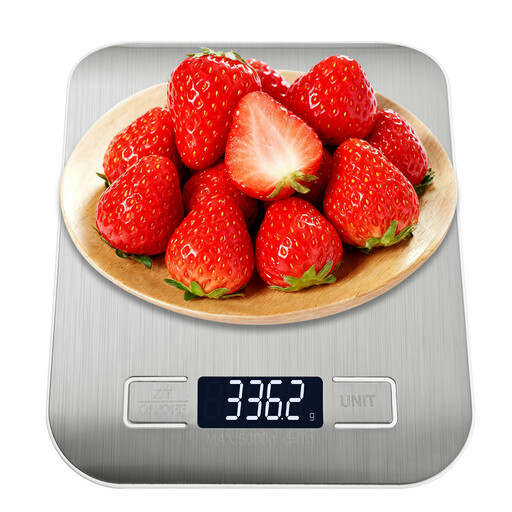
Digital kitchen scale with stainless steel surface
For weighing ingredients into a bowl; the title lists a tare function.
Capacity of up to 5 kg and 1 g increments. The title lists an LCD display and automatic shut-off.
The listed units are g, ml, oz, lb and fl.
Joybuy
 No image available
Digital kitchen scale, 10 kg
For weighing ingredients and adding them to a bowl; the description lists a tare function.
Capacity of up to 10 kg and 1 g increments. The product details list dimensions of 21 × 15,5 × 2,9 cm.
Joybuy
 No image available
Vivreal CFC-03White
For weighing ingredients in a bowl; the description lists a tare function.
Capacity of up to 5 kg; the product details list 1 g increments and dimensions of 18 × 14 × 1,5 cm.
According to the description, it requires two AAA batteries, which are not included.
Joybuy
Frequently asked questions
How can I tell if a scale is suitable for weighing a small amount of salt?
Compare the stated lower end of the weighing range and the increments with the quantity you plan to weigh. Also check that the combined weight of the container and salt is within the maximum capacity. A 0.1 g display alone is not independent proof of the actual measurement deviation.
How can I weigh salt without making a mess on the scale?
Place a suitable container on the scale and tare it before adding the salt. According to the manufacturer, the Soehnle Cooking Star lets you scoop salt directly with its removable spoon; only the spoon is specifically described as dishwasher-safe.
Which batteries should I check before using the scale for the first time?
According to the product pages, the CASO FinoCompact requires two AAA batteries and the KitchenDuo requires three AAA batteries; neither model includes them. Check what’s included and the specified battery type for the model you choose.
What are my rights when buying online or if a product develops a fault in Germany?
Consumers generally have a 14-day right to cancel an online purchase, although the details and exceptions depend on the contract. Germany’s consumer advice centre distinguishes the statutory rights you have against the seller from a voluntary guarantee.
What rules apply to kitchen scales and their batteries?
EU rules on non-automatic weighing instruments also apply when they are made available through distance selling. This does not mean that private dough-making requires an individually verified scale; check the applicable German regulations for specific legal questions. Germany’s Federal Environment Agency advises that used batteries and rechargeable batteries must not be put in household waste, but should be taken to a collection point.


