What to look for when buying
Choose a scale based on how you actually weigh your prepared ingredients: one after another in a bowl, as small individual portions or as a larger batch.
Standard digital kitchen scale
A good fit if: you mostly weigh seeds in grams into a bowl and tare between ingredients.
Keep in mind: this doesn’t automatically mean it will measure small individual portions more precisely.
Compact precision scale
A good fit if: you often weigh small amounts of seeds individually and they fall within the specified range.
Keep in mind: CASO gives the FinoCompact a maximum capacity of 500 g; the bowl and its contents must stay within this limit.
Dual-range or combination scale
A good fit if: you regularly weigh both small portions and heavy bowls.
Keep in mind: according to the manufacturer, the CASO KitchenDuo has separate ranges of up to 1 kg in 0.1 g increments and up to 15 kg in 1 g increments. The limits apply to their respective ranges.
| What you need |
What to look for |
Who it matters most to |
| Adding ingredients to one bowl |
Check that you can reset the display to zero between ingredients and that the bowl sits securely. ADE describes tare as useful for adding ingredients one after another. |
If I’m weighing several prepared ingredients into the same bowl, I don’t want to keep transferring them. Around 36% of consumers prioritise weighing ingredients in one bowl. |
| Small portions of seeds |
Compare the minimum weight and increments for the range you need. GEFU lists a minimum weight of 1 g and 0.1 g increments up to 1 kg for the PREZISO. |
If you’re portioning individual small amounts of seeds, check that the precision range suits the smallest amount you need to weigh. Around 29% of consumers prioritise small individual portions. |
| Bowl and larger batch |
Compare the combined weight of the bowl and ingredients with the maximum capacity of the range you’re using. CASO lists 15 kg in the standard range and 1 kg in the precision range for the KitchenDuo. |
If I’m weighing a larger bowl or several prepared portions at once, the total load matters. Around 21% of consumers prioritise larger batches. |
| Cleaning and storage |
Check the surface, storage options and whether batteries are included. Tefal lists a wipe-clean glass platform and two AAA batteries included with the BC50U0; CASO doesn’t list batteries as included with the KitchenDuo. |
If you put your scale away between baking sessions, look for a surface that’s easy to clean and somewhere suitable to store it. Around 14% of consumers prioritise ease of everyday use. |
Joybuy products for weighing ingredients in bowls
This selection includes digital kitchen scales with a tare function for weighing ingredients one after another in a bowl.
 No image available
Aigostar Austin kitchen scale, up to 5 kg
The stated tare function is useful when you’re weighing ingredients one after another into the same bowl.
The product name specifies a maximum capacity of 5 kg and a glass platform.
View at Joybuy
 No image available
Digital kitchen scale with stainless steel platform, up to 5 kg
The stated tare function is handy for adding several ingredients to a bowl one at a time.
The product name lists a stainless steel platform, an LCD display, automatic switch-off and a maximum capacity of 5 kg.
View at Joybuy
 No image available
Digital kitchen scale, up to 10 kg
If you’re weighing a larger bowl of ingredients, the stated maximum capacity is an important point of comparison.
The product name lists a maximum capacity of 10 kg, a stainless steel and plastic construction, and dimensions of 21 × 15,5 × 2,9 cm.
View at Joybuy
 No image available
Digital scale with removable bowl
A scale with a removable bowl may suit you if you want to weigh ingredients directly in the bowl.
The product name specifies a removable bowl.
View at Joybuy
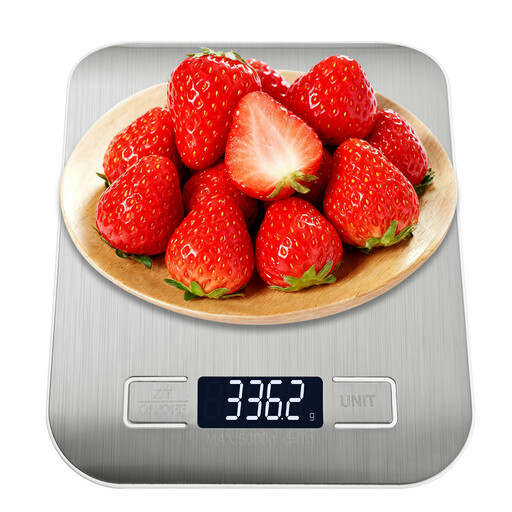 No image available
Vivreal CFC-03White kitchen scale, up to 5 kg
When weighing ingredients in a bowl, take the bowl’s weight into account alongside the stated maximum capacity.
The product name lists a maximum capacity of 5 kg and a stainless steel platform with an anti-fingerprint coating.
View at Joybuy
Frequently asked questions
How do I weigh prepared cracker ingredients one after another?
Place the scale on a flat, firm surface, put the bowl on it and tare. Weigh one ingredient, then reset the display before adding the next. Keep an eye on the combined weight of the bowl and its contents. Beurer’s instructions recommend using the scale on a flat, firm surface.
Does a display in 0.1 g increments prove that the error is no more than 0.1 g?
No. The display increments and weighing ranges stated by manufacturers don’t, by themselves, prove an independently verified error limit. Also compare the minimum weight with your smallest portion.
Does a scale need to be officially verified for home cracker baking?
For the purely private use discussed here, official verification isn’t treated as a buying requirement. Section 6 of the German Measurement and Calibration Ordinance distinguishes commercial use from purely private activities; if you’re using a scale commercially, you’ll need to check the requirements for your specific use.
Can I place seeds directly on the scale platform?
If food will come into direct contact with the platform, check the information for that specific surface. In the EU, materials intended to come into contact with food are covered by Regulation (EC) No 1935/2004; this doesn’t mean every scale platform is suitable. If you use a separate suitable container, it’s the surface of that container that matters.
What should I do if my scale is faulty, and how should I dispose of an old one?
If your scale develops a fault, contact the seller and distinguish your statutory consumer rights from any voluntary manufacturer’s guarantee. Old electrical appliances shouldn’t go in household rubbish; easily removable batteries should be returned separately. The Verbraucherzentrale explains how to make a complaint, while the German Environment Agency provides guidance on disposing of electrical appliances and batteries.


