Which type of scale is right for you?

Making truffles in a bowl

If you weigh chocolate and other ingredients one after another in the same bowl, look for a tare function, enough capacity for the bowl and its contents, and an easy-to-read display. Soehnle lists these features and capacities for its Page Compact 300 and Page Profi 300 models.

Weighing small additions separately

A finer graduation can be useful if your recipe quantities are genuinely small and you weigh them without a heavy, filled bowl. CASO Design and Beurer offer different measuring ranges and graduations for this purpose.

Easy to use day to day

If you only use your scale occasionally, check that you can still see the display with your bowl on the platform, how the scale is powered and what care instructions apply. CASO Design notes that batteries are not included with the KitchenDuo.

What should you look for when buying?

Platform kitchen scale

A good choice if: you weigh chocolate and other ingredients one after another in a mixing bowl.

The trade-off: A 1 g graduation does not tell you the actual measurement error and does not provide a finer display for small quantities.

Compact precision scale

A good choice if: you weigh small additions separately and the container and its contents are within the maximum capacity.

The trade-off: The smaller weighing platform and lower maximum capacity may make it unsuitable for a filled bowl.

Combined kitchen and precision scale

A good choice if: you want to weigh both larger bowls and small additions with one device.

The trade-off: With the CASO KitchenDuo, the finer graduation and higher capacity apply to two separate weighing ranges.

What you need What to check before buying Who is this important to?
Weighing the bowl and the full batch Compare the maximum capacity, including the container, the weighing platform, tare function and visibility of the display. If I add all the ingredients for a full batch to one bowl, the scale needs to support the bowl and its contents, and the reading needs to remain easy to see. Around 42% of consumers prioritise weighing the bowl and the full batch together.
Weighing small recipe quantities Check the graduation across the weight range you need, as well as the maximum capacity and container size. For small additions, I want a suitable graduation without assuming that it tells me the measurement error. Around 25% of consumers prioritise weighing small quantities separately.
Using the display and tare function Check with your own bowl that the display and tare button remain visible and accessible. With a wide bowl, I want to be able to read the weight as I add ingredients without having to move the container. Around 17% of consumers focus mainly on readability and ease of use.
Power supply and care Check what’s included, which batteries are needed and the care instructions. If I only use the scale occasionally, I want to have it ready when I need it and be able to look after it easily. Around 16% of consumers prioritise readiness for use and care.

Which mistakes should you avoid?

  • Assuming a 0.1 g display means a measurement error of 0.1 g

    Graduation refers to the increments shown on the display. For the Beurer KS 36, it also depends on the weight range, according to the instruction manual. The Physikalisch-Technische Bundesanstalt notes that there is no statutory minimum accuracy requirement for household scales.

    Check the graduation for the quantities you actually weigh, and distinguish between the manufacturer’s specifications and independently tested results.

  • Comparing only the weight of the chocolate with the maximum capacity

    The scale also has to support the container and any ingredients already added. A precision scale with a maximum capacity of 500 g may therefore not be suitable for a filled bowl.

    Estimate the maximum total weight, including the container, and compare it with the measuring range of the specific model.

  • Leaving display and power checks until you start cooking

    A wide bowl can obscure the display. And if a required battery is missing, the scale may not be ready to use straight away.

    Check that you can see the display clearly with your usual bowl, and make sure you have the right power supply in advance.

    The manufacturer says that batteries are not included with the CASO FinoCompact and KitchenDuo. Make sure you have the required power supply ready when you prepare to use them.

A guide to the leading brands

Soehnle

The Page Compact 300 and Page Profi 300 are platform scales designed for containers of different sizes.

  • Soehnle specifies a 5 kg capacity, 1 g graduation and tare function for the Page Compact 300. The Page Profi 300 has a 20 kg capacity, 1 g graduation and a hold function.
  • The stated 1 g graduation does not offer a finer display for small recipe quantities and, on its own, says nothing about measurement error.

CASO Design

The FinoCompact is designed for small quantities, while the KitchenDuo combines a standard scale with a separate precision-weighing range.

  • CASO Design specifies 0.1 g increments up to 500 g for the FinoCompact. According to the manufacturer, the KitchenDuo offers 1 g increments up to 15 kg in its standard range and 0.1 g increments up to 1 kg in its precision range.
  • The FinoCompact’s maximum capacity limits its use with heavy containers. The product page states that batteries are not included with the KitchenDuo.

Beurer

The KS 36 is aimed at anyone who wants to weigh small quantities on a compact precision scale.

  • Beurer specifies a maximum capacity of 2 kg and a weighing platform measuring 11,5 × 8,0 cm.
  • According to the instruction manual, the graduation changes from 0.1 g to 0.2 g or 0.5 g depending on the weight range. The 0.1 g graduation therefore does not apply throughout.

WMF

With a 20 × 20 cm weighing platform, this digital kitchen scale is an option for adding ingredients to a bowl.

  • WMF specifies a 5 kg capacity, 1 g increments, a tare function and a 20 × 20 cm platform for this model.
  • These specifications do not demonstrate independently measured accuracy or a finer graduation than 1 g.

Joybuy products for weighing ingredients in the kitchen

The following digital platform scales are described as suitable for weighing ingredients in the kitchen. Compare capacity, graduation and power supply with your bowl and the way you prepare your food.

Digital kitchen scale with stainless steel weighing platform

Digital kitchen scale with stainless steel weighing platform

Suitable for weighing ingredients in a container, provided its total weight is within the stated capacity.

5 kg capacity; 1 g graduation; tare function; USB-C power supply.

View at Joybuy

Digital kitchen scale with stainless steel platform and LCD display

Digital kitchen scale with stainless steel platform

An option for weighing ingredients in a container, provided the total load stays within the maximum capacity.

5 kg capacity; 1 g graduation; tare function; several selectable units. Batteries are included, according to the product description.

View at Joybuy

Unique Bluetooth kitchen scale with a 10 kg capacity

Unique Bluetooth kitchen scale, 10 kg

The stated capacity gives you room for the combined weight of the bowl and ingredients. Also check that the platform is suitable for your container.

10 kg capacity; 1 g graduation; dimensions 20 × 14 cm; glass surface.

View at Joybuy
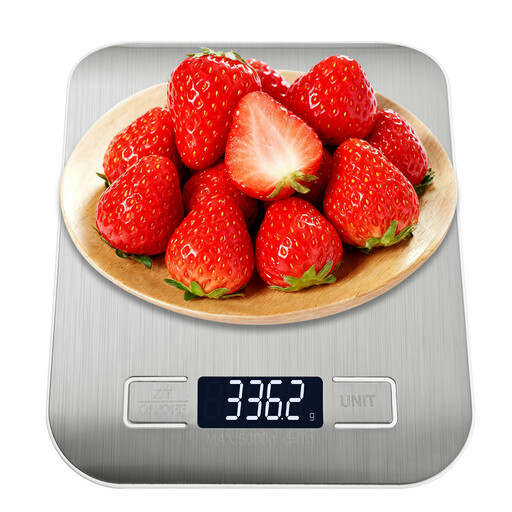
Vivreal CFC-03White kitchen scale

Vivreal CFC-03White kitchen scale

Suitable for weighing ingredients in a container, as long as the bowl and its contents together weigh no more than 5 kg.

5 kg capacity; 1 g graduation; weighing platform 18 × 14 cm; stainless steel surface. Two AAA batteries are not included.

View at Joybuy

Frequently asked questions

Does a kitchen scale need to be calibrated for making truffles at home?

Calibration is not a selection criterion for domestic use. The Physikalisch-Technische Bundesanstalt distinguishes household scales from scales used for legally regulated applications; commercial transactions based on weight are a different use case.

How do I use the tare function when adding ingredients?

Place the container on the scale and tare it before adding the ingredient. You can tare the scale again before adding more ingredients, but keep an eye on the combined weight of the container and its contents.

What should I know before using a precision scale for the first time?

Check the instructions for the specific model. For the KS 36, Beurer recommends calibrating the scale with the supplied weight before first use and placing it on a level surface. This guidance does not automatically apply to other scales.

Are batteries included, and where can I dispose of used batteries?

It depends on the model: the manufacturer says that batteries are included with the Soehnle Page Compact 300, but not with the CASO FinoCompact or KitchenDuo. In Germany, consumers can return used batteries from appliances free of charge to retailers or local collection points. They must not be put in household rubbish.