If you’re weighing grains in a bowl, choose scales with a tare function and check that the bowl and its contents together stay within the maximum capacity. For larger quantities, a sufficiently large weighing platform and an easy-to-read display are important. In a small kitchen, consider the scales’ footprint and storage space too. A manufacturer’s stated display increments, such as 1 g, are not independent evidence of measurement error.
Who these scales are suitable for
Hosts using large bowls
If you weigh several portions at once, choose a maximum capacity and weighing platform to suit your bowl, and make sure the display remains easy to read. Manufacturer information for certain Beurer and CASO models lists larger weighing platforms and higher capacities.
Cooks short on kitchen space
If you plan to put your scales away after cooking, their dimensions and the size of the weighing platform are important factors. Soehnle describes different model sizes to suit different space requirements.
Cooks who add ingredients one at a time
If you’re adding grains and other ingredients to the same container, a tare function lets you remove the container’s weight from the display and reset it before adding the next ingredient. WMF lists this feature for the digital kitchen scales described.
What to look for when buying
First, check the tare function and maximum capacity for the bowl and its contents together. Then compare the weighing platform and display with your bowl, and consider how much storage space you have.
| What matters |
What to check when buying |
Who it matters most to |
| Deducting the bowl’s weight |
Check for a tare function and make sure the maximum capacity covers the bowl plus its contents. |
If I weigh several ingredients one after another in the same container, I want to be able to deduct its weight easily. Around 36% of consumers prioritise weighing ingredients in the same bowl. |
| Weighing large quantities |
Compare the total weight with the maximum capacity, and the bowl’s diameter with the weighing platform. |
When weighing several portions at once, I need sufficient capacity and a platform that holds my bowl securely. Around 29% of consumers say larger batches are their main consideration. |
| Display and storage |
Check that the display is visible with the bowl in place and that the scales are easy to store. |
If I have limited worktop or storage space, the scales need to fit my bowl without taking up more room than necessary. Around 21% of consumers prioritise readability and space. |
| Power and care |
Check the battery type or charging port, as well as the care instructions for the specific model. |
I want to know whether I’ll need to replace batteries or charge a battery, and how to clean the scales. Power and care are the main considerations for around 14% of consumers. |
Common buying mistakes
-
Only counting the grains towards the maximum capacity
The bowl adds weight too. Although the tare function removes its weight from the display, it doesn’t reduce the actual load on the scales.
Before you buy, estimate the total weight of the bowl and the largest quantity of grains you plan to weigh.
-
Confusing 1 g display increments with a guaranteed measurement error
A display increment of 1 g describes the steps shown on the display, not the maximum error in a measurement.
Consider what the manufacturer’s specifications mean when choosing scales, and compare accuracy only using verifiable tests of the specific model.
-
Focusing only on capacity when using large bowls
Even if the maximum capacity is sufficient, a bowl may not sit securely on the scales or could obscure the display.
Compare the weighing platform and the position of the display with your container. A hold function only helps you read the display if the specific model has one.
Brands to consider
Soehnle
Soehnle offers models in different sizes, according to the manufacturer. For the Page Compact 300, the manufacturer lists a maximum capacity of 5 kg and display increments of 1 g. Page Profi models have larger weighing platforms and higher maximum capacities.
- The range of model sizes makes it easier to choose scales to suit the space available.
- Specifications for capacity and display increments are not independent measures of accuracy.
WMF
For its Digital Kitchen Scales in Black, CMMF 3201000339, WMF lists a tare function, a maximum capacity of 5 kg and a weighing platform measuring 23 × 15 cm.
- WMF says the model has display increments of 1 g and a battery-level indicator.
- According to the product information, the model described is not dishwasher-safe.
Beurer
For the KS 34 Stainless Steel, item number 70312, Beurer lists a maximum capacity of 15 kg, a weighing platform measuring 26,3 × 20 cm and a hold function.
- The hold function can make the display easier to read if a container obscures it.
- These specifications apply to the version with item number 70312, not necessarily to every KS 34 model.
ZWILLING
For the Enfinigy 53011-051-0, ZWILLING lists a maximum capacity of 10 kg, a tare function and a battery that can be charged using a USB cable.
- Rechargeable power may appeal to buyers who prefer not to use replaceable batteries.
- A rechargeable battery is no proof of greater accuracy. At the end of its life, it should be disposed of separately.
ADE
For the Home Isabella KE2354, ADE lists two separate weighing platforms, each with its own tare function: the larger platform weighs up to 5 kg and the smaller one up to 500 g.
- The manufacturer specifies 0,1 g increments for the smaller platform.
- An additional platform for small quantities isn’t essential if you’re only weighing portions of rice.
Joybuy product selection
The following digital scales are suitable for portioning ingredients in the kitchen. Depending on the model, check that the tare function, maximum capacity and design suit your bowl and the quantity you plan to weigh.
 No image available
Digital kitchen scales with tare function, 5 kg
The tare function is useful for weighing grains in a container.
Maximum capacity: 5 kg. Stainless steel platform and LCD display, according to the product name.
View at Joybuy
 No image available
Digital kitchen scales with stainless steel platform, 5 kg
The tare function is useful when weighing grains in a bowl.
Maximum capacity: 5 kg. The product name also mentions an automatic shut-off function.
View at Joybuy
 No image available
Digital kitchen scales, 10 kg
The tare function is designed for weighing in a bowl; the stated maximum capacity is 10 kg.
The product name specifies stainless steel and plastic, and dimensions of 21 × 15,5 × 2,9 cm.
View at Joybuy
 No image available
Digital scales with removable bowl
The removable bowl is a handy option if you want to weigh grains in a container supplied with the scales.
View at Joybuy
 No image available
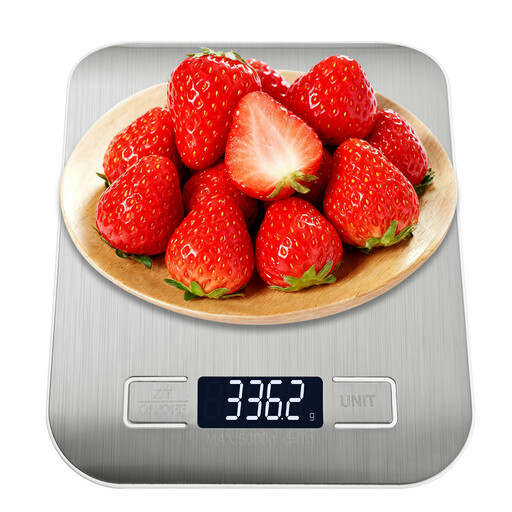
Vivreal CFC-03White kitchen scales, 5 kg
The stated maximum capacity of 5 kg may be useful when weighing several portions of grains.
The product name specifies a stainless steel platform and the option to switch between units of measurement.
View at Joybuy
Frequently asked questions
How do I weigh rice or other grains directly into a bowl?
Place the empty bowl on the scales and, if your model has a tare function, reset the display before adding the grains. The maximum capacity still needs to cover the combined weight of the bowl and its contents.
Do kitchen scales with 1 g increments have a maximum error of 1 g?
No. This figure describes the display increments, not the maximum measurement error. You’ll need suitable test documentation for the specific model to establish its measurement error.
What should I look for when it comes to cleaning and power?
Check the care instructions and whether the model uses batteries or a rechargeable battery. WMF says the digital kitchen scales described are not dishwasher-safe; for the Enfinigy 53011-051-0, ZWILLING lists a battery that can be charged using a USB cable.
Do kitchen scales used for private cooking need to be calibrated in Germany?
For the private cooking use described here, calibration is not listed as a purchase requirement. Section 3 of the MessEV defines which non-automatic weighing instruments are covered according to their intended use; this does not determine whether calibration is needed for subsequent commercial or official use.
How should I dispose of old digital scales and their batteries?
In Germany, old electrical equipment should be taken to an authorised collection point or a retailer that is required to accept it. Old batteries and rechargeable batteries must not go in household waste; the Federal Ministry for the Environment lists retailers and local authorities as return points.


