
Lieferung heute & morgen

Qualitätsgarantie

Willkommens-Angebote freischalten: KOSTENLOSE Lieferung | Bis zu 80 % RABATT | Kostenlose 30-Tage-JoyPlus-Testphase
App herunterladen
A kitchen sieve needs to do more than simply drain water in everyday use. Home cooks use one to wash vegetables, families to drain pasta, tea lovers to strain loose leaves and coffee drinkers to achieve a clearer brew. In commercial kitchens, durability, hygienic cleaning and the right size also matter.
However, a product name alone tells you little about how well it will perform. A fine-mesh fine-mesh sieve is not automatically suitable for large quantities of pasta, while a coarsely perforated colander may let fine particles through. So before you buy, take a close look at the design, material and intended use.
A compact sieve is handy for berries, tea or individual portions. But a capacity of 0.5 litres can quickly prove too small for several portions of pasta. If you overfill the sieve, water drains more slowly and it becomes harder to toss the food.
Check the diameter, height and capacity. A 2.2-litre model is better suited to vegetables, fruit or smaller quantities of pasta, while an expandable sink strainer can cover more of the area above your sink.
Terms such as ‘rust-proof’, ‘extra sturdy’ or ‘professional’ are of limited use without technical details. For a stainless steel sieve, the product information should ideally state the material it is made from and whether it is intended for contact with food. Care instructions also matter for handles made from plastic, wood or silicone.
A wooden handle can feel comfortable to hold, but it needs different care from a one-piece stainless steel or silicone model. For plastic handles, check the product description or packaging for the specified temperature rating.
A coarse sieve drains liquid quickly, but may not catch small grains, flour or tea particles. A very fine mesh filters more thoroughly, but may work more slowly with thicker foods and needs careful cleaning.
Different tasks call for different designs:
Stainless steel is a practical choice for many kitchens, as it holds its shape and is easy to wipe clean. Check whether the model is dishwasher-safe or should be washed by hand. With fine-mesh sieves, rinse off food residue straight after use to stop the mesh from clogging.
Silicone or PBT heads can be useful with coated cookware, provided the product information confirms they are suitable for this purpose. A skimmer should not be left in a hot pan or over an open flame if the manufacturer advises against it.
A kitchen sieve with a handle is well suited to small quantities and working directly over a pan. A long handle keeps your hand further from the heat. A hook on the handle can help it rest securely on the rim of a pan. For the sink, an expandable model is a good choice if you need to fit different sink sizes.
Also consider the sieve’s weight, handle shape and how securely it can be set down. A long handle is not necessarily more comfortable if it makes the sieve top-heavy.
The openings should suit the task. Round holes are fine for pasta and blanched vegetables. Flour, fine tea particles and soy milk need a finer mesh. Terms such as ‘200 Mesh’ or ‘800 Mesh’ describe the filter’s mesh density; how effectively it catches particles also depends on the material and construction.
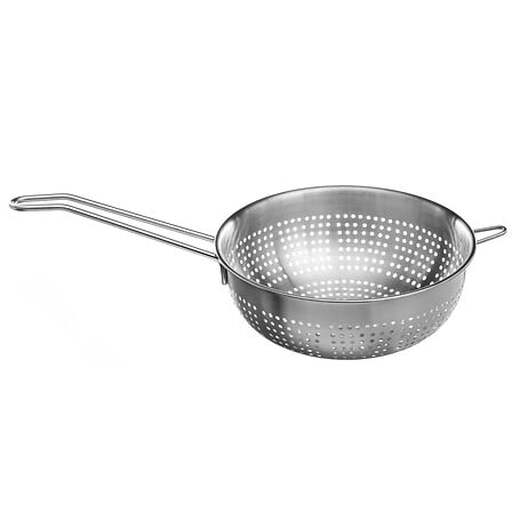
Why it suits this profile: This compact 0.5-litre sieve is designed for small portions, berries, fruit and individual ingredients. The long handle makes it easier to hold while rinsing and draining.
The capacity and compact dimensions are clearly stated, making it easier to tell whether this sieve is intended for individual portions or larger quantities.
Stainless steel construction, 0.5-litre capacity and a long handle for small kitchen tasks.
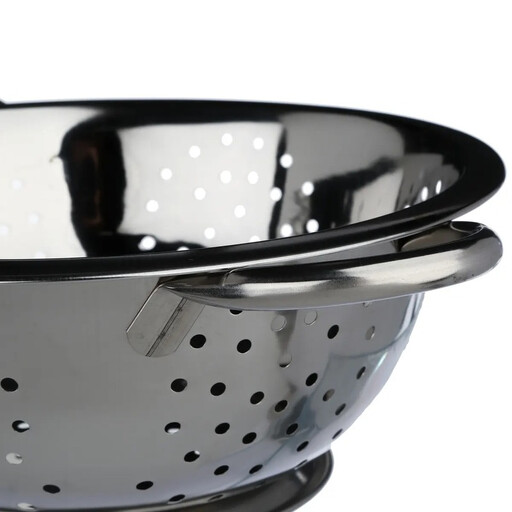
Why it suits this profile: This sieve has a diameter of 24 cm and a height of 12 cm. It is designed for pasta, vegetables, fruit and dry ingredients.
Specific measurements are more useful than vague claims such as ‘large’ or ‘extra spacious’. Before buying, you can compare the size with your sink and cupboard.
2.2-litre capacity, 24 cm diameter and stainless steel construction for a range of kitchen tasks.

Why it suits this profile: This expandable draining sieve is designed to fit sinks of different widths and offers a 3.6-litre capacity for larger quantities.
The expandable design reduces the risk of buying a sieve that won’t sit securely over your sink. It’s still worth checking the stated length against the width of your sink.
3.6-litre capacity, stainless steel mesh, expandable length and a handle for draining over the sink.
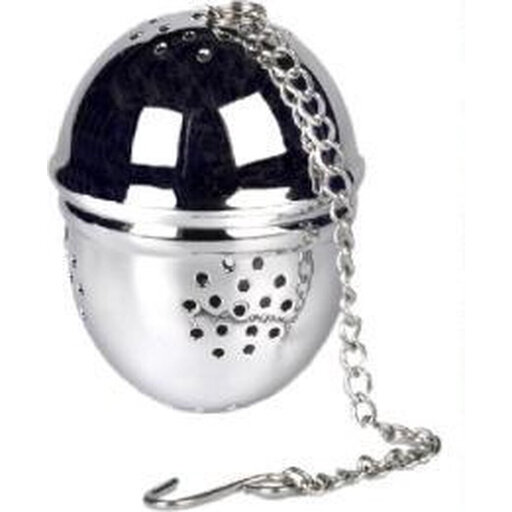
Why it suits this profile: This round tea strainer, with a diameter of 4 cm, is designed for loose-leaf tea and use in cups or teapots.
Its compact design is clearly intended for drinks, not pasta or vegetables. That helps you avoid choosing the wrong product based on a generic label such as ‘multifunctional sieve’.
Stainless steel, a round shape and a 4 cm diameter for loose-leaf tea in different vessels.
For fried foods or dumplings, a skimmer can be more practical than a deep sieve. PBT or silicone models often have a long handle and perforated surface. A draining spoon lets you lift food out while allowing water or oil to drain away.
For soy milk and very fine liquids, nylon filters with a specified mesh density are an option. For coffee, you can use a 304 stainless steel filter or an 800 Mesh model. However, the flow rate depends on the grind size, quantity and liquid. Product descriptions should therefore not be taken as a guarantee of a particular flavour.
We’ve put together a complete, regularly updated list of products that meet these strict selection criteria and fully comply with the safety regulations in force in the EU.
For pasta, choose a colander with plenty of capacity, sturdy handles and good drainage. If you’re cooking several portions, make sure its diameter and capacity suit the amount in your pan. A small kitchen sieve with a handle is better for individual portions or lifting food out of the cooking water.
Rinse a fine-mesh sieve under running water as soon as possible after use. If residue has dried on, a brief soak can help. Use a soft brush and take care not to distort the mesh. Check the product information to see whether the sieve is dishwasher-safe.
A colander usually refers to a bowl or sieve for draining larger quantities. A draining sieve can also be used over the sink and is often designed specifically to let water drain away. Retailers sometimes use the terms interchangeably, so it’s best to check the actual dimensions, hole structure and intended use.