
Lieferung heute & morgen

Qualitätsgarantie

Willkommens-Angebote freischalten: KOSTENLOSE Lieferung | Bis zu 80 % RABATT | Kostenlose 30-Tage-JoyPlus-Testphase
App herunterladen
A kitchen sieve is one of the most frequently used kitchen utensils. It’s useful for draining pasta, washing fruit and vegetables, draining other foods and sifting dry ingredients. Yet unclear size information and exaggerated product claims often lead to unsuitable purchases.
Before you buy, check whether the kitchen sieve you have in mind really suits the way you cook. A small draining sieve is handy for a portion of berries, but can quickly overflow when you’re preparing food for the family. A fine-mesh sieve catches small particles, but liquids drain through it more slowly. The material, handle design and ease of cleaning all affect how practical it is for everyday use.
A large diameter doesn’t automatically mean that a sieve can hold a lot. Height, shape and usable capacity matter too. A shallow model is ideal for rinsing, while a deep colander can hold more pasta or vegetables.
The description stainless steel kitchen sieve doesn’t tell you everything about how a product is made. Check the exact material specification, how sturdy the rim is and how the sieve body is joined to the handle. For example, the Zwilling model is listed as 18/10 stainless steel. Other products combine stainless steel with wood, plastic or silicone.
A sieve for draining needs to sit securely over a sink, saucepan or bowl. A long handle makes it easier to work with hot liquids, while a flat base helps keep the sieve steady when set down. For small portions, a kitchen sieve with a handle may be more practical than a large, freestanding model.
Stainless steel is a good choice for many households, as it’s durable and easy to clean when cared for properly. Look for specifications such as 18/10 stainless steel or 304 stainless steel, if provided by the seller. If the product combines stainless steel with plastic, check the temperature guidance. A plastic frame isn’t necessarily suitable for boiling liquids.
Silicone can be a good alternative for coated pans, as it’s less likely to scratch their surface during normal use. Follow the care instructions provided by the manufacturer for plastic and silicone parts.
Choose a hole size to suit what you’ll be using the sieve for:
A sieve with small holes may drain liquids more slowly than a colander with larger perforations. For ramen, dumplings or hotpot ingredients, compact sieves with long handles are often easier to control.
Models with a capacity of around 0.5 to 1 litre are enough for one person or small quantities. Families and frequent cooks may prefer larger options, such as a 2.2-litre sieve or an expandable draining sieve with a capacity of 3.6 litres.
Also check:
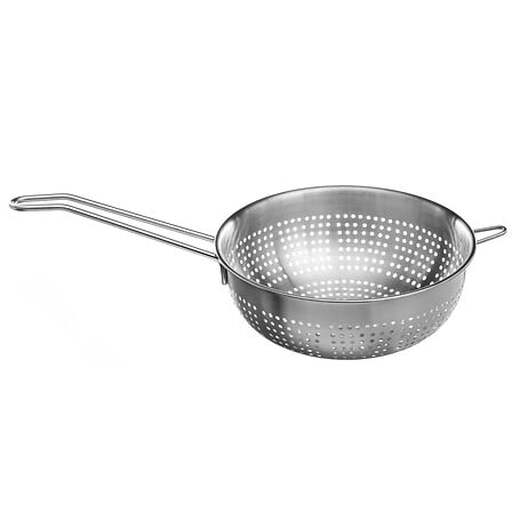
Why it suits this profile: This compact 0.5-litre model is ideal for individual portions, berries, herbs and small amounts of vegetables. The long handle makes it easier to hold while rinsing or draining.
The stated capacity gives you a clearer idea of what the sieve is designed for than diameter alone. This helps you avoid choosing a model that’s too large or unwieldy for small quantities.
0.5-litre capacity, stainless steel construction and a long handle for small kitchen tasks.
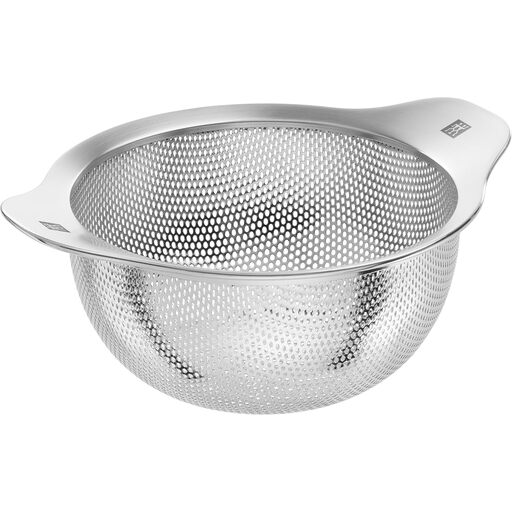
Why it suits this profile: Made from 18/10 stainless steel, this 16cm sieve combines the functions of a strainer, colander and bowl. Its flat base helps it stand securely.
The 18/10 material specification and exact size make it easier to compare with other sieves. The stackable options in 16, 20 and 24cm make it easier to store several sieves.
18/10 stainless steel, 3-in-1 design, flat base and, according to the product description, dishwasher-safe.
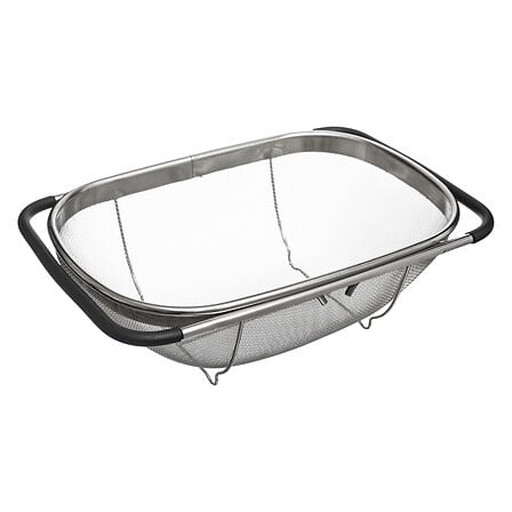
Why it suits this profile: This expandable draining sieve is designed for larger amounts of pasta, vegetables or fried food, and can be positioned over sinks of different sizes.
Its 3.6-litre capacity and adjustable length reduce the risk of choosing a sieve that’s too small for family portions.
3.6-litre capacity, expandable design, stainless steel and an ergonomic handle.
For Asian cooking, hotpot and individual portions, a Japanese noodle strainer with a pot hook or a small slotted spoon can also come in handy. A slotted straining spoon lets you lift dumplings and vegetables out of liquids without needing a full-size colander. For flour, soy milk or icing sugar, consider fine-mesh options such as a stainless steel mesh sieve.
We’ve put together a comprehensive, regularly updated list of products that meet these strict selection criteria and fully comply with the safety regulations in force in the EU.
For pasta, a deep colander with enough capacity and a stable base is a practical choice. A sieve with a handle may be all you need for small portions. For family-sized servings, consider the diameter, height and capacity together.
A colander or pasta strainer usually has larger openings, allowing cooking water to drain quickly. A fine-mesh sieve catches smaller particles and is better suited to flour, icing sugar, stock or finer liquids.
Rinse the sieve soon after use and dry it thoroughly. Don’t use steel wool on stainless steel or harsh abrasive cleaners on plastic frames. Regularly check the mesh, rim and handle for signs of damage, and follow the relevant instructions for cleaning it in the dishwasher.