
Lieferung heute & morgen

Qualitätsgarantie

Willkommens-Angebote freischalten: KOSTENLOSE Lieferung | Bis zu 80 % RABATT | Kostenlose 30-Tage-JoyPlus-Testphase
App herunterladen
A kitchen sieve is one of the most frequently used kitchen essentials: it washes fruit and vegetables, drains pasta, filters liquids and helps with baking. Even so, buying the wrong one can lead to unnecessary expense. Not every sieve fits your sink, portion size or intended use.
A large diameter does not automatically mean a high capacity. Depth, base area and handle positioning are also important. A shallow draining colander may tip when draining heavier foods, while a deep pasta colander takes up more cupboard space.
Before buying, check:
A fine-mesh sieve with small mesh openings is suitable for flour, icing sugar, fine liquids or tea leaves. However, it may drain more slowly when handling large quantities of pasta. A coarsely perforated vegetable colander, on the other hand, is practical for washing and draining, but will not reliably retain small particles.
The hole or mesh structure should therefore suit the intended purpose:
Plastic is lightweight and often affordable. Stainless steel is shape-retaining and, for suitable models, may be dishwasher-safe. A coating may be more susceptible to scratches. Even with dishwasher-safe products, the manufacturer’s instructions should be followed.
Look for food-safe materials, smooth edges and clear care instructions. With a stainless steel sieve, rust-resistant properties and the specific grade of stainless steel are also relevant, where stated.
For everyday use, sturdy handles, evenly sized openings and neatly finished edges are important. Products that come into direct contact with food should be explicitly intended for this purpose. Temperature limits are particularly important for plastic models. A sieve with a plastic frame is not automatically suitable for boiling-hot liquids.
For small portions or berries, a compact sieve of around 0.5 litres is usually sufficient. Family households are more likely to benefit from 2 to 3.6 litres. A large pasta colander should also sit securely in the sink or over a saucepan.
An extendable sieve can be a worthwhile choice for small kitchens, as it can be placed across sinks of different widths and then stored in a more compact form. Alternatives include models with hanging loops, long handles or foldable designs. Check that the mechanism locks securely and that the support surfaces fit your sink.
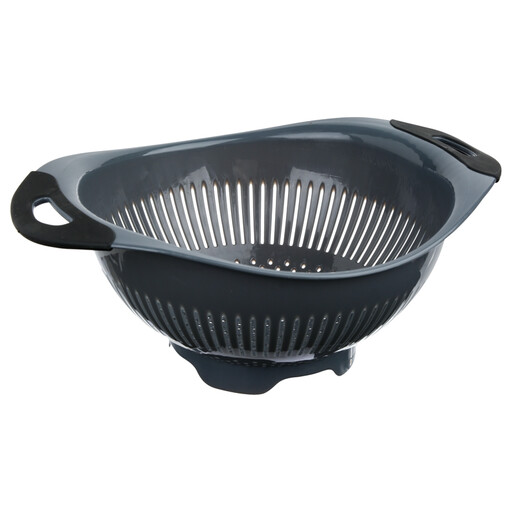
Why this product suits this profile: This 2.5-litre plastic sieve is designed for everyday tasks such as washing vegetables, rinsing fruit and draining pasta. Measuring 31.6 × 24.3 × 12.5 cm, it offers a medium capacity for typical household portions.
The stated capacity and exact dimensions make it easier to assess the product before buying. According to the product description, the TPR handle has an anti-slip design.
Food-safe PP, a 2.5-litre capacity and a low product weight of 0.162 kg.
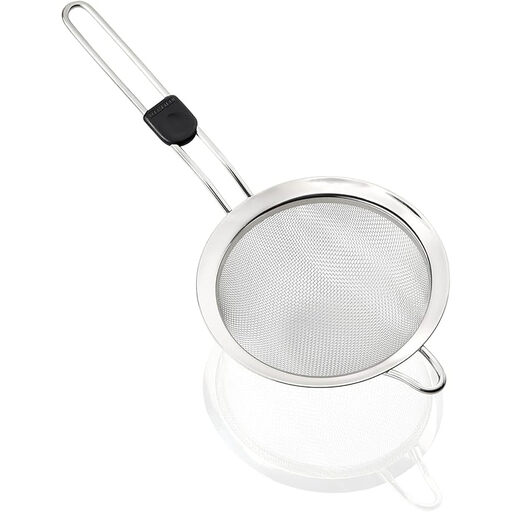
Why this product suits this profile: This 16 cm sieve made from rust-resistant stainless steel is designed for baking ingredients, liquids and smaller draining tasks. The hanging loop helps keep storage organised.
The stated mesh size of 1.5 mm shows that this is intended more as a fine-mesh sieve than as a large pasta colander. This makes it easier to assess its intended use realistically.
Stainless steel construction, 1.5 mm mesh openings, thumb rest and, according to the product information, dishwasher-safe.
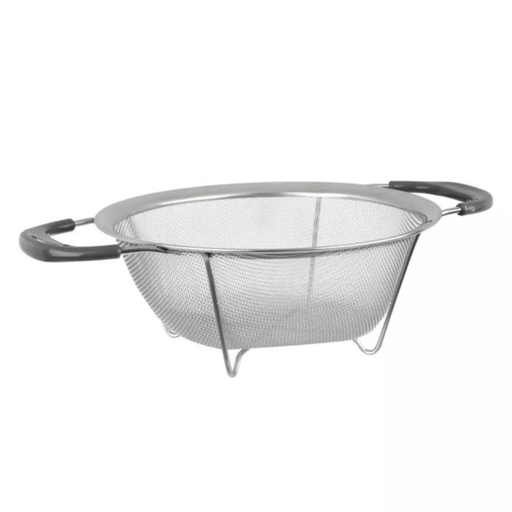
Why this product suits this profile: This 22 cm sieve combines a fine 316 stainless steel mesh with a plastic frame. According to the product description, it is suitable for sifting flour, draining pasta, washing berries and filtering liquids.
The product description explicitly states the plastic frame’s temperature limit: very hot liquids should not be poured in directly. This helps prevent incorrect use.
22 cm diameter, 316 stainless steel mesh and, according to the product information, dishwasher-safe.
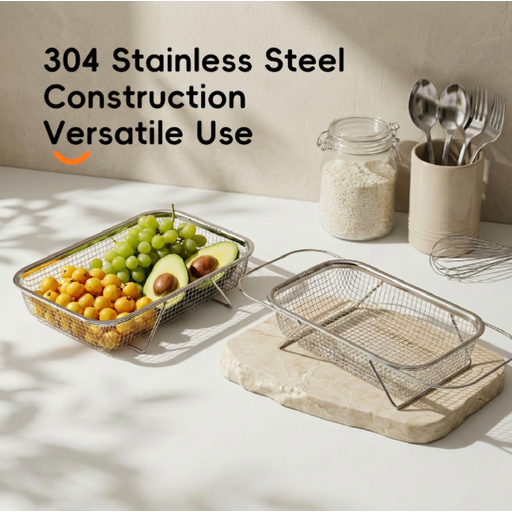
Why this product suits this profile: According to the product description, this extendable sink sieve made from 304 stainless steel is designed to fit different sink sizes. The stated length is 29.5 cm and the width is 6.9 cm.
The extendable design reduces the storage space required. Before loading it, check that the sieve rests securely on your sink.
Food-safe 304 stainless steel, an extendable design and dense, evenly distributed drainage openings according to the product description.
We have put together a complete, regularly updated list of products that fully meet these strict selection criteria and the safety regulations applicable in the EU.
Rinse a new kitchen sieve thoroughly before using it for the first time. Do not remove residues with harsh cleaning products or abrasive sponges. Fine metal mesh can become misshapen through pressure, knives or heavy foods.
When handling hot liquids, follow the material and temperature instructions. Plastic parts can be damaged by high temperatures. A sieve should also not be used directly on hobs, in the oven or in the microwave unless it is expressly designed for this purpose.
For individual portions, a small sieve of around 0.5 litres is often sufficient. For family meals, 2 to 3.6 litres is more practical. Measure your sink, saucepan and storage space before buying as well.
That depends on how you intend to use it. Stainless steel is shape-retaining in many designs and suitable for long-term use. Plastic is usually lighter and may be more comfortable to hold with wet hands. Material quality, construction, temperature limits and care instructions are the key factors.
A fine-mesh sieve is commonly used for sifting flour, icing sugar and cocoa, or for filtering fine particles from liquids. For large quantities of pasta, a coarsely perforated draining colander is usually more practical.