
Lieferung heute & morgen

Qualitätsgarantie

Willkommens-Angebote freischalten: KOSTENLOSE Lieferung | Bis zu 80 % RABATT | Kostenlose 30-Tage-JoyPlus-Testphase
App herunterladen
A kitchen sieve is a staple in many British households, but it is often underestimated when making a purchase. Pasta strainers, fine-mesh sieves, flour sifters and expandable sink strainers can differ considerably in terms of material, mesh size, capacity and ease of use. A model that works well for draining pasta is not automatically suitable for icing sugar or homemade juices.
As Joybuy Product Recommendation Officers, we therefore focus on clear product features rather than marketing promises. Before choosing a model, you should be aware of three common buying mistakes.
The term stainless steel does not automatically specify the exact alloy or how the product has been made. For everyday kitchen use, details such as 18/10 stainless steel, 304 stainless steel or 316 stainless steel are more helpful. Neatly finished edges, sturdy handles and a sieve mesh that does not easily deform during normal use are equally important.
With a stainless steel kitchen sieve featuring a plastic frame, you should also check whether the frame is designed for hot liquids. For example, the model with a 22 cm diameter states that the plastic frame should not be used above 70 °C.
A coarse-holed pasta strainer lets water drain quickly, but it will not retain fine flour or fruit pulp. For icing sugar, cocoa, flour or soya milk, a fine-mesh sieve with closely spaced mesh is more suitable. If you only want to wash vegetables and drain pasta, you generally do not need an especially fine structure.
A small sieve is easy to store, but it can overflow when handling larger portions. A 24 cm pasta strainer offers more capacity, but also requires more storage space. With an expandable sink strainer, the usable width, support surfaces and stability over the sink are all important. A model with a 3.6-litre capacity is designed for larger quantities, while a mini kitchen sieve is better suited to small portions or compact kitchens.
For regular use, rust-resistant metals such as stainless steel are practical because they are odour-neutral and easy to clean when suitably finished. According to the product details, the 22 cm sieve with 316 stainless steel mesh and plastic frame is suitable for food contact and dishwasher-safe. For coated products or items made partly from plastic, it is worth checking the cleaning instructions and temperature limits.
Also look out for potentially sharp edges on the mesh. A sieve should be allowed to dry completely after cleaning before being put away. Abrasive cleaners, wire wool and hard brushes can damage the mesh and frame.
A defined mesh size is useful for baking ingredients. According to the product data, the Leifheit ProLine kitchen sieve has a mesh opening of 1.5 mm, making it suitable for flour, icing sugar and similar dry ingredients. For liquids containing fruit pulp or fine residues, closely woven filter or strainer models may be appropriate.
A classic colander with larger openings, on the other hand, is suitable for pasta, potatoes and vegetables. Your choice should be based on the smallest particles you want the sieve to retain.
A deep strainer with a 2.2-litre capacity is suitable for everyday portions. A 24 cm model provides plenty of room for pasta or washed vegetables. Practical handles and a raised base make draining easier, especially when both hands are needed to handle the pan and sieve.
For small kitchens, collapsible or expandable models are worth considering. With a folding model, however, check whether the folding points are easy to clean. For dishwasher-safe products, follow the manufacturer’s care instructions, as repeated exposure to high temperatures can affect plastic parts over time.
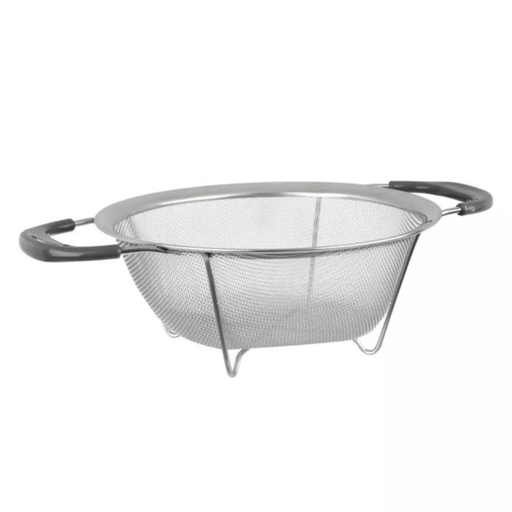
Why this product suits this profile: The 22 cm diameter covers several everyday tasks, including draining, washing and sieving. The combination of stainless steel mesh and a plastic frame offers low weight alongside clearly specified construction.
The product details specify a dishwasher-safe design while also stating the temperature limit for the plastic frame. This makes it easier to plan its use with hot liquids.
316 stainless steel mesh, 22 cm diameter and suitable for straining and washing.
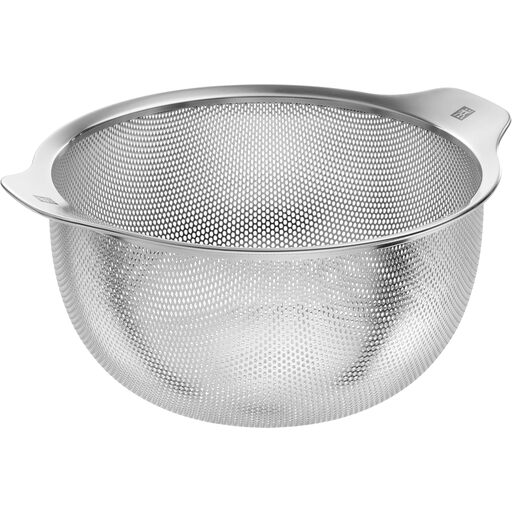
Why this product suits this profile: The 24 cm pasta strainer, made from 18/10 stainless steel, is designed for larger portions and regular kitchen use. Side handles and a raised base make it easier to handle.
According to the product information, the construction uses 18/10 stainless steel rather than a material mix with a vulnerable plastic frame. The integrated handles and base reduce the risk of slipping while draining.
24 cm diameter, 18/10 stainless steel, side handles and dishwasher-safe cleaning.
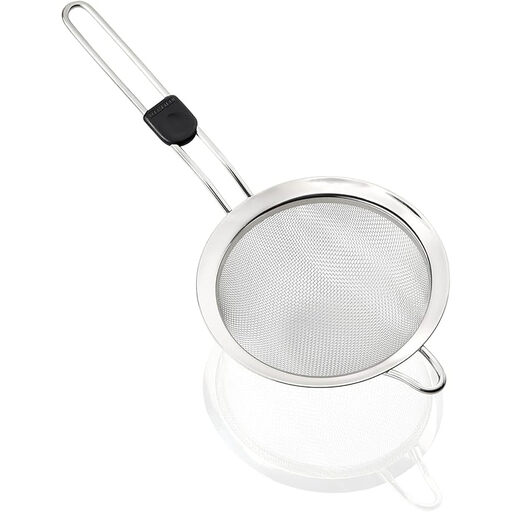
Why this product suits this profile: The specified 1.5 mm mesh opening is suitable for flour, icing sugar and other dry ingredients. The thumb rest and hanging loop are practical for repeated baking preparation.
Instead of simply describing the mesh as “fine”, the product specifies an exact mesh opening. This makes it easier to assess whether the sieve is suitable for your intended baking application.
16 cm diameter, 1.5 mm mesh opening, rust-resistant stainless steel and dishwasher-safe cleaning.
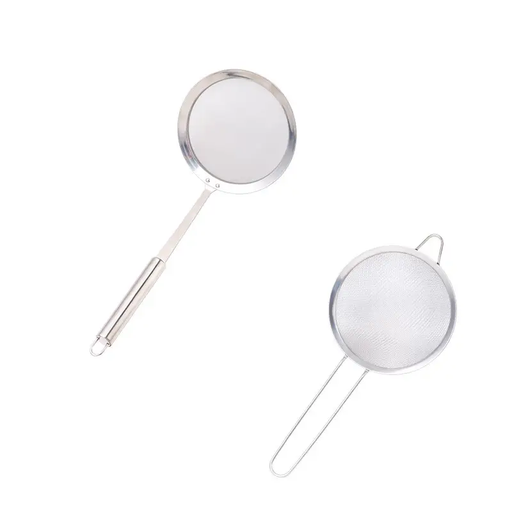
Why this product suits this profile: The two-piece set with fine 304 stainless steel mesh is designed for tasks such as straining soya milk, flour and other liquids. The additional skimming spoon broadens its intended range of uses.
The product name clearly states the material and intended use. With fine mesh, however, avoid pressing too hard to prevent the sieve from bending or becoming damaged.
304 stainless steel, fine mesh and a two-piece set for straining liquids and dry ingredients.
We have put together a complete, regularly updated list of products that fully meet these strict selection criteria and the safety regulations applicable in the EU.
For typical household portions, a diameter of around 22 to 24 cm is versatile. For small portions or limited storage space, a more compact model will be sufficient. For family-sized portions, you should also consider capacity, base area and handle shape.
This depends on the individual product. According to the product information, several models in this selection are dishwasher-safe. For plastic frames or special surfaces, hand washing may help extend the product’s lifespan. Before first use, every kitchen sieve should be cleaned with warm water and washing-up liquid.
There is no standard lifespan that applies to every product. It depends on the material, level of use and care. Avoid pressing hard foods forcefully, contact with knives and abrasive cleaning products. Check the mesh regularly for tears, deformation and sharp edges.