
Lieferung heute & morgen

Qualitätsgarantie

Willkommens-Angebote freischalten: KOSTENLOSE Lieferung | Bis zu 80 % RABATT | Kostenlose 30-Tage-JoyPlus-Testphase
App herunterladen
A kitchen sieve needs to do more in everyday use than simply let water drain away. It should drain pasta safely, rinse vegetables, hold back rice or sift flour finely. At the same time, it should not take up too much space and ought to be easy to clean. Anyone who focuses only on the price or a shiny finish may overlook important differences.
A compact sieve is useful in small kitchens, but it can quickly overflow when handling a large portion of pasta. Conversely, a large colander takes up a lot of storage space and is unnecessarily bulky for a handful of berries. The key factors are therefore diameter, height and capacity – not just the product name.
A fine-mesh sieve holds back flour, icing sugar, cocoa or small grains of rice. However, draining very large portions of pasta may take longer. A colander with large perforations, on the other hand, is well suited to potatoes, vegetables and pasta, but lets small ingredients pass through more easily. The right mesh size therefore depends on how you use it most often.
Not every stainless steel sieve is made in the same way. Details such as 304 stainless steel, 18/8 or 18/10 describe the alloy and provide better guidance than general claims such as “robust”. For products with plastic frames, you should also check whether they are dishwasher-safe and what temperatures they are designed for. A plastic frame may, for example, be more sensitive to very hot liquids.
Stainless steel has low odour retention, is corrosion-resistant and is suitable for many everyday kitchen tasks. With a stainless steel sieve featuring a plastic frame, the join between the two materials should be securely made. Clear information about suitability for food contact is useful when the product comes into direct contact with food.
Plastic or TPE models can be lighter and more flexible. An expandable sieve can be stored in a space-saving way, but should be allowed to dry completely after use. With coated or enamelled versions, make sure there are no damaged areas.
For individual portions or small amounts of vegetables, a small sieve measuring around 12 to 16 cm in diameter is often sufficient. A 22 to 24 cm model provides more volume for pasta and family-sized portions. A capacity of 2.2 litres is suitable for larger quantities, while a 0.5-litre sieve is more suited to berries, small portions or herbs.
An expandable sieve can be used across sinks of different widths. Before buying, however, compare the dimensions when retracted and fully extended with the width of your sink.
A sieve with a handle is useful when one hand is needed to hold the pan or operate the tap. Side handles distribute the weight more effectively when handling large quantities. A stand prevents the sieve from sitting directly in the draining water.
When it comes to cleaning, look for dishwasher-safe materials, easily accessible holes and a design with as few seams as possible. Very fine mesh should be rinsed immediately after sifting, so that flour, rice starch or fruit fibres do not become stuck. Metal brushes and abrasive cleaners can damage surfaces or mesh.
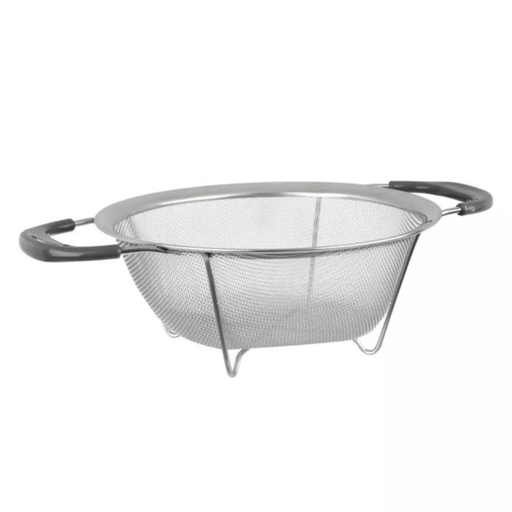
Why this product suits this profile: The 22 cm sieve handles several everyday tasks: sifting flour, draining pasta, and rinsing fruit and vegetables. The plastic frame keeps the weight down to 0.25 kg.
The diameter and material are clearly specified. The sieve is listed as dishwasher-safe; when handling hot liquids, observe the stated temperature limit for the plastic frame.
316 stainless steel mesh, 22 cm diameter and dishwasher-safe design.
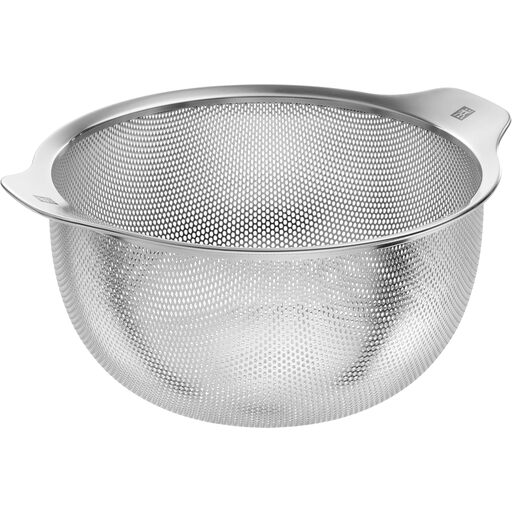
Why this product suits this profile: The 24 cm version, made from 18/10 stainless steel and featuring side handles and a raised stand, is designed for larger portions and regular use.
The size reduces the risk of family-sized portions spilling over the edge. The stand keeps the sieve away from the bottom of the sink; it is not designed for direct use on a hob, over an open flame or on hot surfaces.
18/10 stainless steel, 24 cm diameter, integrated handles and dishwasher-safe design.

Why this product suits this profile: The expandable sieve is designed for sinks of different widths and offers a capacity of 3.6 litres. It is suitable for pasta, vegetables and fried foods.
The expandable design can save storage space and prevents a large sieve from permanently taking up valuable worktop space. Before buying, compare the sink dimensions with the maximum extension length.
3.6-litre capacity, stainless steel construction and expandable support for the sink.
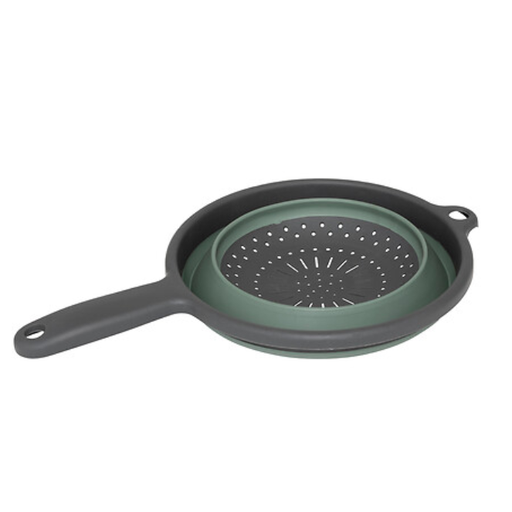
Why this product suits this profile: This foldable mini kitchen sieve, made from TPE, TPR and PP, weighs just 155 g and can be stored compactly for small quantities of fruit, vegetables or pasta.
The foldable design tackles the common lack-of-storage problem in small kitchens. Because of its compact size, it is better suited to smaller portions than large family quantities.
Lightweight, foldable design and a product length of 22.5 cm with a maximum depth of 36.5 cm.
We have put together a complete, regularly updated list of products that fully meet these strict selection criteria and the safety regulations applicable in the EU.
For small portions, a diameter of 12 to 16 cm is often sufficient. Families who regularly prepare pasta or larger quantities of vegetables will benefit from a 22 to 24 cm model. You should also take the height into account, so that the sieve does not overflow too quickly.
That depends on the specific product. Some stainless steel sieves are explicitly approved for use in the dishwasher, while others should be washed by hand. With combinations of stainless steel and plastic, frequent washing at high temperatures may put strain on the plastic parts over time.
Its service life depends on the material, construction and care. A stainless steel sieve should be dried thoroughly after cleaning and should not be scrubbed with steel wool. Plastic, TPE or TPR models should not be used beyond their stated temperature limit. Damaged mesh, sharp edges or loose handles are reasons to replace the sieve.