
Lieferung heute & morgen

Qualitätsgarantie

Willkommens-Angebote freischalten: KOSTENLOSE Lieferung | Bis zu 80 % RABATT | Kostenlose 30-Tage-JoyPlus-Testphase
App herunterladen
A kitchen slicer can make meal preparation easier. However, appliances vary considerably in slicing thickness, materials, operation and cleaning. If you focus only on a low price or a large number of functions, you may end up buying a product that gets little use in everyday life.
A multifunction slicer with several attachments sounds versatile. However, what matters is whether the included blades are actually suitable for the foods you want to prepare. A vegetable slicer for slices, julienne strips and grating is not automatically suitable for bread, cheese or meat. For regular sausage and bread slices, an electric food slicer is generally designed differently from a manual vegetable slicer.
With an electric food slicer, the adjustable slicing thickness should be clearly stated. A very thin setting is useful for cold meats, for example, while bread or firm vegetables often require a wider slice. If there is no clear measurement in millimetres, it is difficult to assess how practical the appliance will be for everyday use.
Blades, collection surfaces and sliding carriages come into direct contact with food. Non-removable components can make cleaning more difficult. For appliances with several attachments, it should also be clear how these are stored and cleaned. With manual slicers and kitchen mandolines, a sturdy finger guard is particularly important because the blades are often exposed.
Pay attention to the specific material stated. Stainless steel is commonly used for blades and, with proper care, is suitable for many slicing tasks. Plastic parts made from PP or ABS can reduce the weight; what matters is a shape-retaining construction and a version suitable for contact with food.
With a kitchen knife, you should also consider the blade length, handle material and intended use. A chopping knife is not automatically designed for fine slices. Conversely, a thin slicing knife should not be used on bones or frozen food.
For households that regularly prepare meals in advance, a sufficiently long carriage and a clearly adjustable slicing thickness are practical features. According to the product description, the Ritter Sono¹ has an 18 cm-long food carriage and a slicing thickness ranging from wafer-thin to approximately 20 mm. According to the supplier, the Ritter serano⁷ offers a 24 cm cutting path and slices of up to 23 mm.
Electric appliances should have easy-to-understand switches and a stable base. Safety momentary or continuous-operation switches can affect how the appliance is operated, but they do not replace careful handling of the blade. With a manual vegetable mandoline, non-slip elements, a stable base and an easily accessible finger guard are important criteria.
For private households, a compact appliance is often sufficient. Catering and hospitality businesses should also consider motor power, continuous operation, the working surface and the availability of replacement parts.
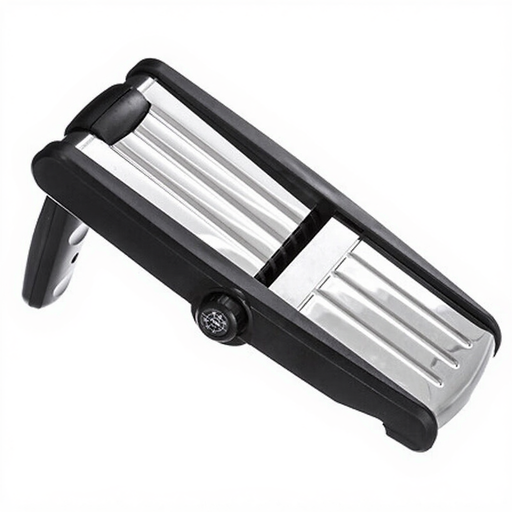
Why this product suits this profile: This compact vegetable slicer comes with three interchangeable stainless steel blades for slicing, grating and making julienne strips. It is a good fit for smaller kitchens and occasional vegetable preparation.
The three clearly defined blade functions make the intended uses easy to understand. Before buying, check that the slicing style you need is included.
Stainless steel blades, ABS plastic, compact dimensions of 24.5 × 13 × 12.7 cm and a weight of 0.365 kg.

Why this product suits this profile: Designed for bread, fruit and vegetables, this appliance features a removable food guide and a glass base plate. It is well suited to households where it will be used regularly.
The stated slice width of up to approximately 20 mm and the 18 cm cutting path provide specific points of comparison instead of a vague claim of versatility.
Removable food guide, safety and continuous-operation switches, ECO motor and manufacture in Germany according to the product details.

Why this product suits this profile: With its metal construction, inclined design and two blades, this model is aimed at frequent users and businesses carrying out recurring slicing tasks.
The electronic speed adjustment and documented slicing thickness of up to 23 mm make the appliance’s limits easier to assess.
24 cm cutting path, smooth and serrated blade, collection tray and electronic speed control according to the product description.
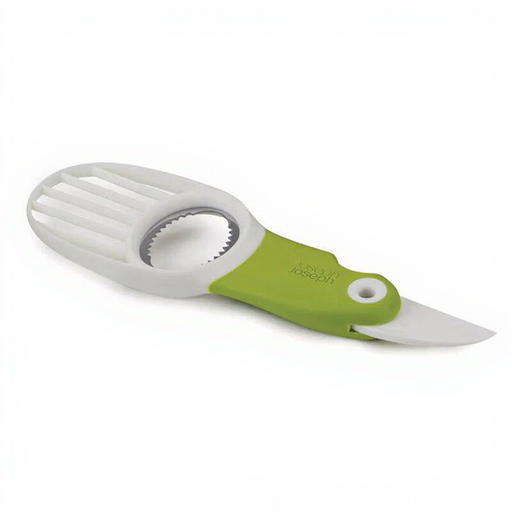
Why this product suits this profile: This 3-in-1 appliance opens, stones and slices avocados. It is designed for a specific purpose, making it suitable for small kitchens, salads and sandwiches.
The manufacturer’s information explicitly states that the product is intended for use with avocados. It is not designed for hard foods, bones or other fruit.
PP and ABS plastic, stainless steel stone remover, non-slip handle and top-rack dishwasher cleaning according to the product details.
We have put together a complete, regularly updated list of products that fully meet these strict selection criteria and the safety regulations applicable in the EU.
For regular meal prep, a vegetable slicer with several cutting attachments is useful if you often need different slicing styles. For large quantities of bread, cheese or cold meats, an electric food slicer may be more suitable. The key factors are adjustable slicing thickness, cutting path and easy cleaning.
Its lifespan depends on the materials, how it is used, cleaning and storage. Stainless steel blades should be kept dry and used only for the foods they are designed to process. With electric appliances, replaceable or repairable components can make long-term use easier. Damaged blades or broken plastic parts should not be used further.
Power consumption depends on the motor output, operating time and frequency of use. For short slicing tasks, running consumption is generally lower than during extended continuous operation. For slicing a few vegetables or chopping herbs, a manual slicer is usually the more obvious choice; for larger quantities, an electric appliance can reduce preparation time and manual effort.