
Lieferung heute & morgen

Qualitätsgarantie

Willkommens-Angebote freischalten: KOSTENLOSE Lieferung | Bis zu 80 % RABATT | Kostenlose 30-Tage-JoyPlus-Testphase
App herunterladen
A kitchen spatula needs to do more than just flip food in a frying pan. Depending on your cookware, temperature and application, the requirements vary significantly. A different material makes sense for non-stick pans compared to a wok or a cast-iron griddle. Terms like "heat-resistant", "dishwasher-safe" or "scratch-resistant" should also be examined more closely before you buy.
The label "heat-resistant spatula" alone tells you very little. What matters is a specific temperature rating in degrees Celsius. Furthermore, the maximum temperature may apply to the spatula head, while the handle can withstand less heat. A silicone spatula with a stated resistance of up to 230 °C is therefore easier to assess than a product with no technical specification.
Direct contact with a flame or leaving it resting on the hot edge of the pan for a long time can still damage the material. You should therefore follow the manufacturer's instructions.
A stainless steel spatula is sturdy and suitable for griddles or uncoated metal pans. However, on delicate coatings, a hard edge can cause scratches, especially with pressure or at the wrong angle. For non-stick pans, flexible models made from silicone or smooth wood or bamboo are generally the more practical choice.
Wooden and bamboo spatulas should not be left soaking in water for long periods. Moisture can cause the material to swell or the handle to crack. With a kitchen utensil set that has wooden handles, it is also important to check whether hand washing is recommended. "Dishwasher-safe" and "recommended for the dishwasher" are not necessarily the same thing.
A wide spatula makes it easier to flip pancakes, fish or larger pieces of vegetables. Narrower models are more manoeuvrable for stirring and for use with small pans. For a wok, a longer wok spatula is useful so that your hand stays a safe distance from the hot surface.
A dough scraper, on the other hand, is not automatically a suitable spatula for flipping. Its soft, flexible edge is good for scraping out bowls and spreading dough, but not necessarily for turning heavy foods.
Pay attention to a stable connection between the spatula head and the handle. With a one-piece silicone spatula, there are fewer gaps where food residue can collect. Wooden handles feel comfortable in the hand and conduct heat relatively slowly, but they should not be left permanently in hot pots or near open flames.
For daily use in British households, the following points are also relevant:
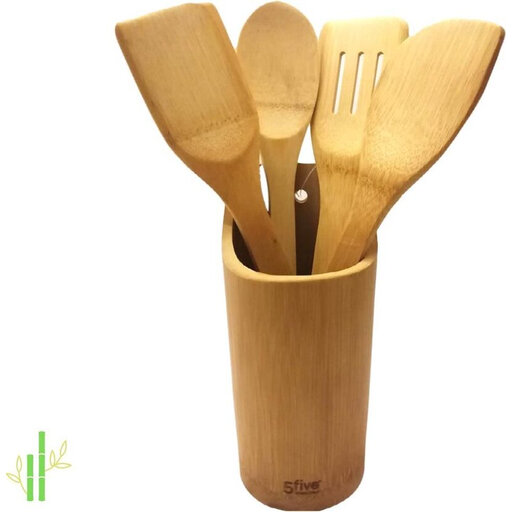
Why this product fits the profile: The set contains four pieces, including two spatulas, a spoon and a rice spoon. At approximately 30 cm in length, it is suitable for basic cooking and serving tasks.
The material specification of bamboo is clearer than a general term like "wood-effect". Because of the natural material, the set should be hand washed and thoroughly dried.
Four-piece set, lightweight and spatulas with slots for draining.
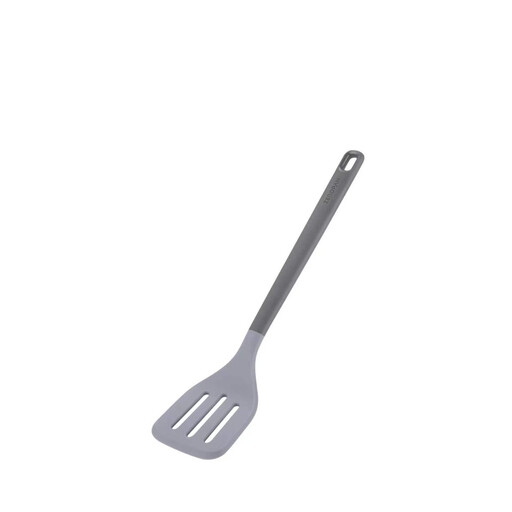
Why this product fits the profile: The flexible silicone head, seamless design and specific temperature rating suit households with non-stick cookware and regular baking use.
The heat resistance up to 230 °C is clearly stated. Open flames and prolonged contact with a hot pan should still be avoided.
Flexible edge, seamless design, suitable for non-stick cookware and dishwasher cleaning.
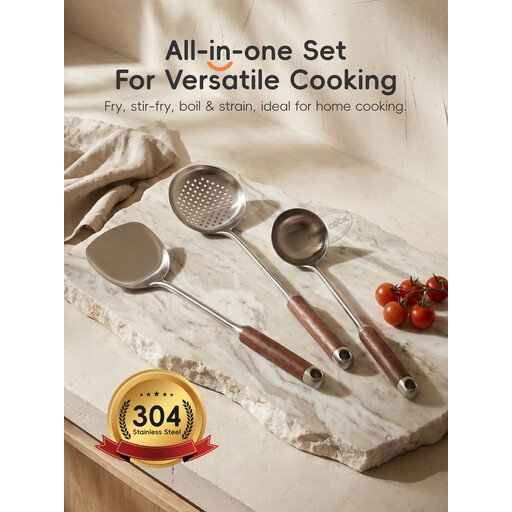
Why this product fits the profile: The three-piece set includes a slotted spatula, a ladle and a skimmer with lengths of approximately 34 to 38 cm for wok, pot and larger cooking vessels.
The 304 stainless steel used and the dimensions are explicitly stated. With non-stick pans, the metal edge should still be used without excessive pressure.
Three different tools, long handles and an integrated hanging loop. Hand washing and thorough drying are recommended for the wooden handle.
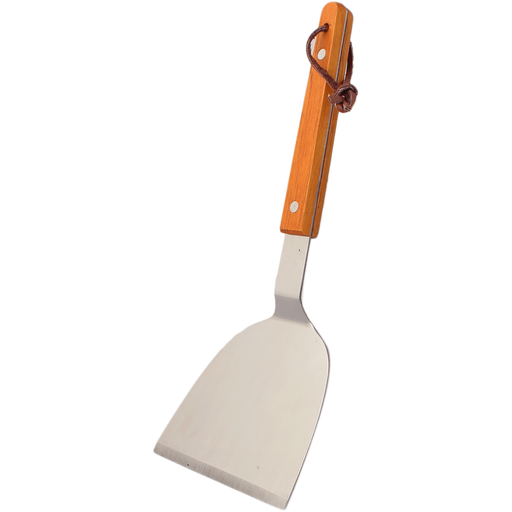
Why this product fits the profile: The rounded shape measuring 26.5 × 12 cm is designed for flat teppanyaki and griddle plates, and helps with flipping and moving food on a flat surface.
The special rounded design makes its intended use clear. For small non-stick pans or baking tasks, a flexible silicone spatula may be more suitable.
Compact dimensions, rounded shape and orientation towards flat grill and teppanyaki surfaces.
We have put together a complete, regularly updated list of products that fully meet these strict selection criteria and the safety regulations in force in the EU.
A flexible silicone spatula or a smooth spatula made from bamboo or wood is usually suitable. With metal models, there is a higher risk of scratching depending on the edge, pressure and coating. The specific suitability should always be stated in the product details.
The lifespan depends on the material, temperature, cleaning and usage. Silicone can become brittle or damaged if overheated. Wood can crack with improper care, while stainless steel retains its shape but can damage coatings. Replacement is advisable as soon as the spatula shows cracks, deformation or material separation.
A set can be economical if you regularly need several tools, such as a spatula, ladle and skimmer. If you only want to flip pancakes or vegetables, a single kitchen spatula is often more space-saving. What matters most are the kitchen tasks you actually need to do and the storage space you have available.