
Lieferung heute & morgen

Qualitätsgarantie

Willkommens-Angebote freischalten: KOSTENLOSE Lieferung | Bis zu 80 % RABATT | Kostenlose 30-Tage-JoyPlus-Testphase
App herunterladen
A kitchen strainer is a staple in many British kitchens, but not every model is suited to the same tasks. Sifting flour, draining pasta, lifting vegetables from hot water or draining oil when frying: the shape, mesh size and material determine whether a strainer is genuinely practical or quickly ends up unused in a drawer.
The term fine-mesh strainer sounds clear-cut, but on its own it tells you very little. A fine mesh is useful for flour or icing sugar. For pasta or larger pieces of vegetables, however, it can slow down drainage. If a specific opening size is provided, it is easier to assess whether the strainer is suitable. For example, the stated mesh opening of the Leifheit ProLine kitchen strainer is 1.5 mm.
A material may be suitable for contact with hot food without being designed for prolonged use on a hot pan rim or directly over a flame. Plastic and silicone parts should only be used within the stated temperature range. Even for a product described as a dishwasher-safe kitchen strainer, it is worth checking the care instructions, as harsh detergents or high temperatures can put strain on surfaces and handles.
A flat kitchen strainer is well suited to draining or sifting dry ingredients. A slotted spoon, draining spoon or frying spoon, on the other hand, is designed for lifting food out of liquids. A hotpot strainer also needs sufficient reach and a secure grip. If you focus only on appearance or a large opening, you can easily overlook how the utensil actually handles in use.
A stainless steel strainer retains its shape and is suitable for many kitchen tasks. The recommended products include stainless steel, 304 stainless steel and 18/10 stainless steel. These terms describe the material composition, but they are no substitute for proper cleaning and drying. Residue containing salt, acid or oil should be removed promptly.
Silicone is particularly useful for coated frying pans and saucepans, as a soft spoon head is less likely to scratch the surface. The stated temperature range for the silicone strainer is -40 °C to 230 °C. However, it is still not designed for direct contact with a flame or for being left on a hot pan for an extended period.
Plastic models can be lightweight and easy to care for. Before buying, however, you should check whether they are intended only for serving or also for use in boiling liquids.
The structure determines what is held back and how quickly liquid drains:
A rice strainer for specialist kitchen tasks can have a very different design from a classic kitchen colander. According to the product description, the Suncha Rice Husk Strainer is specifically intended for filtering rice bran and features a double-sided design. It is therefore not automatically the right choice for general draining.
A handle with a thumb rest can make repeated straining more comfortable. When working with hot liquids, sufficient length, a secure grip and distance from the liquid are important. A draining spoon with a pan-rim hook can be practical when cooking, while a small spoon for hotpot or fondue is more geared towards lifting individual items precisely.
For cleaning, smooth surfaces, easily accessible joins and clear care instructions all matter. Fine mesh should be rinsed immediately after use so that flour, starch or fruit fibres do not become stuck. With stainless steel, drying the strainer afterwards is recommended, particularly if it is going to be stored for a longer period.
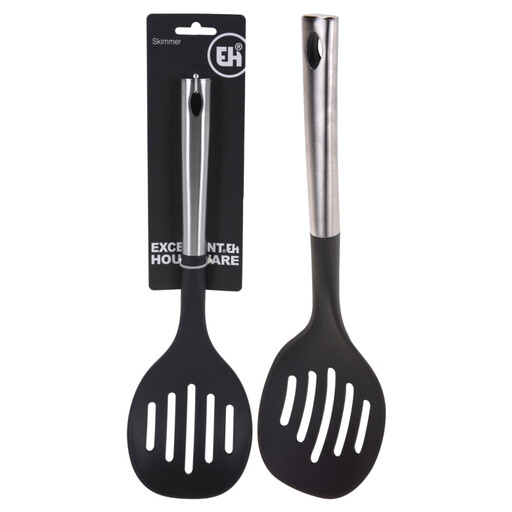
Why this product suits this profile: The 34 cm spoon is suitable for everyday draining, serving and lifting vegetables, pasta or dumplings.
The slotted design is clearly intended for draining and is not a substitute for a fine-mesh flour sieve. This makes its intended use clear.
Stated length of 34 cm, slotted head and, according to the product description, dishwasher-safe.
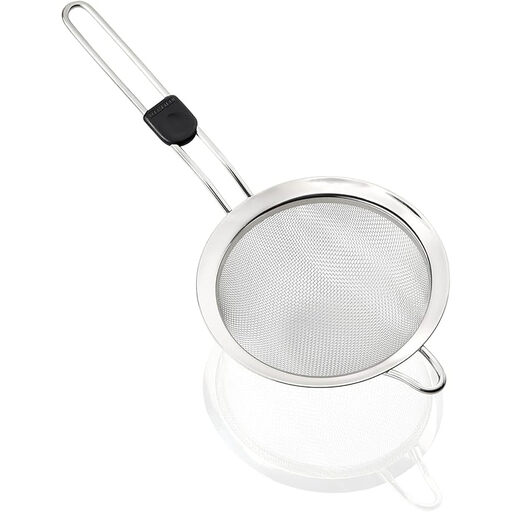
Why this product suits this profile: Keen bakers and households that regularly sift flour or dry ingredients get a compact stainless steel model with a defined mesh opening.
The stated 1.5 mm opening makes its filtering performance easier to assess than a purely promotional claim such as “extra fine”.
Stainless steel, 16 cm diameter, thumb rest, hanging loop and, according to the product information, dishwasher-safe.
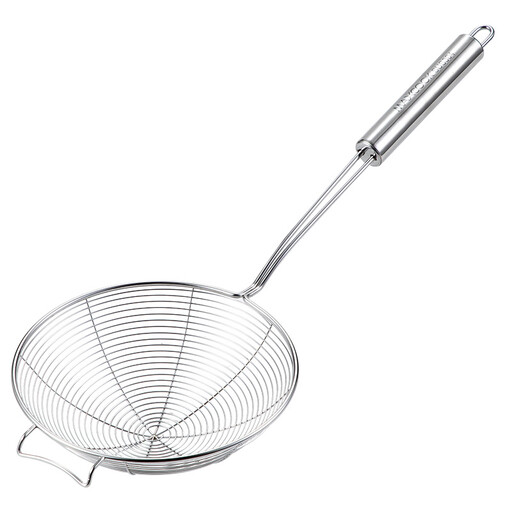
Why this product suits this profile: For fans of hotpot, Asian cuisine, pasta and fried dishes, this model combines a deep spoon shape with drainage holes.
The secure pan-rim hook and extended handle address common problems when lifting food out of deep pans.
304 stainless steel, 16 cm spoon head, hollow handle, pan-rim hook and hanging hole according to the product description.
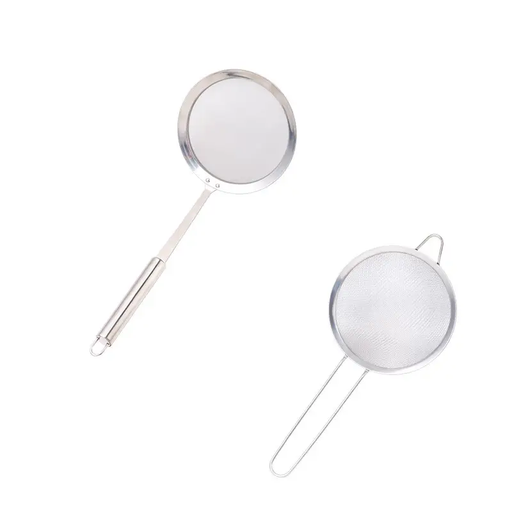
Why this product suits this profile: This two-piece set is aimed at households that want to filter soya milk, flour or other liquids and finely textured ingredients.
Its positioning as a fine-filtering set is clearer than that of a coarsely perforated pasta strainer, which may let fine particles through.
304 stainless steel and a two-piece set for fine filtering of soya milk or flour, according to the product name.
We have put together a complete, regularly updated list of products that fully meet these strict selection criteria and the safety regulations applicable in the EU.
For flour, icing sugar and fine dry ingredients, a fine-mesh strainer with a small mesh opening is a sensible choice. A specific measurement such as 1.5 mm makes it easier to assess suitability. A coarsely perforated draining spoon or a classic pasta strainer is less suitable for this task.
Stainless steel retains its shape and is easy to clean with normal kitchen care. After straining, residue should be removed and the strainer dried. 304 or 18/10 stainless steel are specific material descriptions, but they do not replace the instructions provided by the relevant manufacturer.
A kitchen strainer with a bowl or rim is often used for draining and filtering. A slotted spoon or frying spoon usually has a perforated or slotted surface and is designed for lifting solid food out of oil, stock or cooking water. For hotpot, dumplings and individual portions, a draining spoon is often easier to handle than a large pasta strainer.