
Lieferung heute & morgen

Qualitätsgarantie

Willkommens-Angebote freischalten: KOSTENLOSE Lieferung | Bis zu 80 % RABATT | Kostenlose 30-Tage-JoyPlus-Testphase
App herunterladen
A kitchen strainer needs to do more than simply drain water. It should hold pasta securely, wash vegetables thoroughly and be easy to clean after use. However, there are clear differences between a basic draining colander, a deep pasta colander and an adjustable sink colander.
Many disappointing purchases result from three common pitfalls:
A stainless steel kitchen strainer is shape-retaining, heat-resistant and does not normally absorb odours. When choosing stainless steel, buyers should check the exact material specification. The term 18/10 stainless steel, for example, refers to steel containing 18 per cent chromium and 10 per cent nickel. According to the product description, the Zwilling strainer uses this alloy.
Plastic, on the other hand, can be lighter and comfortable to handle. A model made from PP plastic with a TPR handle, for example, is suitable for users who prefer a low weight. It is important to check whether it is suitable for contact with food and how it should be cleaned.
Coated metal can be visually appealing, but requires careful attention to maintenance instructions. The black Premier Housewares draining colander, for example, is specified as suitable for hand-washing with warm soapy water and for use in the dishwasher. Information about use on the hob, in the oven or in the microwave should not be inferred automatically from the material alone.
For a pasta strainer, the diameter alone—whether 20 or 24 cm—is not the only important factor. A deep strainer bowl can hold more food, but also takes up more space in the sink and kitchen cupboard.
As a practical guide:
A draining colander with a wide base stays more stable while draining. With an adjustable sink colander, check both the minimum and maximum width. The description “extendable” alone is not enough if you do not know the dimensions of your sink.
The size of the holes determines which foods remain safely in the strainer. Larger holes are often sufficient for spaghetti. If you also want to rinse rice, small pasta or chopped fruit, choose smaller, evenly distributed openings.
A kitchen strainer with a handle gives you a controlled grip when pouring. Side handles are practical when placing the strainer on a saucepan or bowl. A long handle with a hook, on the other hand, can be useful when blanching or draining directly over the edge of a saucepan.
For easy cleaning, smooth surfaces with as few seams as possible are preferable. Food scraps or pieces of dough can become lodged in fine perforations. Before buying, check whether the product information states that the strainer is dishwasher-safe or should be cleaned by hand.
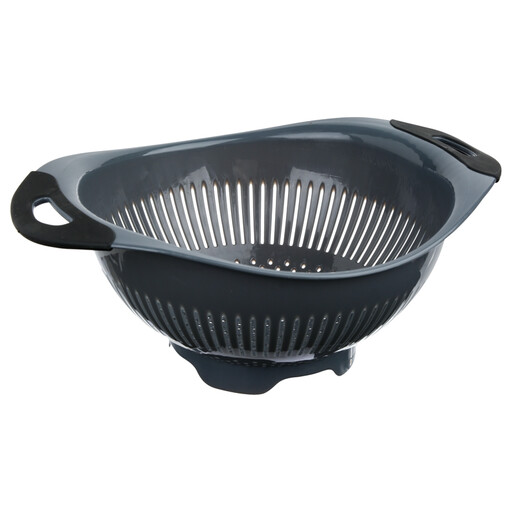
Why this product suits this profile: This lightweight PP model has a 2.5-litre capacity and handles everyday tasks such as draining pasta, rinsing fruit and washing vegetables.
The stated dimensions and capacity make the actual size easier to understand than a diameter measurement alone. The TPR handle is designed for wet hands.
2.5-litre capacity, low product weight of 0.162 kg and a non-slip TPR handle.
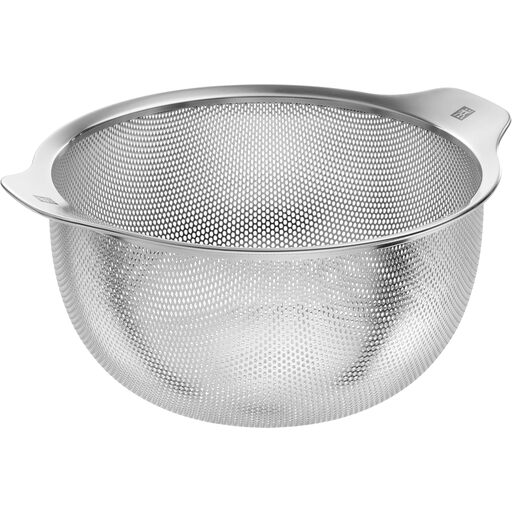
Why this product suits this profile: This 24 cm stainless steel model is ideal for households looking for a shape-retaining strainer for pasta, vegetables and fruit.
The product details specify the material, diameter, integrated side handles and raised base. This makes it easier to assess stability and ease of use before buying.
18/10 stainless steel, 24 cm diameter, side handles, raised base and dishwasher-safe according to the product description.
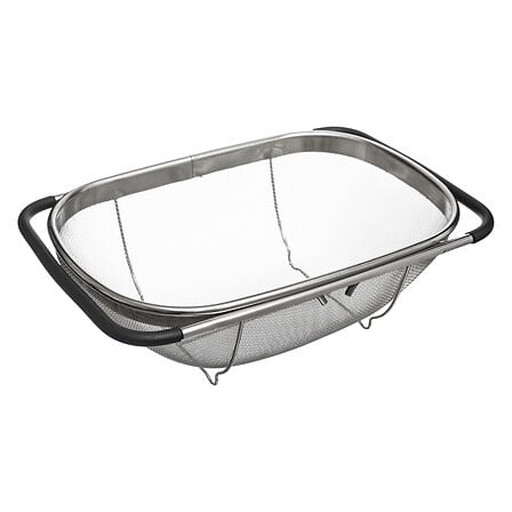
Why this product suits this profile: This extendable draining colander is designed for users who work with sinks of different sizes or frequently prepare larger quantities.
The product details specify an adjustable length of 53.5 cm and a capacity of 3.6 litres. Check the width of your sink before buying.
3.6-litre capacity, extendable design, stainless steel construction and ergonomic handle.
We have put together a complete, regularly updated list of products that fully meet these strict selection criteria and the safety regulations applicable in the EU.
Before ordering a pasta strainer or colander, check the following points:
A small spaghetti strainer with a long handle is a different solution from a deep family-sized colander. A finer perforation can be useful for rice and small ingredients. If you regularly wash vegetables and drain pasta, a medium-sized model with a stable base will usually be the most practical choice.
For pasta, a sufficiently large strainer bowl, heat-resistant material and secure handles are essential. A 24 cm model may be suitable for several portions, although the actual capacity depends on its height and shape. For individual portions or cooking in a saucepan, small strainers with long handles may be worth considering.
Its lifespan depends on the material thickness, construction, frequency of use and care. Stainless steel withstands many everyday kitchen demands, but should be dried thoroughly after cleaning. Abrasive brushes can damage the surface. If the rim becomes bent, sharp edges develop or the handles become loose, stop using the strainer.
A standard strainer can be used flexibly on bowls and saucepans and is usually easy to store. An adjustable sink colander provides more support and can be practical when handling large quantities. However, it must fit the width of the sink and often requires more storage space.