
Lieferung heute & morgen

Qualitätsgarantie

Willkommens-Angebote freischalten: KOSTENLOSE Lieferung | Bis zu 80 % RABATT | Kostenlose 30-Tage-JoyPlus-Testphase
App herunterladen
A kitchen tap needs to suit your water supply, sink and everyday habits. Even so, people often choose one based on looks or price alone. This can lead to leaks, restricted movement or an unsuitable hot water supply. Bathrooms, caravans and outdoor kitchens also have different requirements from a standard kitchen sink tap.
So the key decisions when buying aren’t just about appearance. Fitting type, connection type, spout reach, material and maintenance requirements all matter.
A low-pressure kitchen tap is designed for open-vented water heaters or unpressurised boilers. It usually has three connections. A standard tap for a pressurised hot water cylinder, on the other hand, has two connections.
Fitting the wrong type of tap can cause faults or damage. Low-pressure taps may continue to drip slightly after being turned off; this is part of how they work. Before you buy, check:
A kitchen tap with a swivel spout makes it easier to fill large pans and use a double-bowl sink. However, a 360° swivel spout is only practical if there’s enough space behind or beside the tap. For a wall-mounted tap, you’ll also need to check that the fixing holes are the right distance apart.
A spout that’s too short won’t reach every part of the sink. A very high spout, on the other hand, can cause more splashing in a small bowl. So check the spout height, reach and actual swivel range.
An aerator can mix air into the water stream, helping to reduce the flow rate. Claims such as ‘up to 30 per cent’ depend on the conditions and won’t necessarily reflect everyday water use. If you’re considering a product with a water-saving feature, check its stated flow rate too.
A removable aerator is easier to clean. Limescale and dirt can affect the water flow, particularly in hard water areas.
Most sink taps are deck-mounted, fitted through a single hole in the worktop or directly through the edge of the sink. Check the diameter of the existing tap hole. For the products featured here, the compatible ranges include 32–40 mm and 33–42 mm.
A wall-mounted kitchen tap needs compatible wall connections. A model with an adjustable fixing distance of 130–170 mm can be fitted to suit different existing distances. Before buying, measure from the centre of one connection to the centre of the other.
Brass, stainless steel and chrome finishes are commonly used for kitchen and bathroom taps. However, the material alone doesn’t guarantee a particular lifespan. The quality of the finish, cartridge and seals also matters, as does the availability of replacement parts.
Clean chrome finishes with a soft cloth. Abrasive cleaners and harsh chemicals can scratch or damage the surface. For stainless steel models, follow the manufacturer’s care instructions too.
A ceramic cartridge lets you control the water flow and temperature using a kitchen mixer tap’s single lever. Any stated test figure for the number of operating cycles is manufacturer information and doesn’t replace regular checks of the connections.
Supplied hoses, seals and fixing parts make installation easier. Even so, check the threads before fitting and check all connections for leaks after turning the water on for the first time. If you’re unsure or the connections are difficult to reach, it’s best to call a plumber.
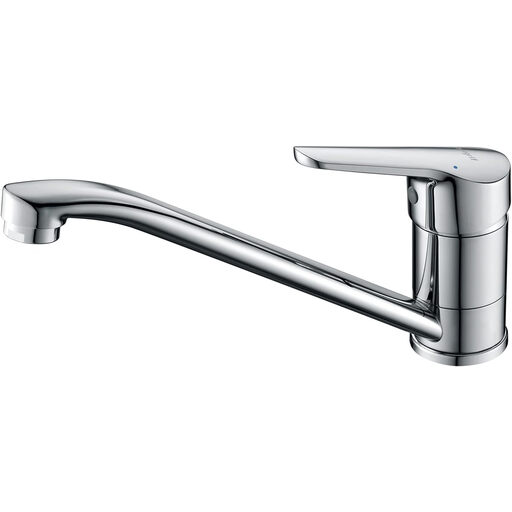
Why it suits this type of user: This single-hole tap has a single-lever handle, a 360° swivel spout and pre-fitted connection hoses. It’s suitable for straightforward replacements on compatible sinks, as well as use as a caravan tap.
The stated tap-hole range of 32–40 mm and the supplied fitting hoses make it easier to check compatibility. Assess the water-saving feature against the actual stated flow rate.
Brass body with a chrome finish, single-lever operation and a 360° swivel range; according to the product details, it’s designed to be fitted with two 40 cm hoses.
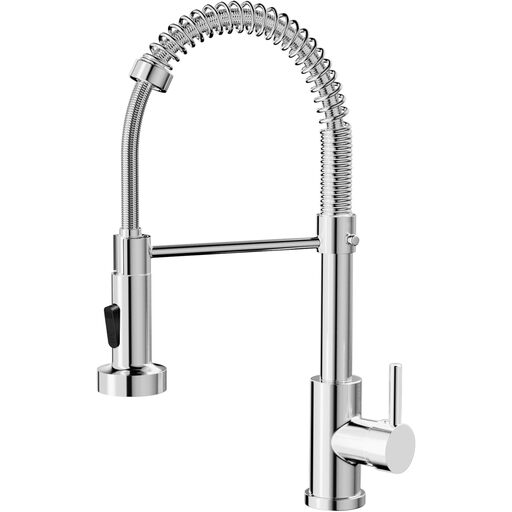
Why it suits this type of user: This tall tap has a pull-out spray head and is designed for frequent washing up, large pans, and both single- and double-bowl sinks.
Before buying, check that the tap hole is 33–42 mm in diameter and that there’s enough room beneath the sink unit. The two spray modes are only useful if the pull-out hose can move freely.
360° rotation, a pull-down spray with stream and spray modes, and a stainless steel construction with PVD coating, according to the product description.
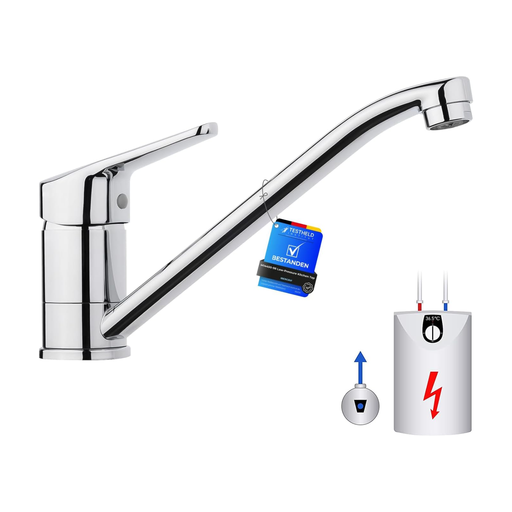
Why it suits this type of user: This low-pressure tap is designed for open-vented water heaters and has a 360° swivel spout. It may suit certain kitchens, smaller households and compatible caravan installations.
The product description specifically states that it’s for use with open-vented systems and has three connection hoses. According to the manufacturer, this model isn’t designed for pressurised high-pressure systems.
Three DVGW-certified connection hoses, according to the product details, a ceramic cartridge and a removable spout for cleaning.
We’ve put together a complete, regularly updated list of products that meet these strict selection criteria and the safety regulations in force in the EU.
You’ll usually need a low-pressure tap with three connections. Check the details for both the boiler and the tap. A model designed for a pressurised high-pressure system won’t necessarily be compatible.
There’s no reliable one-size-fits-all answer. It depends on water quality, how often you use it, the cartridge and seals, and how well it’s maintained. Regularly cleaning the aerator and checking the connections can help keep it working well. If it drips or becomes stiff to operate, check the parts for wear.
Water use depends mainly on the flow rate, how long the tap is used and how the water is heated. A water-saving tap can reduce water flow, provided the feature suits the way you use it. According to the product details, a cold-start cartridge can prevent the tap from calling for hot water unnecessarily when the lever is in the middle position. The actual savings depend on how you use it.