
Lieferung heute & morgen

Qualitätsgarantie

Willkommens-Angebote freischalten: KOSTENLOSE Lieferung | Bis zu 80 % RABATT | Kostenlose 30-Tage-JoyPlus-Testphase
App herunterladen
A reliable digital kitchen timer is an unsung hero that can mean the difference between a perfectly cooked steak and a culinary disappointment. However, the market is flooded with models whose weaknesses often only become apparent during daily kitchen use. A hard-to-read display, an alarm that's too quiet, or a weak magnet can quickly render a simple device useless.
This guide will show you which pitfalls to avoid when buying and which technical features truly matter. This way, you'll find a short-interval timer that will assist you with precision and reliability, whether for cooking, baking, or other household tasks.
Before you decide on a model, you should be aware of the three most common flaws that lead to frustration with cheap or poorly designed devices:
To avoid a bad purchase, focus on the following three core functions. These will determine how useful your cooking timer will truly be in everyday life.
The display is the timer's most important interface. Look for sufficiently large digits and high contrast. Models with backlit LCD or bright LED displays offer clear advantages here, as they are easy to read even from a distance or in poor lighting conditions. A good countdown timer clearly and unambiguously shows the remaining minutes and seconds.
In the heat of the moment while cooking, setting the time must be quick and easy. Look for devices with clearly labelled, sufficiently large buttons. Some modern timers offer alternative control concepts like rotary dials, which allow for particularly fast time setting. The basic functions—start, stop, and reset—should be accessible without navigating through complicated menus. An additional stopwatch for cooking (count-up function) is also a useful feature.
The alarm volume should be suitable for the noise level of a typical kitchen. Some models even offer adjustable volume, which is a significant advantage. For mounting options, a strong magnet on the back has become the standard. Check if the magnet is large and powerful enough. Alternatively, or in addition, a sturdy, fold-out stand is useful for flexibly positioning the digital egg timer on the countertop.
Here are some recommendations tailored to different requirements and usage scenarios.
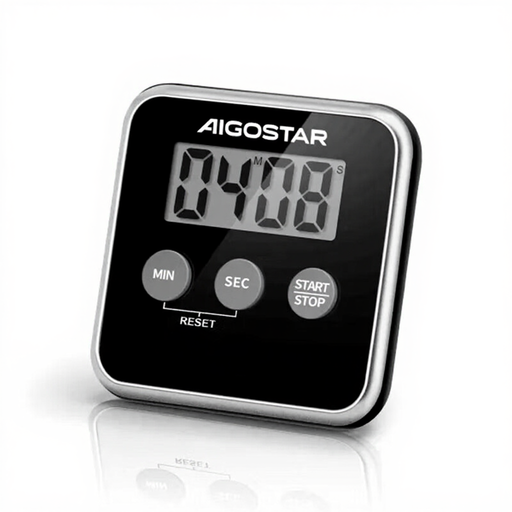
Why This Fits Their Persona: This model focuses on the essentials: precise timing without unnecessary bells and whistles. It's ideal for anyone seeking a straightforward, reliable timer for everyday cooking and baking tasks.
The large, clear LCD display avoids the problem of poor readability. The alarm is loud enough to be heard even over running kitchen appliances.
Operation via separate minute and second buttons is very intuitive and fast. The compact design fits into any kitchen.
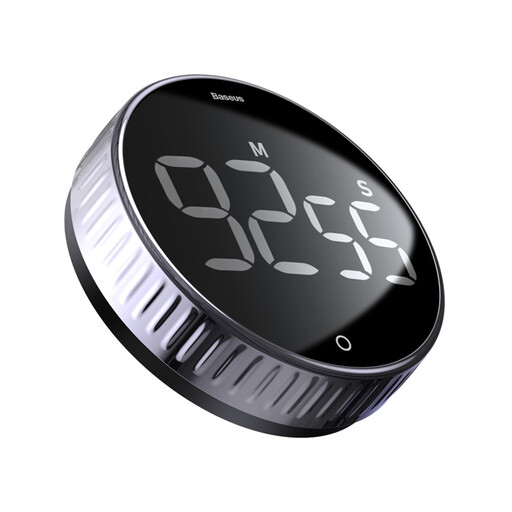
Why This Fits Their Persona: For users who value aesthetics and modern controls. Its minimalist design and innovative rotary mechanism make this timer a stylish accessory for any countertop.
The large, bright LED display is perfectly readable from any angle. The strong magnet ensures a secure hold on metallic surfaces, preventing it from sliding down.
Setting the time by rotating the outer ring is exceptionally fast and intuitive. The loud 80 dB alarm is easily audible even in noisy environments.
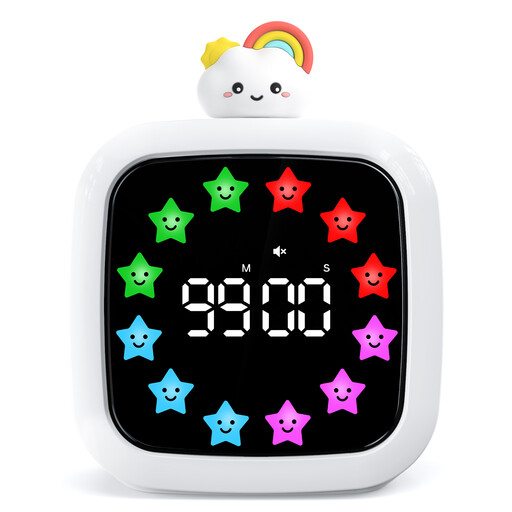
Why This Fits Their Persona: Ideal for families with children, students, or for applying time management techniques like the Pomodoro method. The visual representation of the remaining time helps make the concept of time more tangible.
Instead of small digits, a shrinking colored block indicates the time. This is more intuitive and more visible than a purely digital display, bypassing the issue of poor readability.
The combination of a visual and digital display is unique. The rechargeable battery and optional alarm tones make it versatile and user-friendly.
We've compiled a complete, up-to-date list of products that fully meet these strict selection criteria and German safety regulations.
Most digital timers are set using buttons labelled "M" (minutes) and "S" (seconds). Press these buttons to enter the desired time, then press the "Start/Stop" button to begin the countdown. To reset, you often press and hold the "M" and "S" buttons simultaneously.
Battery life depends heavily on the model and frequency of use. Simple LCD timers with standard button cells or AAA batteries can last from several months to over a year with normal use. Models with bright LED displays or rechargeable batteries have a shorter runtime per charge but offer the convenience of not needing to replace batteries.
Yes, absolutely. A kitchen timer is a versatile tool. It's excellent for timing homework, study sessions (e.g., the Pomodoro Technique), fitness exercises, meditation, or even limiting screen time for children. Its simple operation makes it a universal time management assistant.