For regular sauce checks
If you want to set the same interval repeatedly while a sauce simmers, a timer that lets you recall a saved time can be useful. TFA Dostmann lists a memory function for the Timer 38.2021.01.


For regular checks on a single sauce, one countdown is enough; a memory function can make it easier to set the same time again. If your sauce and side dish have different cooking times, a timer with two explicitly parallel countdowns is a better fit. Also check that you can hear or see its signal from where you plan to use it. A timer reminds you to check, but it doesn’t replace supervision at the hob.
If you want to set the same interval repeatedly while a sauce simmers, a timer that lets you recall a saved time can be useful. TFA Dostmann lists a memory function for the Timer 38.2021.01.
If a side dish has its own schedule while your sauce is cooking, look for two countdowns that are genuinely displayed at the same time. TFA Dostmann and ADE list this feature on selected models in their timer ranges.
In a busy cookery-class kitchen, you need to be able to notice the signal from your workstation. Depending on the model, this could be an audible alarm or a visual light signal; TFA Dostmann and ADE describe these options on selected models.
First decide whether you need to time just one sauce or several dishes with different cooking times. Then consider the signal and where you’ll place the timer.
| What you need | What to check before buying | Who it matters most to |
|---|---|---|
| Regular sauce checks | Check whether you can recall a countdown and whether its maximum duration covers your longest interval. TFA Dostmann lists a memory function and a maximum of 99 min. 59 sec. for the 38.2021.01. | If I check the same sauce at set intervals, I want to set the interval again without entering the full time from scratch. Around 33% of consumers put repeatable check intervals first. |
| Parallel cooking times | Look for confirmation that two countdowns can run and be displayed at the same time. TFA Dostmann lists a maximum of 99 hr. 59 min. 59 sec. for the 38.2025; ADE lists a maximum of 23 hr. 59 min. 59 sec. for the KT102. | If my sauce and side dish have different finish times, I want to track both separately. Around 25% of consumers prioritise parallel cooking times. |
| Noticing the alarm | Check whether the timer has adjustable volume levels, a silent mode or a visual signal. A light is only useful if you can see it from your workstation. TFA Dostmann and ADE describe these options on selected models. | If the cookery-class kitchen is noisy or I don’t want to disturb others, I need an alarm I can notice from where I’m working. Around 25% of consumers put being able to notice the signal first. |
| Placement and power | Check that the magnet, stand or hanging loop suits where you plan to put the timer, and find out which batteries are included. Technoline lists magnetic and tabletop placement for the KT 200; TFA Dostmann says the 38.2025 requires two AAA batteries, which are not included. | If I want to position or attach the timer somewhere visible during a class and use it straight away, I’ll check the location and batteries beforehand. Around 17% of consumers put placement and readiness to use first. |
A stopwatch function doesn’t mean that two countdowns can run at the same time. For a sauce and a side dish, you specifically need two parallel countdown displays.
Check the product description for wording such as “two countdowns at the same time”, rather than judging by the number of functions alone.
According to the manufacturer, Silent Mode on the TFA Dostmann 38.2056.04 replaces the audible alarm with an LED warning light.
Decide where you’ll place the timer and which alarm mode you need. Choose an audible alarm if you won’t be able to see the display or light signal from there.
What’s included and the available time range vary by model. Some timers don’t come with batteries, and the maximum time you can set may also be limited.
Compare the longest time you need with the manufacturer’s specifications, and check before the class whether the required batteries are included.
A timer doesn’t monitor the sauce or switch off the hob. The German Fire Service Association lists food left unattended or forgotten on the hob as a common cause of fires.
Use the alarm as a reminder to check, and keep an eye on the hob.
The models listed cover different needs: repeatable single intervals, adjustable signals or two parallel times.
The KT 200 is designed for a single countdown and a stopwatch.
The KT102 is designed for two cooking times running at the same time.
The digital CONTARE 12330 combines a single countdown with a stopwatch.
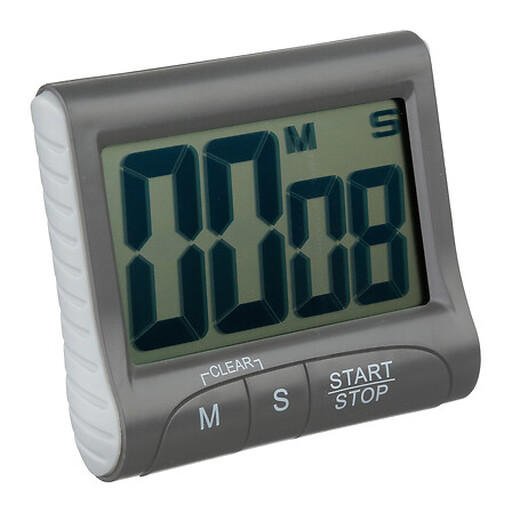
The 00002949 digital kitchen timer combines a large display with a choice of alarm and placement options.
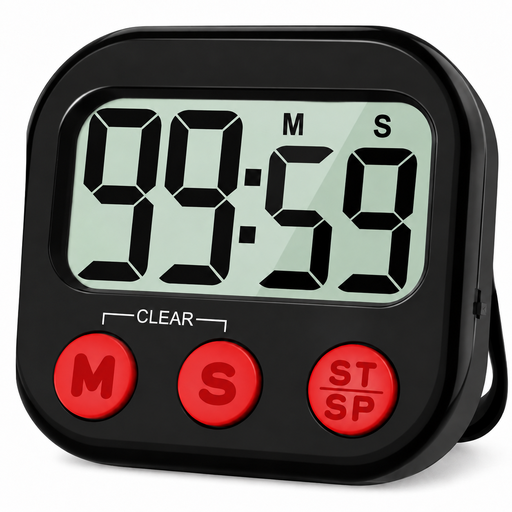
This selection includes digital timers for single sauce countdowns.
 No image available
Could suit individual sauce intervals that fall within the stated time range.
The product name specifies a maximum of 99 min. 59 sec. and adjustable volume.
 No image available
An option for a single countdown if you want to check a sauce at set intervals while it simmers.
One countdown is enough for a single check interval. If your sauce and side dish have different cooking times, check whether the model explicitly offers two parallel countdown displays. TFA Dostmann lists this feature for the 38.2025, and ADE for the KT102.
Choose a spot where you can see the display or a light signal, or hear the alarm. Depending on the model, you may be able to attach it with a magnet or use its stand. A timer reminds you to check, but it doesn’t replace supervision at the hob; the German Fire Service Association warns of the dangers of food left unattended or forgotten on the hob.
Check what’s included with the specific model. According to the manufacturer, the TFA Dostmann 38.2021.01 comes with one AAA battery; the 38.2025 requires two AAA batteries, which are not included. GEFU says the CONTARE is not dishwasher-safe. Your statutory rights against the seller and a voluntary guarantee are separate entitlements.
According to guidance from Germany’s Federal Ministry for the Environment, waste electrical equipment must not go in household rubbish; it should be taken to an authorised collection point. Used batteries must be returned separately to a collection point, free of charge.
The German Federal Network Agency lists checks in its market surveillance, including correct CE marking, identifiable manufacturer details and German-language instructions with the required warnings. Meeting these criteria does not automatically confirm that an individual timer is compliant.